// book · by Iris Athens (pen name)
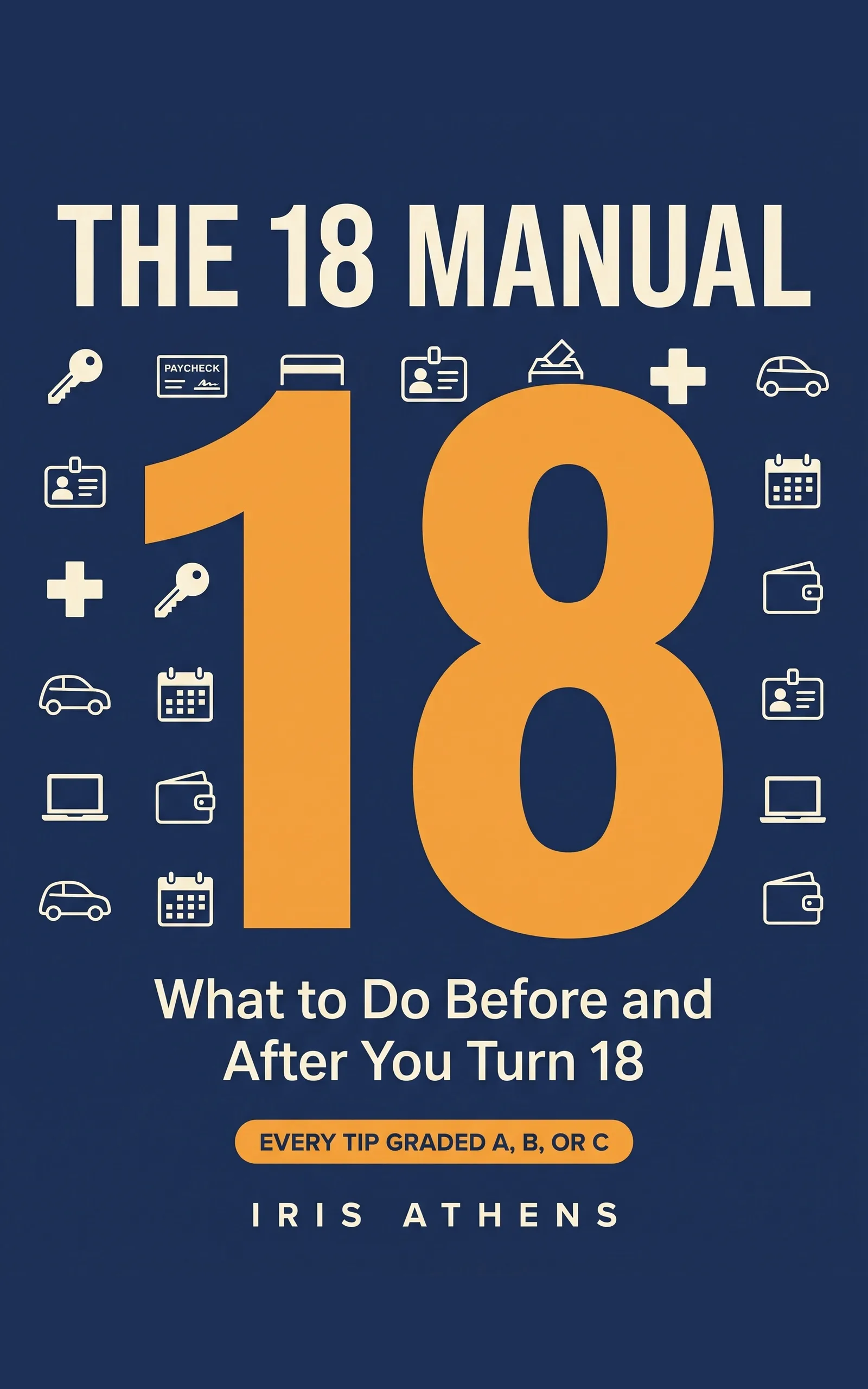
The 18 Manual
What to Do Before and After You Turn 18: Money, Work, Rent, Health, and Your Legal Rights, Graded by What It Costs and How Well It Works
Nobody sends a letter when you turn 18. This book is that letter: about 130 moves, each with its cost, its payoff and a grade for how sure the proof is.
Links go to Amazon. ToolGenX publishes this book under a pen name and earns from every sale. Amazon sets the price and handles delivery and returns.
This book explains published US rules and where to check them. It is not legal, tax, medical or financial advice.
- author
- Iris Athens
- length
- 142 pages (paperback)
- formats
- Kindle, paperback
- sold by
- Amazon
This book is for you if
- You are 16 to 19 and nobody told you what changes on your 18th birthday
- You are about to sign your first lease, job offer or phone contract
- You want to build credit without falling into card debt
- You are looking for a useful 18th birthday or graduation gift
Skip it if
- You live outside the United States (the rules and agencies are American)
- You need advice on your own legal, tax or medical case
// problems this book helps with
Start from your problem
Each page below answers one real question in plain words, then shows where The 18 Manual goes further.
- First apartment at 18: what to know before you sign the lease
About to rent your first apartment at 18? What to check in the lease, how to get your deposit back, renters insurance and the signs of a fake listing.
- Why is my first paycheck so much smaller than I expected?
Your first paycheck is smaller because of FICA, income tax and your W-4. See what each line takes in 2026 and how to get back tax you did not owe.
- Turned 18 and forgot to register for Selective Service? What to do now
Missed the 30-day Selective Service window after turning 18? You can still register online until 26. What it costs you to wait and what it does not mean.
- How to build credit at 18 without falling into a credit card trap
Secured card, credit-builder loan or authorized user? Compare the ways to build credit at 18, the under-21 rule, and the moves that do not count.
- Sent money to a scammer? What to do right now, step by step
Just sent money to a scammer? Call the payment company today, then report it. The steps for gift cards, fake checks, stolen IDs and photo threats.
- Can I stay on my parents' health insurance until 26? The rule and the end date
You can stay on a parent's health plan until 26, even if you marry or move out. See when coverage ends, the 60-day window and your options after.
- A useful 18th birthday or graduation gift that won't end up in a drawer
Looking for a useful 18th birthday or graduation gift? Here is one that teaches the money, rent and health rules, plus an hour of your time to go with it.
- What changes legally when you turn 18, and what to do in that first week
At 18 your contracts count, your medical records become yours and men must register with Selective Service. See each rule with its proof grade.
// Also on this topic
- guideIs a family code word enough to keep your child safe from a stranger pickup?
Many families pick a secret code word for pickups. Why it is a useful extra but not a free pass, and the rule that does more of the work.
- guideHome alone rules for kids the first time: what to say at the door, the phone and the smoke alarm
First time leaving your child home alone? The house rules and the exact words for the door, the phone, a burn and the smoke alarm.
- guideWhat to teach kids about strangers, now that "stranger danger" is out
Stranger danger is out. What to teach kids 8 to 12 instead: watch what people do, check first, and know who to ask for help.
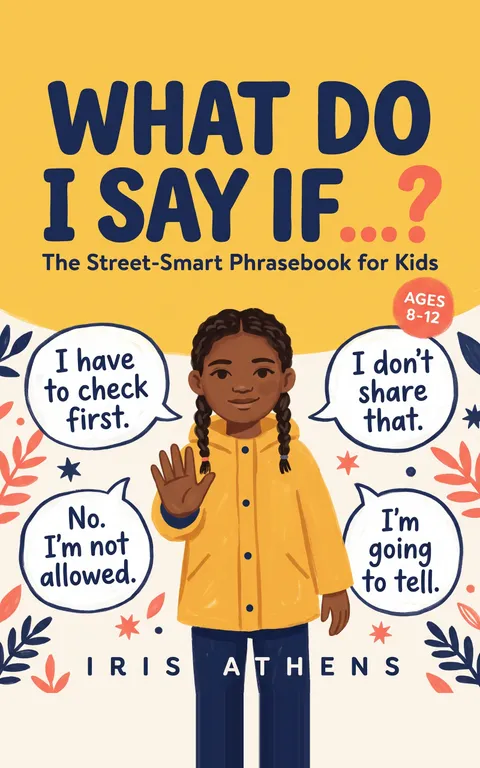
- bookWhat Do I Say If...?
The Street-Smart Phrasebook for Kids 8-12: The Exact Words to Say No, Get Help, and Stay Safe With Strangers, Friends, Bullies, and People Online
About 130 moves, each with a price tag and a grade
Most books for new adults are a long list of things you should do. The list is fine. The trouble is that it never says which items matter and which are just nice ideas.
Iris Athens built this book a different way. Every move has four short parts. Do this is the move in one sentence. Costs is what it takes in money, time and hassle. Pays back is what you get or what it saves you from. Proof is a grade from A to C.
An A is a law or an official rule. Saying no to overdraft coverage on a debit card is an A, because a federal rule says the bank can't charge that fee unless you opted in. Keeping your card balance under 30 percent of your limit is a C, because there is no official cutoff. Both are in the book. Only one of them is a rule.
Start with the Cheap A's
Right after the opening, one page lists the moves that cost close to nothing and have the strongest proof. There are 17 of them. Register to vote. Pull your free credit reports. Freeze your credit at all three bureaus. Put your 26th birthday in your calendar, because that is when a parent's health plan can stop covering you.
The book says it plainly: nobody does all of it. Do a few of the Cheap A's this month and you are already ahead.
Where the rules come from
Every item points to a public source in the back of the book: the IRS, the CFPB, the FTC, HealthCare.gov, the Department of Labor, Selective Service, HUD and others. The sources were checked in October 2026. The groups listed did not write or review the book.
Numbers carry their year. For 2026, Social Security and Medicare take 7.65 percent of your wages. The federal minimum wage has been $7.25 since July 24, 2009. Where a rule depends on the state, the book says so and names where to look, and it often gives one state as an example instead of pretending one rule fits all fifty.
What the book will not do
It won't tell you what to study, who to date or how to get rich. It won't give you personal legal, tax or medical advice. For those, it names a real place to ask, often for free.
It also won't try to scare you. A lot of what goes wrong at 18 can be fixed, and some of it can be avoided once you know the rule.
If you want to try the book's approach first, our free pages on what changes legally when you turn 18 and building credit at 18 use the same grades and sources. Buying it for someone? Start with our gift page.
What is inside
- The Cheap A's: one page of free or nearly free moves backed by a law, an official rule or strong research
- The week you turn 18: age of majority, voting, Selective Service, jury duty, REAL ID and the health care proxy most families forget
- Money and credit: overdraft opt-out, a $500 starter emergency fund, free credit reports, credit freezes and why cosigning is a trap
- Paychecks and taxes: the W-4, every line on a pay stub, when to file, filing for free and the 2026 numbers
- Work, school and rent: minimum wage and overtime, the 2027-28 FAFSA, student loans, leases, deposits and renters insurance
- Health: staying on a parent's plan until 26, five insurance words, surprise bill rights, and when to use 911, the ER or urgent care
- Scams, cars and legal red lines: the payment methods only scammers demand, used car checks, and the photo and threat laws that apply at 18
- A Check Yourself page at the end of every chapter, and a source list in the back with the item number for each rule
Chapters
- 01How to Use This Book
- 02For the Grown-Up Who Gave You This
- 03The Cheap A's
- 04The Week You Turn 18
- 05Your Money Setup
- 06Credit Without the Trap
- 07Your Paycheck and Taxes
- 08Work and Your Rights
- 09School After School
- 10Renting Your First Place
- 11Health Insurance and Doctors
- 12Body and Mind Basics
- 13Scams and Your Identity
- 14Getting Around
- 15Legal Red Lines at 18
- 16When Things Go Wrong
The paperback, up close









Questions about The 18 Manual
- What age is The 18 Manual written for?
- Readers 16 to 19. It works before the birthday, when a teen can pre-register to vote in many states and plan ahead, and in the year or two after, when the first paycheck, the first lease and the first insurance card show up. The rules and agencies in it are American.
- Is The 18 Manual a good 18th birthday or graduation gift?
- It was written with that in mind. A short opening chapter, For the Grown-Up Who Gave You This, tells the giver what helps most: don't quiz them, be the person they call, and sit with them for an hour on the first chapter, because some steps, like the medical forms, need an adult's help to set up.
- What do the A, B and C grades mean?
- A means a law, an official rule or strong research. B means official guidance from a government agency or a professional body, the standard advice. C means it makes sense and some evidence points that way, but the proof is thin. Every item also lists what it costs in money, time and hassle.
- Does the book give legal, tax or medical advice?
- No. It explains published US rules and where to check them. For a personal case it points to free, qualified help where it exists, such as IRS free tax help, legal aid through LawHelp.org, HealthCare.gov and your own doctor. Iris Athens is not a lawyer, accountant, doctor or financial adviser.
- How current are the rules in the book?
- The sources were checked in October 2026, and yearly numbers carry their year, such as the 2026 standard deduction of $16,100 and the 2026 Roth IRA limit of $7,500. Rules change and many depend on your state, so each item points to the official page where the current version lives.
Get The 18 Manual
About 130 grown-up moves, from a first bank account to a first lease, each graded by what it costs and how well it works, so a new 18-year-old knows which ones are worth the time.
Links go to Amazon. ToolGenX publishes this book under a pen name and earns from every sale. Amazon sets the price and handles delivery and returns.