Last updated
Why is my first paycheck so much smaller than I expected?

The night you opened your first pay stub
You worked every shift they gave you. You did the math on the bus: your hours times your rate. You even knew what you were going to buy.
Then the deposit landed. It was smaller. Not a little smaller.
You checked the hours. They looked right. So now you are wondering if someone made a mistake, or if this is just how it works and everyone knows but you.
Mostly, it is just how it works. Nobody explains it, so it feels like a mistake.

Why "that's just taxes" is not an answer
Every adult you ask says the same thing. It's taxes. Get used to it.
That is true, and it is also not much help. It doesn't tell you which taxes, how much each one takes, or which part you might get back. It skips the one form that changes the number, the W-4 you signed on your first day.
So you end up with a gap you can't explain. And a gap you can't explain is also how you miss a real mistake, like hours that never got paid.

The lines on the stub, one by one
Here is what usually comes out, under the 2026 rules the book uses.
Social Security, 6.2 percent. It counts toward your own future benefits.
Medicare, 1.45 percent. Together with Social Security that is 7.65 percent, often labeled FICA. Say you earn $300 before taxes. FICA alone is about $23.
Federal income tax. How much depends on your W-4. This is the line you can change.
State tax, in many places. Your state sets that one.
The IRS employer tax guide, Publication 15, lists the current rates. Read your stub against your own record of hours each payday. It takes about ten minutes and catches missing hours or overtime while they are easy to fix.

The money you might get back
This is the shift that changes the feeling. Some of that income tax may not be yours to pay.
Many part-time workers earn too little to owe federal income tax, but their employer held some back anyway. For the 2026 tax year, the standard deduction for a single person is $16,100. If a parent can claim you, yours is the larger of $1,350 or your earned income plus $450, up to $16,100.
The IRS says to file a return if you can get money back. That is true even when you are not required to file. File online for free, choose direct deposit, and the IRS says the refund usually comes in about three weeks. The IRS Tax Withholding Estimator can also help you fix your W-4, so less is held back from now on.

Two quick checks before you assume it is only taxes
First, ask if you are a W-2 employee or a 1099 contractor. A contractor gets no tax taken out, but owes self-employment tax of 15.3 percent on net earnings of $400 or more. A form calling you a contractor doesn't by itself make you one, the Department of Labor says.
Second, check your rate. If you are under 20, federal law lets an employer pay $4.25 an hour, but only for your first 90 days in a row on the job. After that it is the full minimum wage. The federal minimum has been $7.25 since July 24, 2009, and many states set it higher.

How the book walks through your pay
This is the problem The 18 Manual was written for. Iris Athens wrote it so a first paycheck stops being a mystery.
Your Paycheck and Taxes has thirteen moves: the W-4, reading your stub line by line, when you have to file, filing anyway to get money back, filing for free, W-2 versus 1099, side gigs, the tips and overtime deductions for 2025 to 2028, the EITC age rule, and an online Social Security account to check your earnings record.
Work and Your Rights covers minimum wage, the youth wage, overtime after 40 hours in one week, and how to file a wage complaint for free.
The book explains the rules. It does not do your taxes. For help with your own return, IRS Free File and free VITA sites are listed at irs.gov. If a message claiming to be the IRS asks for your details, our page on money lost to a scam has what to do. The real IRS mails a letter first.
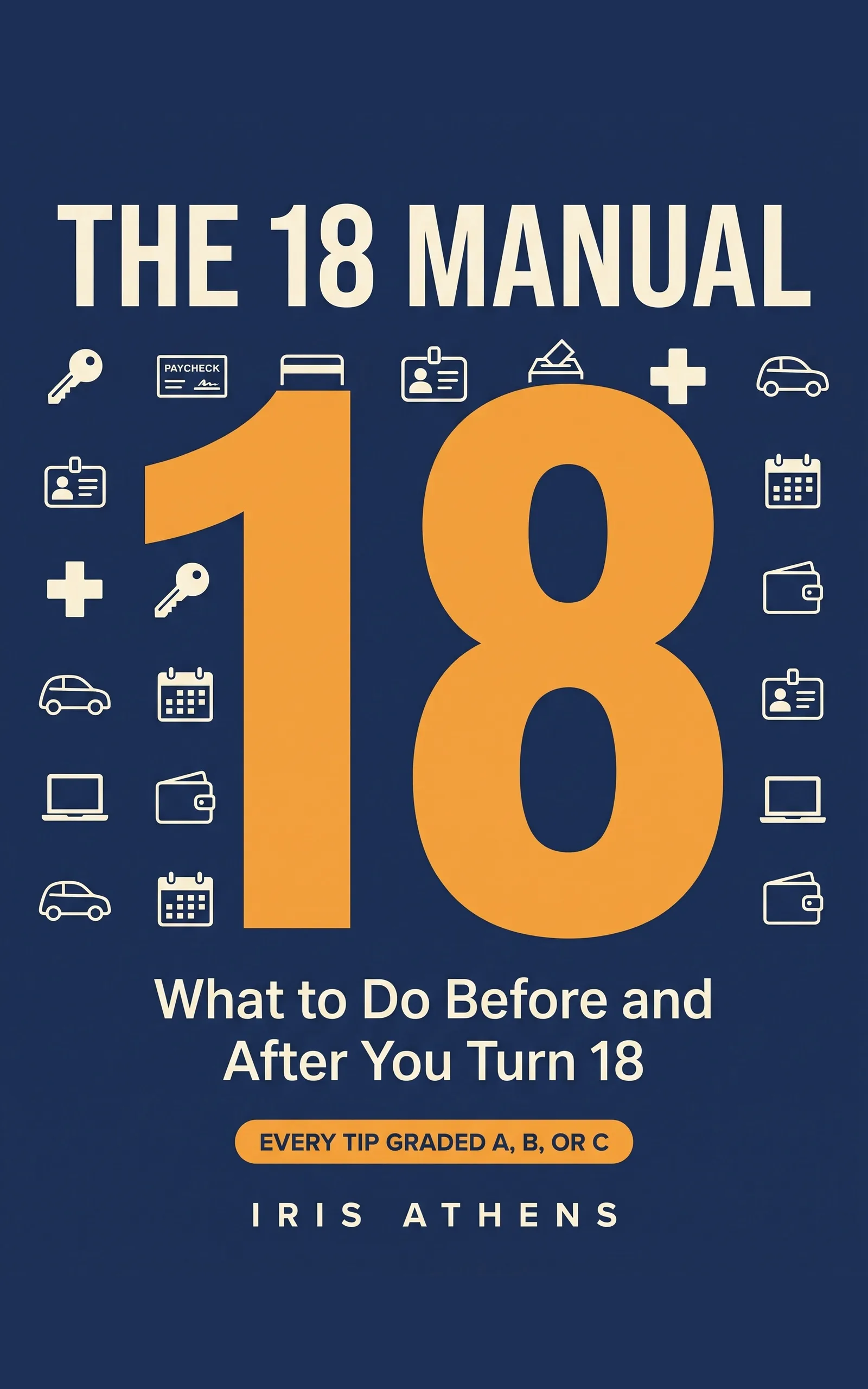
The book for this problem
The 18 Manual
What to Do Before and After You Turn 18: Money, Work, Rent, Health, and Your Legal Rights, Graded by What It Costs and How Well It Works. By Iris Athens, 142 pages.
Where this problem is in the book:
- Your Paycheck and Taxes
- Work and Your Rights
Links go to Amazon. ToolGenX publishes this book under a pen name and earns from every sale. Amazon sets the price and handles delivery and returns.

Is The 18 Manual the right book for you?
Yes, if
- You just got your first paycheck and the number felt wrong
- You filled out a W-4 on your first day and had no idea what you were doing
- You work part-time and wonder if you should file taxes at all
Skip it if
- You want someone to fill out your own tax return
- You are paid as a contractor and need a full self-employment tax plan
Fair doubts before you buy
Can I just ask my manager why it is smaller?
You can, and sometimes you should, if hours or overtime look wrong. But most of the gap is taxes, and your manager may not know how the W-4 works either. The IRS has a free estimator for that, and the book walks you through each line of the stub.
Is filing taxes worth it on a part-time job?
If federal income tax was taken out, it often is. The IRS says to file if you can get money back, and gives withheld income tax as an example. Skip the return and that money stays with the government.
Get The 18 Manual
About 130 grown-up moves, from a first bank account to a first lease, each graded by what it costs and how well it works, so a new 18-year-old knows which ones are worth the time.
Links go to Amazon. ToolGenX publishes this book under a pen name and earns from every sale. Amazon sets the price and handles delivery and returns.
This book explains published US rules and where to check them. It is not legal, tax, medical or financial advice.

Questions people ask about this
- What is FICA on a paycheck?
- FICA is the label for two taxes: Social Security and Medicare. For 2026, Social Security takes 6.2 percent of your wages, up to $184,500 a year, and Medicare takes 1.45 percent. Together that is 7.65 percent. They come out of almost every paycheck, even a small one.
- How do I fill out a W-4 for my first job?
- The W-4 tells your employer how much federal income tax to hold back. If you are unsure, the IRS Tax Withholding Estimator at irs.gov can fill one in for you from your answers. The IRS says it takes about 25 minutes. It suggests rechecking every January and after a big change, like a second job.
- Do I have to file taxes if I made a little money?
- It depends on your income and whether a parent can claim you. For 2025 returns, a single dependent under 65 generally had to file if earned income was over $15,750, among other tests. Even if you do not have to file, filing can get back income tax that was withheld. Check IRS Publication 501 for the current table.
- How can I file my taxes for free?
- In October 2026, the IRS Free File page listed free guided software for incomes of $95,000 or less, with a note to check back in January 2027. Free volunteer help, called VITA, was generally for incomes of $69,000 or less in the 2026 season. Limits change, so check irs.gov/freefile.
- Is my employer required to give me a pay stub?
- Not under federal law. Employers must keep accurate records of your hours and pay, but federal law does not require a pay stub. Some states do. If you do not get one, ask how to see your pay details and check your state labor department's rules.
Related problems
- What changes legally when you turn 18, and what to do in that first week
At 18 your contracts count, your medical records become yours and men must register with Selective Service. See each rule with its proof grade.
- How to build credit at 18 without falling into a credit card trap
Secured card, credit-builder loan or authorized user? Compare the ways to build credit at 18, the under-21 rule, and the moves that do not count.
- Sent money to a scammer? What to do right now, step by step
Just sent money to a scammer? Call the payment company today, then report it. The steps for gift cards, fake checks, stolen IDs and photo threats.
- Everything inside The 18 Manual
Every chapter, who the book is for, and every problem it helps with.
// Also on this topic
- guideHome alone rules for kids the first time: what to say at the door, the phone and the smoke alarm
First time leaving your child home alone? The house rules and the exact words for the door, the phone, a burn and the smoke alarm.
- guideWhat to teach kids about strangers, now that "stranger danger" is out
Stranger danger is out. What to teach kids 8 to 12 instead: watch what people do, check first, and know who to ask for help.
- bookWhat Do I Say If...?
The Street-Smart Phrasebook for Kids 8-12: The Exact Words to Say No, Get Help, and Stay Safe With Strangers, Friends, Bullies, and People Online