Last updated
Home alone rules for kids the first time: what to say at the door, the phone and the smoke alarm

| What happens | What your child says | What they do |
|---|---|---|
| Someone knocks, even a "friend of your mom" | Nothing. They do not have to answer | Stay away from the door, keep it locked, call or text you |
| A delivery person wants a signature | Nothing. The package can wait | Leave it on the porch; you sort it out later |
| A neighbor they know wants to come in | "I'm not allowed to open the door. You can call my mom." | Keep the door locked and call you |
| A caller asks if parents are home | Your family line, like "They can't come to the phone right now. Can I take a message?" | Write down the name and number, then hang up |
| A strange noise | "I heard a noise and I'm nervous." (to you, on the phone) | Do not go looking. Call 911 if someone is really trying to get in |
| A small burn | "I burned my hand. It's red and it hurts." | Cool running water. No ice, no butter, no cream, no popping blisters |
| The smoke alarm goes off | "There's a fire at my house. My address is ____." (to 911, from outside) | Get out, get low under smoke, go to the meeting spot, stay out |
| A big hurt | "I'm hurt and I'm home alone. My address is ____." (to 911) | Call 911 first, stay on the line, then call you |
| A friend wants to come over | "I'm not allowed to have friends over when I'm alone." | Keep the door shut; text you to ask |
Reading the home alone table
Each row is one moment from the Home Alone chapter. The middle column is the line your child says, short on purpose. The right column is what they do next.
Two rules sit under all of it. First, the door stays shut, no matter who it is. Second, in a real emergency, your child calls 911 first and you second. Every other row comes back to one of those.
Notice how often the answer is "nothing." Your child does not owe anyone at the door a reply. A real delivery person will come back another time.

The age question has no single answer
The American Academy of Pediatrics says there is no single right age to stay home alone. Experts typically agree 11 or 12 is fine for a few hours. Some mature 8 or 9 year olds can manage half an hour or so. State laws set minimum ages anywhere from 8 to 14.
The book puts it in kid words: your grown-up decides when you're ready, not your age and not your friends. Before the first time, the AAP suggests you agree on the house rules, post your numbers on the fridge, and do a practice run while you are close by.

The knock at 4:15
Picture it. You are at the store, twenty minutes away. Your son is at the kitchen table with a snack. Someone knocks.
A voice says:
Hello? I'm a friend of your mom's. Can you open up for a second?
He is polite. You raised him to be. That is exactly why he needs the rule decided before the knock. When the rule is "the door stays shut for everyone," there is nothing to weigh. He stays away from the door and texts you. If the knocking keeps going, he calls. If someone tries to get in, he calls 911.
The phone works the same way. A caller asks, "So you're by yourself?" The book's example line keeps it calm:
They can't come to the phone right now. Can I take a message?

Fire and hurts: the two emergencies to rehearse
Fire moves fast. The book tells kids they may have only a couple of minutes, so they do not stop to grab things. The National Fire Protection Association recommends two ways out of every room, a meeting spot outside, and practicing the plan twice a year. Push the test button on the smoke alarm and walk the plan together.
For hurts, the practice question is a good one to ask at dinner: which is a 911 hurt, a scraped knee or a fall where you can't move your leg? If your child is not sure, they call you. If they cannot reach you and they are scared, they call 911.
For a small burn, cool running water. Not ice, not butter, not cream. The book notes that experts differ on how long, from 3 to 5 minutes up to 20, so ask your child's doctor and pick one for your house.
Chapters for the first afternoon alone
Iris Athens wrote What Do I Say If...? for exactly this problem.
Home Alone has ten situations, each with the line to say, what to do if the person pushes, and a practice line for you to read, including the knock and the phone call above.
Emergencies covers what to say to 911, step by step, plus fire, gas, choking and calling 911 by mistake.
Our Family Safety Plan has a page for your home alone rules, your phone line, a check-in plan and your fire escape routes. It goes on the fridge.
If your child also plays online while you are out, our page on a stranger in a game asking for personal info covers that side.
The book for this problem
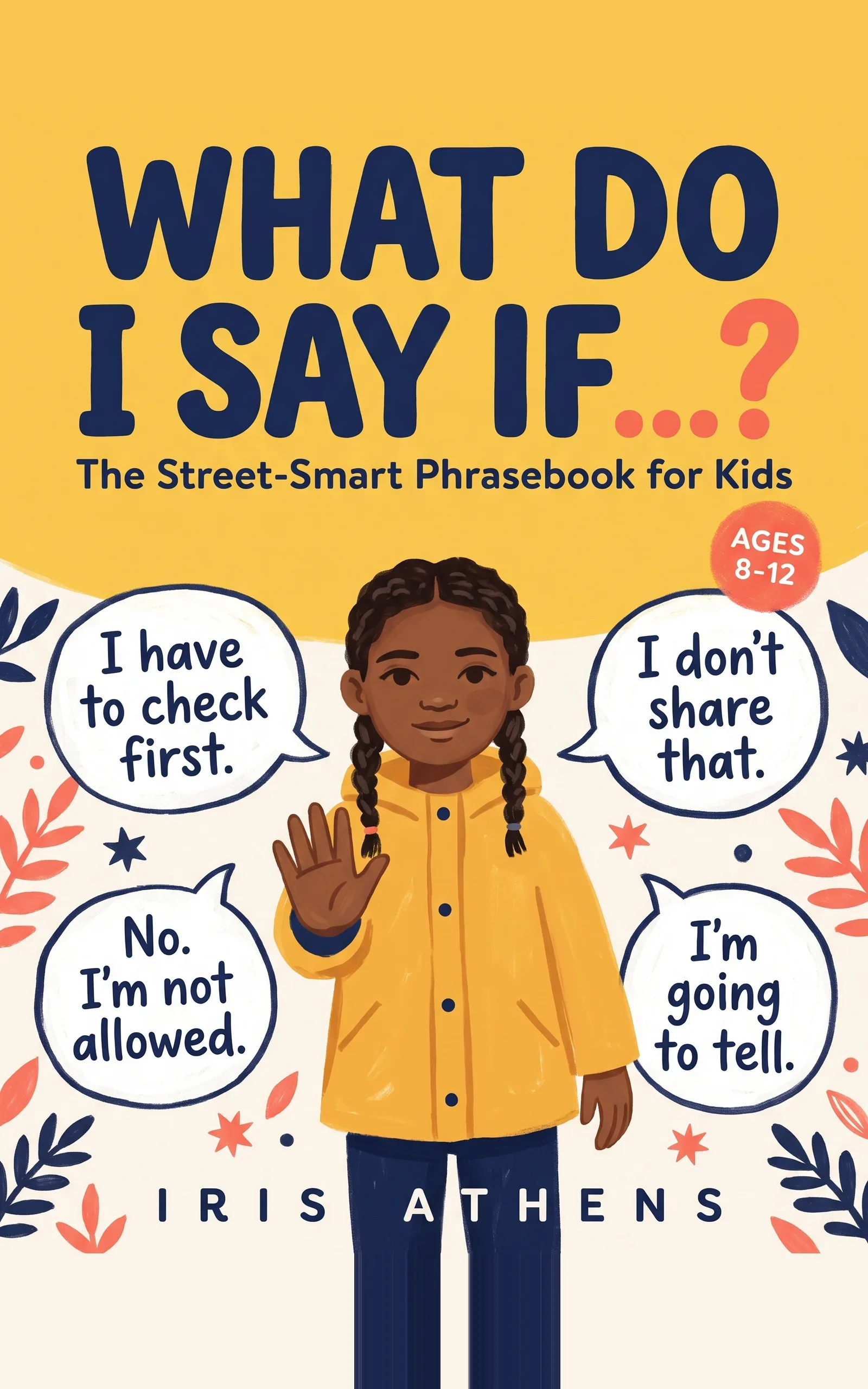
What Do I Say If...?
The Street-Smart Phrasebook for Kids 8-12: The Exact Words to Say No, Get Help, and Stay Safe With Strangers, Friends, Bullies, and People Online. By Iris Athens, 159 pages.
Where this problem is in the book:
- Home Alone
- Emergencies
- Our Family Safety Plan
Links go to Amazon. ToolGenX publishes this book under a pen name and earns from every sale. Amazon sets the price and handles delivery and returns.

Is What Do I Say If...? the right book for you?
Yes, if
- Your child is about to stay home alone for the first time
- You have rules in your head but have never said them out loud together
- You want your child to know exactly what to say at the door and on the phone
Skip it if
- You need to know the legal minimum age in your state; check your state rule directly
- Your child is not ready yet. The book says the grown-up decides, not the age
Fair doubts before you buy
They are eleven. Do they really need scripts for this?
A rule like "do not open the door" is easy to agree with at dinner. It is harder when a friendly voice says it is a friend of your mom. A line said out loud a few times beforehand is what comes out in that moment, and it takes ten minutes to practice.
What if my child feels scared alone?
The book treats that as normal, even for grown-ups. It gives your child a line to call you with, a second person to call if you do not pick up, and permission to say they are not ready yet. That last part matters as much as the rules.
Get What Do I Say If...?
Rules are easy to remember at the kitchen table; this book gives kids 8 to 12 the exact words to say in the moment, with strangers, friends, bullies and people online.
Links go to Amazon. ToolGenX publishes this book under a pen name and earns from every sale. Amazon sets the price and handles delivery and returns.
This book is not a substitute for supervision or professional help. If a child may be in danger, call 911 or the Childhelp National Child Abuse Hotline at 1-800-422-4453.

Questions people ask about this
- What age can a child stay home alone?
- The American Academy of Pediatrics says there is no single right age. Experts typically agree 11 or 12 is fine for a few hours, and some mature 8 or 9 year olds can manage half an hour or so. State laws set minimum ages anywhere from 8 to 14, so check your own state.
- Should a child answer the door when home alone?
- No. The book makes it one rule for everyone: when home alone, the door stays shut and locked. That includes delivery people and neighbors you know. If someone keeps knocking, your child calls you. If someone tries to get in, they call 911.
- What should a child say on the phone when home alone?
- Never that they are alone. The AAP leaves the exact words to you, so pick one line together and practice it. The book gives an example: they can not come to the phone right now, and an offer to take a message. Then your child writes down the name and number and hangs up.
- What should a child do if the smoke alarm goes off when home alone?
- Get out, using the family escape plan, and stay out. If there is smoke, get low and go under it. Go to the family meeting spot and call 911 from outside or from a neighbor. Do not go back for a pet or anything else. Then call the grown-up.
- How do I prepare my child to stay home alone?
- Agree on the house rules, post your phone numbers on the fridge, and do a practice run while you are nearby, as the AAP suggests. Make sure your child knows the address and your cell number by heart, and who to call second if you do not answer.
Related problems
- What to teach kids about strangers, now that "stranger danger" is out
Stranger danger is out. What to teach kids 8 to 12 instead: watch what people do, check first, and know who to ask for help.
- Is a family code word enough to keep your child safe from a stranger pickup?
Many families pick a secret code word for pickups. Why it is a useful extra but not a free pass, and the rule that does more of the work.
- A stranger in an online game is asking your child where they live. What do you do right now?
Someone in a game chat asked your child for their school, address or a photo. What to do in the next ten minutes, and the words for next time.
- Everything inside What Do I Say If...?
Every chapter, who the book is for, and every problem it helps with.
// Also on this topic
- guideWhy is my first paycheck so much smaller than I expected?
Your first paycheck is smaller because of FICA, income tax and your W-4. See what each line takes in 2026 and how to get back tax you did not owe.
- guideFirst apartment at 18: what to know before you sign the lease
About to rent your first apartment at 18? What to check in the lease, how to get your deposit back, renters insurance and the signs of a fake listing.
- bookThe 18 Manual
What to Do Before and After You Turn 18: Money, Work, Rent, Health, and Your Legal Rights, Graded by What It Costs and How Well It Works