Last updated
What to teach kids about strangers, now that "stranger danger" is out

The rule you grew up with has a hole in it
You are at the grocery store. Your daughter is nine. She wanders one aisle over to look at the cereal, and for ten seconds you cannot see her.
Your stomach drops. Then you see her ponytail and breathe again.
Later you wonder what she would have done. You told her years ago not to talk to strangers. But if she were really lost, a stranger is exactly who she would need. And the people you worry about most do not always look like strangers at all.

Why "don't talk to strangers" leaves kids stuck
The National Center for Missing & Exploited Children (NCMEC) moved away from stranger danger, and the book follows that choice. The reasons are plain once you hear them.
Kids do not know who counts as a stranger. Is the crossing guard one? The friend of a friend? The man who waves from the next yard? A child cannot sort that out under stress.
People who harm children are usually someone the child knows. So a rule about strangers points their attention the wrong way.
And a lost child needs to be able to ask a stranger for help. If every stranger is scary, the safest move becomes the forbidden one.

Watch what people do, not how they look
Here is the shift. People who are not safe usually look just like everybody else. What gives them away is what they do. The book names the behaviors: asking a kid for help instead of a grown-up, asking a kid to keep secrets, trying to get a kid alone, or rushing them.
That gives your child something they can actually spot. Take the lost puppy trick. A grown-up asks your child to help look behind a building. The clue is not the person's face. It is that grown-ups ask other grown-ups for help, not kids. The line to say is short:
I can't help you. Ask a grown-up.
Then your child walks away toward other people and keeps one or two arm's lengths away the whole time.
The same goes for the scary-story trick, when someone says your mom is hurt and there is no time. Real emergencies still get checked. Your child says they have to check with the grown-up in charge and walks, fast, to a teacher, a coach or a store worker.

Two habits that do most of the work
Check first. Before going anywhere with anyone, taking anything, or getting in any car, your child checks with the grown-up in charge of them. That includes people they know. The line on the book's cut-out card is one your child can say in any tone, to anyone:
I have to check first.
Know who to ask. If your child needs help, they pick the helper. NCMEC's KidSmartz program suggests a police officer in uniform, a store worker with a name tag, or a parent with kids. In a store, never leave the building or go to the parking lot to look.
Then there is the one time to be loud. If someone grabs your child, the book says to yell, pull away and run toward people. One of its lines:
This is not my dad!
NCMEC found that most children who got away from an attempted abduction did something active like that. Practice only the yell. The book is clear: no real grabbing, even in practice.
Practice beats a talk
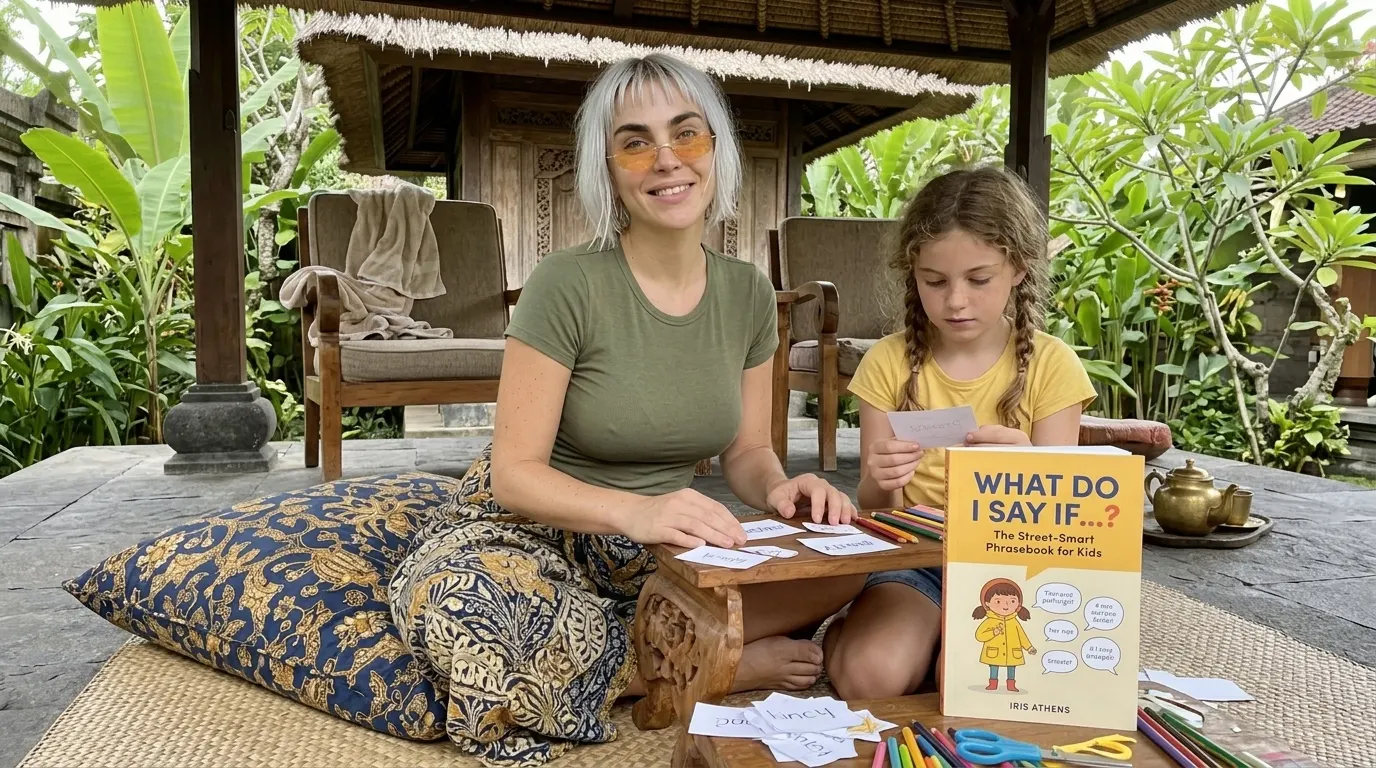
One talk at the kitchen table fades. What sticks is saying the words out loud. Each situation in the book ends with a practice line for you to read in character. For the ride offer, you say something like "It's pouring rain! Hop in, your mom won't mind." Your child answers in their strong voice. Then you swap, and they play the pushy one.
The book has one firm rule about this. Never test your child with a staged stranger in real life. Practice happens when they know it is practice.

Chapters that teach check first
Iris Athens wrote What Do I Say If...? for exactly this problem.
Your Inside Alarm teaches kids to notice the tight-tummy feeling and act on it without needing proof.
Safe Grown-Ups has your child write down a team of at least three trusted adults, and lists who to ask when they are out.
Out in Public covers 14 situations, from getting lost at a mall to a car pulling up to ask for directions, each with the words to say and a practice line.
If your family is thinking about a secret word for pickups, read our page on whether a family code word is enough first.
The book for this problem
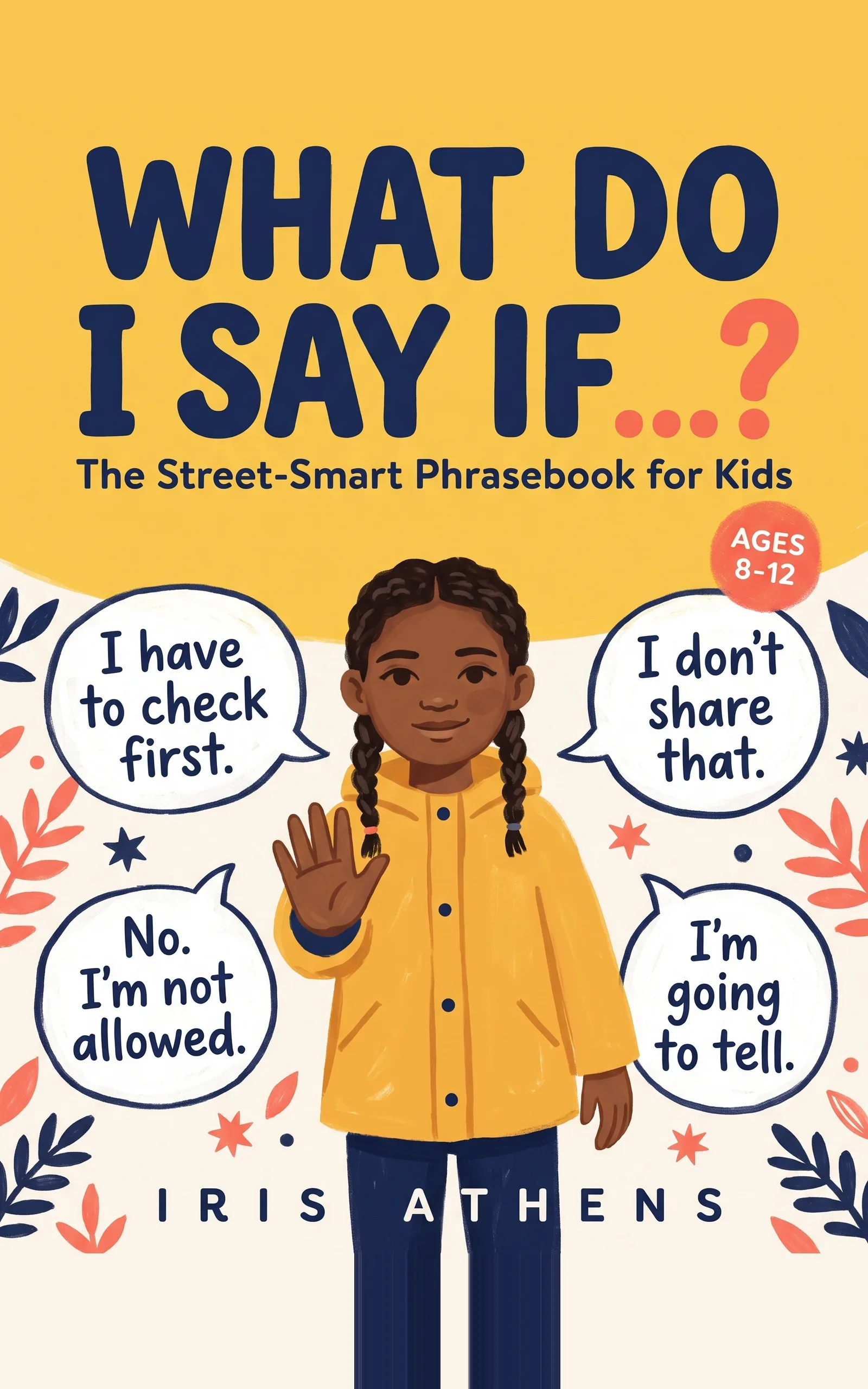
What Do I Say If...?
The Street-Smart Phrasebook for Kids 8-12: The Exact Words to Say No, Get Help, and Stay Safe With Strangers, Friends, Bullies, and People Online. By Iris Athens, 159 pages.
Where this problem is in the book:
- Your Inside Alarm
- Safe Grown-Ups
- Out in Public
Links go to Amazon. ToolGenX publishes this book under a pen name and earns from every sale. Amazon sets the price and handles delivery and returns.
Is What Do I Say If...? the right book for you?
Yes, if
- You grew up with stranger danger and are not sure what replaced it
- Your child is 8 to 12 and starting to walk, play or shop a little on their own
- You want words your child can actually say, not a list of fears
Skip it if
- A child is missing or in danger right now. Call 911
- Your child is under 7 and needs picture-book basics first
Fair doubts before you buy
Is it not safer to just tell kids never to talk to strangers?
The book argues no. A child who is lost in a store needs to talk to a stranger, and the safest one is a person they pick, like a worker with a name tag. A blanket rule also misses the bigger risk, since people who harm kids are often someone the child knows.
My child will forget all this the first time it matters.
That is the problem the book is built around. Rules fade under stress. A short sentence your child has said out loud ten times does not. Each situation has a practice line for you to read, so the words are already in their mouth.
Get What Do I Say If...?
Rules are easy to remember at the kitchen table; this book gives kids 8 to 12 the exact words to say in the moment, with strangers, friends, bullies and people online.
Links go to Amazon. ToolGenX publishes this book under a pen name and earns from every sale. Amazon sets the price and handles delivery and returns.
This book is not a substitute for supervision or professional help. If a child may be in danger, call 911 or the Childhelp National Child Abuse Hotline at 1-800-422-4453.

Questions people ask about this
- Why did experts stop teaching stranger danger?
- NCMEC moved away from it for three reasons the book lists. Kids do not know who counts as a stranger. People who harm kids are usually someone the child knows. And a lost child needs to be able to ask a stranger for help. So the focus moved to behavior and checking first.
- What does check first mean for kids?
- Before your child goes anywhere with anyone, gets in a car, takes a gift or changes plans, they check with the grown-up in charge of them. The rule covers people they know, too. A neighbor offering a ride in the rain still gets a check first.
- Who should a lost child ask for help?
- NCMEC suggests a police officer in uniform, a store worker with a name tag, or a parent with kids. In a store or mall, the book adds the information desk and a security guard. The key is that the child chooses who to ask, and never goes out to the parking lot to look.
- What are the tricks people use to lure kids?
- The book teaches the clues instead of scary stories. A grown-up asks a kid, not another grown-up, to help find a pet. A stranger says your mom is hurt and you have to come now. Someone offers a ride, a gift or a photo shoot. Rushing and secrets are the warning signs.
- What should my child do if someone grabs them?
- Get as loud as they can. The book teaches kids to yell that this person is not their parent, then pull away, kick, twist and run toward people. NCMEC found that most children who got away from an attempted abduction did something active. In practice, only the yell is rehearsed, never real grabbing.
Related problems
- Your child is being bullied and goes back to school tomorrow. What should they say to the bully?
Your child is being bullied and school is tomorrow. The calm words to say, what to do next, and how to report it if telling once did not work.
- Is a family code word enough to keep your child safe from a stranger pickup?
Many families pick a secret code word for pickups. Why it is a useful extra but not a free pass, and the rule that does more of the work.
- Home alone rules for kids the first time: what to say at the door, the phone and the smoke alarm
First time leaving your child home alone? The house rules and the exact words for the door, the phone, a burn and the smoke alarm.
- Secrets vs. surprises: how to explain the difference to your child without scaring them
A calm way to teach kids 8 to 12 the difference between a surprise and a secret, which secrets they always tell, and the words to say.
- Everything inside What Do I Say If...?
Every chapter, who the book is for, and every problem it helps with.
// Also on this topic
- guideWhat changes legally when you turn 18, and what to do in that first week
At 18 your contracts count, your medical records become yours and men must register with Selective Service. See each rule with its proof grade.
- guideSent money to a scammer? What to do right now, step by step
Just sent money to a scammer? Call the payment company today, then report it. The steps for gift cards, fake checks, stolen IDs and photo threats.
- bookThe 18 Manual
What to Do Before and After You Turn 18: Money, Work, Rent, Health, and Your Legal Rights, Graded by What It Costs and How Well It Works