Last updated
Can I stay on my parents' health insurance until 26? The rule and the end date

| Your situation | The rule | Who to check with |
|---|---|---|
| Under 26, married, moved out or not a tax dependent | You can still join or stay on a parent's plan | The plan, and your state for any extra rules |
| Parent has a Marketplace plan | Coverage runs through December 31 of the year you turn 26 | HealthCare.gov or your state marketplace |
| Parent has a job-based plan | The end date depends on the plan | The parent's employer or plan, in writing |
| You are about to turn 26 | A 60-day Special Enrollment Period, before or after you lose coverage | HealthCare.gov |
| You missed that window | Open Enrollment, November 1 to January 15 on HealthCare.gov. State marketplaces may differ | HealthCare.gov or your state marketplace |
| Low income | Medicaid any time of year. Under 138% of the poverty level in expansion states | HealthCare.gov or your state Medicaid office |
| In foster care and on Medicaid at 18 | Every state must cover you through Medicaid until 26, with no income test | Your state Medicaid office |
| Under 30 and buying your own plan | A catastrophic plan is allowed: low premium, high deductible | HealthCare.gov |
Reading the under-26 table
Start with the top row. It answers the question most people actually have. You can stay on a parent's plan until 26 even if your life changes. Marriage, a new address, your own job offer: none of them end it.
The book grades this an A, because it is a federal rule under the Affordable Care Act. The HealthCare.gov page for young adults under 26 states it the same way.
The next two rows are about the end date. That is where people get caught. A Marketplace plan and a job plan end differently, so find out which kind your parent has.
The rest of the table is the plan B. If you age off, earn little, or come from foster care, there is still a way in. Each row names who can check your own case.

The date to put in your phone today
This is one of the book's Cheap A's. It costs five minutes and nothing else.
Add two reminders. One goes 60 days before your 26th birthday. The other goes each fall, for Open Enrollment.
Why 60 days? Losing coverage at 26 opens a Special Enrollment Period. You can sign up for your own Marketplace plan if you lost coverage in the past 60 days or will lose it in the next 60. The HealthCare.gov page on special enrollment has the full list of reasons. Miss it, and you may wait for Open Enrollment, November 1 to January 15.

Five words that make a bill make sense
Being on a plan is one thing. Using it is another. The book asks you to learn five words and find each number on your own plan.
Premium is what you pay every month for the plan. Deductible is what you pay for covered care before the plan pays. Copay is a fixed amount, like $20, for a visit. Coinsurance is your percentage share of a bill. Out-of-pocket maximum is the most you pay for covered care in a year. For 2026, Marketplace plans can't set it above $10,600 for one person.
Then, when a bill comes, hold it next to the explanation of benefits from your insurer. In the words of CMS, that statement is not a bill. Your bill should not be higher than the patient balance on it.

Standing at the front desk with no card
You have a sore throat that will not quit. The clinic asks for your insurance card. You realize you have never seen it.
So you text your mom. She is at work. The line behind you grows.
The fix takes one minute and one conversation. Ask your parent if you are on their plan, and save a photo of the card on your phone. At 18 you can also ask each of your doctors for your own patient portal login, because your records are now yours.

Where the book covers health insurance
This is the problem The 18 Manual was written for. Iris Athens put health coverage in one chapter so you don't have to piece it together.
Health Insurance and Doctors has fourteen moves. It covers staying on a parent's plan, the 26th birthday reminder, your options if you are not on a parent's plan, Medicaid, the five words, reading an explanation of benefits, surprise bill rights, free preventive care, picking a primary care provider, and when to use 911, the ER or urgent care.
The Cheap A's pulls the health moves with the strongest proof onto one page, including the 26th birthday reminder and your rights against surprise medical bills. The federal help line for those is 1-800-985-3059.
The book does not choose a plan for you, and it is not medical or insurance advice. For your own options, HealthCare.gov and your state Medicaid office can check your case. Turning 18 changes more than insurance; see our page on what changes legally at 18.
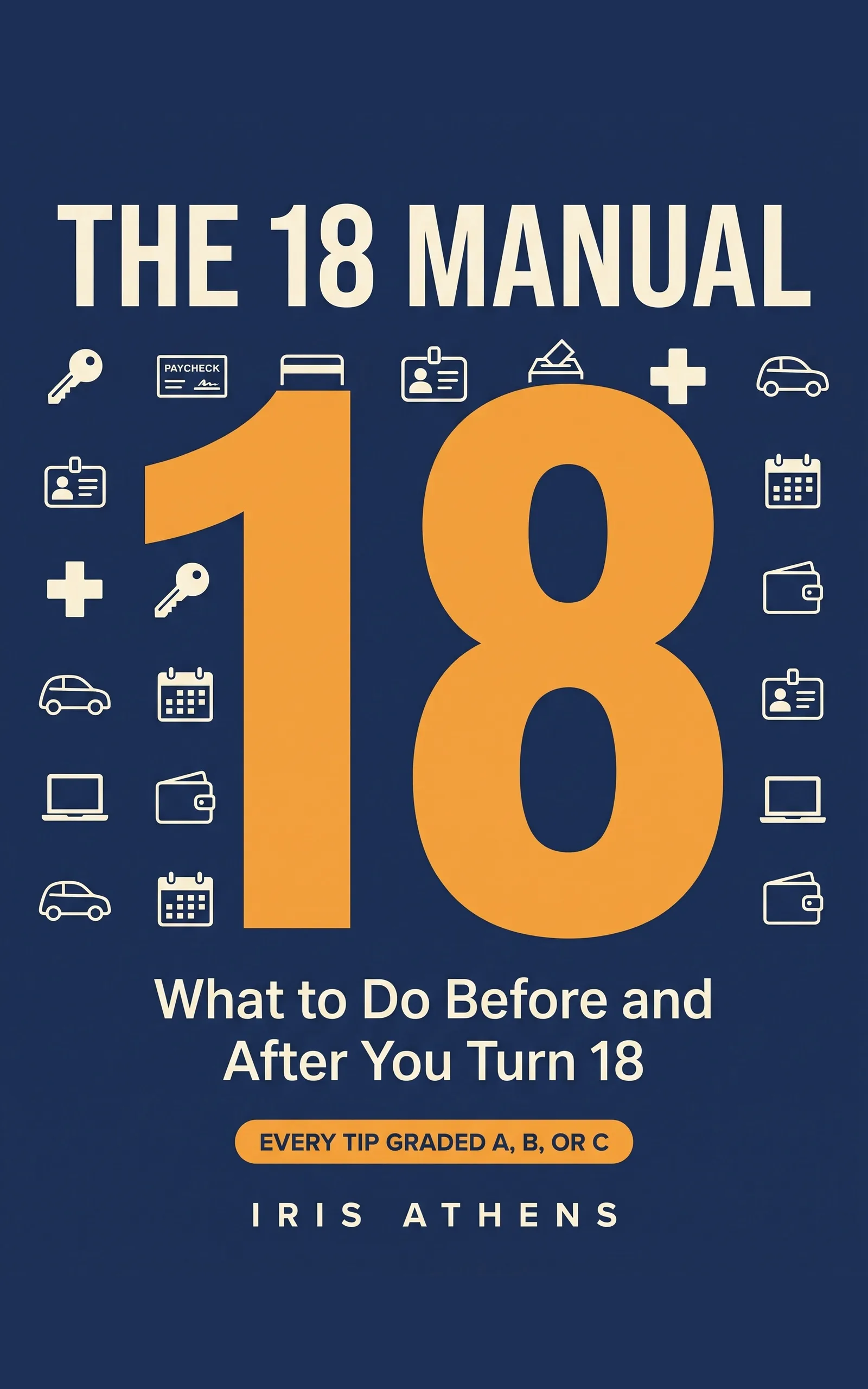
The book for this problem
The 18 Manual
What to Do Before and After You Turn 18: Money, Work, Rent, Health, and Your Legal Rights, Graded by What It Costs and How Well It Works. By Iris Athens, 142 pages.
Where this problem is in the book:
- Health Insurance and Doctors
- The Cheap A's
Links go to Amazon. ToolGenX publishes this book under a pen name and earns from every sale. Amazon sets the price and handles delivery and returns.

Is The 18 Manual the right book for you?
Yes, if
- You are on a parent's plan and want to know how long it lasts
- You are moving out, marrying or starting a job and wonder if you lose coverage
- You want the dates written down before you turn 26
Skip it if
- You want someone to pick a health plan for you
- You have a coverage dispute that needs your insurer or a lawyer
Fair doubts before you buy
My parents handle the insurance. Why do I need to know this?
Because the end date is yours, not theirs. If you miss the 60-day window around your 26th birthday, you may have to wait for Open Enrollment, which leaves a gap. And at 18, the insurer and your doctors start talking to you, not to your parents.
Is this not on HealthCare.gov already?
It is, and the book sends you there. The book adds the steps around it: a photo of the card, a calendar alert, the five words on every bill, and where to go when you are sick, each with its own proof grade.
Get The 18 Manual
About 130 grown-up moves, from a first bank account to a first lease, each graded by what it costs and how well it works, so a new 18-year-old knows which ones are worth the time.
Links go to Amazon. ToolGenX publishes this book under a pen name and earns from every sale. Amazon sets the price and handles delivery and returns.
This book explains published US rules and where to check them. It is not legal, tax, medical or financial advice.

Questions people ask about this
- Can I stay on my parents health insurance if I move out?
- Yes. You can stay on a parent's plan until 26 even if you move out, get married, are not claimed as a dependent on their taxes, or are offered coverage at your own job. Some states set their own extra rules, so check yours.
- When exactly does coverage end at 26?
- On a Marketplace plan, it runs through December 31 of the year you turn 26. On a job-based plan, the date depends on the plan. Ask the parent's employer or the plan for the exact date in writing.
- What happens when you turn 26 and lose your parents insurance?
- Losing coverage because you turn 26 gives you a Special Enrollment Period. You can sign up for a Marketplace plan if you lost coverage in the past 60 days or expect to lose it in the next 60. Miss it and you may wait for Open Enrollment, November 1 to January 15 on HealthCare.gov.
- Can I get my own health insurance if my parents claim me as a dependent?
- You can buy a Marketplace plan, but if someone claims you as a tax dependent, you will not get the income-based savings that lower the price for many people. If you are under 30, a catastrophic plan is also an option. HealthCare.gov says a Bronze or Silver plan may be better value if you qualify for tax credits.
- Can I get Medicaid at 18?
- If your income is low, you can apply any time of year. In states that expanded Medicaid, adults can qualify with income below 138 percent of the federal poverty level. For 2026 the poverty level for one person is $15,960, so 138 percent is about $22,000 a year. Rules vary by state.
Related problems
- What changes legally when you turn 18, and what to do in that first week
At 18 your contracts count, your medical records become yours and men must register with Selective Service. See each rule with its proof grade.
- Why is my first paycheck so much smaller than I expected?
Your first paycheck is smaller because of FICA, income tax and your W-4. See what each line takes in 2026 and how to get back tax you did not owe.
- First apartment at 18: what to know before you sign the lease
About to rent your first apartment at 18? What to check in the lease, how to get your deposit back, renters insurance and the signs of a fake listing.
- Everything inside The 18 Manual
Every chapter, who the book is for, and every problem it helps with.
// Also on this topic
- guideWhat to teach kids about strangers, now that "stranger danger" is out
Stranger danger is out. What to teach kids 8 to 12 instead: watch what people do, check first, and know who to ask for help.
- guideIs a family code word enough to keep your child safe from a stranger pickup?
Many families pick a secret code word for pickups. Why it is a useful extra but not a free pass, and the rule that does more of the work.
- bookWhat Do I Say If...?
The Street-Smart Phrasebook for Kids 8-12: The Exact Words to Say No, Get Help, and Stay Safe With Strangers, Friends, Bullies, and People Online