Last updated
Secrets vs. surprises: how to explain the difference to your child without scaring them

| Question | A surprise | A secret to tell |
|---|---|---|
| How long is it kept? | A little while | Sometimes forever |
| How does it end? | Soon, and everyone ends up smiling | It does not end on its own |
| Example from the book | Your sister is making Dad a birthday card | A grown-up gives you money and says "Don't tell your mom" |
| Another example | Your class is planning a party for your teacher on Friday | An online friend says "Delete our chats so your parents don't see" |
| How it feels | Fun, a bit exciting | Worried, scared or icky |
| What your child does | Keeps it until the big moment | Tells a trusted grown-up. "I don't keep secrets from my mom and dad." |
Reading the surprise or secret table
The table is the whole idea of the chapter in one place. Look at the first two rows. A surprise has an end date, and the end is happy. A secret might be meant to last forever. That one difference is something an 8-year-old can check for themselves.
The examples come straight from the book's own quiz. The birthday card and the class party are surprises. The money with "don't tell your mom" and the chat that has to be deleted are secrets to tell. Read them to your child and let them circle the answer. Then ask them how they could tell.
Then add the simplest rule on the page. If someone says "Don't tell," that's a sign it's time to tell.

Why this is the way into the body safety talk
Many parents put off the body safety talk because they cannot find a first sentence. Secrets and surprises gives you one. It starts with birthday cards, not with danger.
From there the next chapter, Your Body Is Yours, is a short step. Your body belongs to you. Private parts are the parts your swimsuit covers. Nobody should look at them, touch them, or ask you to touch theirs. The main exception is a doctor or nurse checking your health, with your grown-up or another helper in the room.
The AAP's guide on preventing child sexual abuse recommends teaching the real names of body parts and telling children clearly that they will not be in trouble for telling you anything. The CDC adds a fact that shapes the whole chapter: most people who harm children are someone the child or family knows and trusts. So the book focuses on what people do, not on strangers.

A Sunday visit, and a hug
Here is a small moment where this all starts. Your aunt arrives for lunch, bends down and says:
Aw, don't I get a kiss? I came all this way!
Your son goes stiff.
The book gives him a polite way out:
No hugs today. Can we high-five?
And it gives you a job: back him up, right there. The AAP says children may say no to touching or hugging, including from adults. When you back your child up in front of relatives, they learn that "no" works.

It is never too late to tell
The book repeats one message on purpose. If a child kept a secret before and wants to tell now, they can tell today. They will not be in trouble for waiting. Lots of kids wait.
It also gives kids a line to start with, because the first sentence is the hardest:
Something happened a while ago, and I need to tell you.
If your child tells you something, the book's advice is to stay calm, believe them and thank them. The Childhelp National Child Abuse Hotline at 1-800-422-4453, by call or text, offers free, confidential counseling for adults and kids. It is not a reporting line. It can point you to your state's child protective services. It is a line we repeat on every page for this book: if a child is in danger right now, call 911.

Chapters to read together, slowly
Iris Athens wrote What Do I Say If...? for exactly this problem. The book suggests reading these chapters together.
Secrets vs. Surprises explains the difference in kid words and ends with the four-question quiz from the table above.
Your Body Is Yours has eight situations, from unwanted hugs and tickling that won't stop to what is okay at a doctor's visit, each with a calm line to say.
When a Grown-Up Breaks the Rules covers the harder moments without naming anyone a "bad person": a grown-up who says "don't tell your parents," gifts given in secret, and a coach who texts privately.
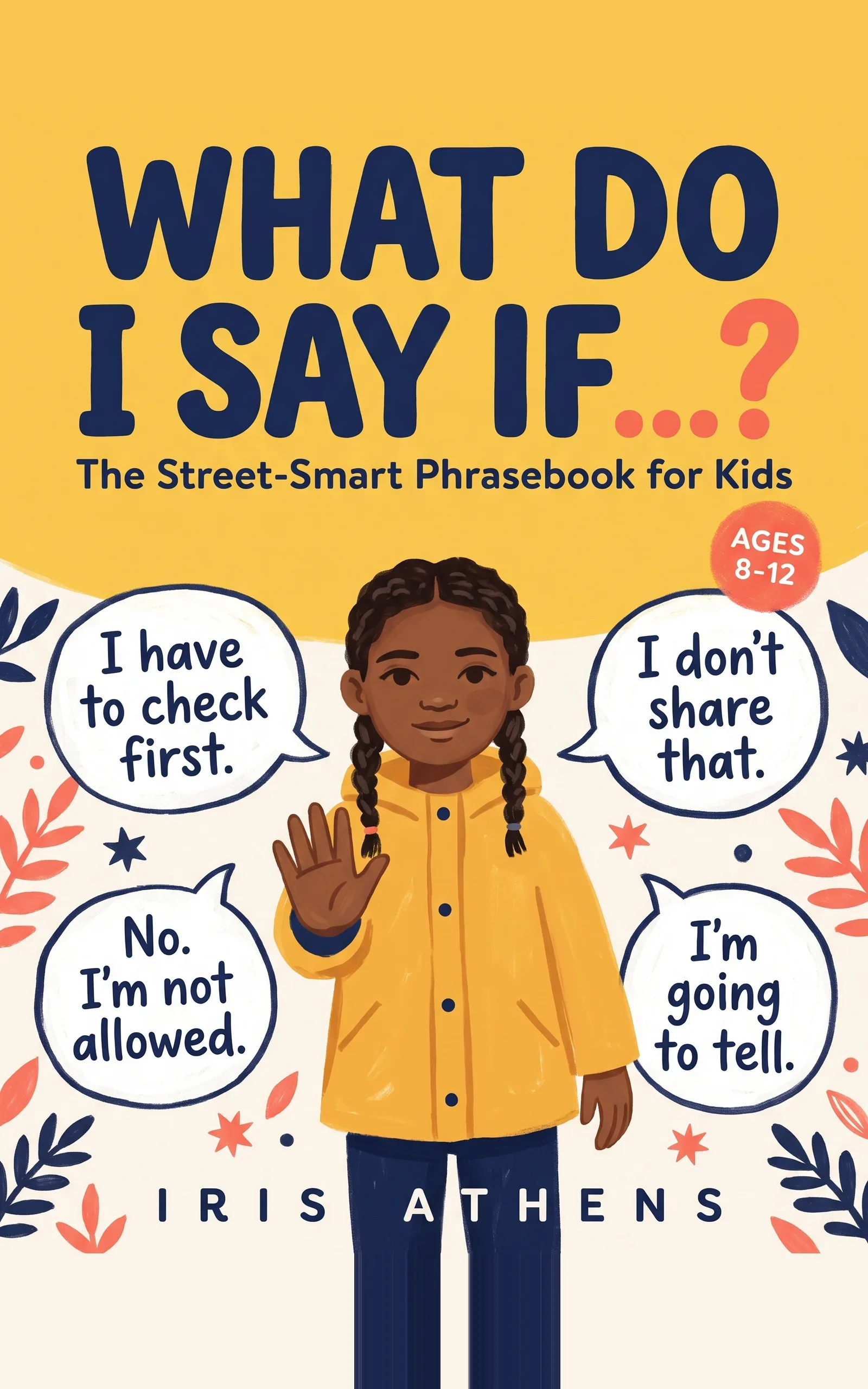
The book for this problem
What Do I Say If...?
The Street-Smart Phrasebook for Kids 8-12: The Exact Words to Say No, Get Help, and Stay Safe With Strangers, Friends, Bullies, and People Online. By Iris Athens, 159 pages.
Where this problem is in the book:
- Secrets vs. Surprises
- Your Body Is Yours
- When a Grown-Up Breaks the Rules
Links go to Amazon. ToolGenX publishes this book under a pen name and earns from every sale. Amazon sets the price and handles delivery and returns.

Is What Do I Say If...? the right book for you?
Yes, if
- You want to start a body safety talk but do not know how to begin
- You want words that are clear without being frightening
- Your child is 8 to 12 and starting to spend time with coaches, clubs and sleepovers
Skip it if
- Your child has told you something has happened. Stay calm, believe them, and call Childhelp at 1-800-422-4453 for guidance
- A child is in danger right now. Call 911
Fair doubts before you buy
Is my child not too young for this talk?
The AAP recommends teaching children the real names of their body parts and who may touch private parts and when, well before the teen years. The secrets and surprises idea is a gentle way in. It is about birthday cards and party plans first, and only then about the secrets that always get told.
Will talking about it make my child afraid of every grown-up?
The book is built to avoid that. It uses no statistics and no scary stories. It teaches kids to watch what people do, like asking them to keep secrets from their family, rather than to fear people. Most grown-ups in a child's life want to keep them safe, and the book says that too.
Get What Do I Say If...?
Rules are easy to remember at the kitchen table; this book gives kids 8 to 12 the exact words to say in the moment, with strangers, friends, bullies and people online.
Links go to Amazon. ToolGenX publishes this book under a pen name and earns from every sale. Amazon sets the price and handles delivery and returns.
This book is not a substitute for supervision or professional help. If a child may be in danger, call 911 or the Childhelp National Child Abuse Hotline at 1-800-422-4453.

Questions people ask about this
- What is the difference between a secret and a surprise?
- A surprise is kept quiet for a little while so someone can be happy later, and it always ends, usually soon. A secret is something someone wants kept hidden, sometimes forever. Some secrets are harmless, like a friend's crush. Others are never okay to keep.
- What secrets should a child never keep?
- The book lists four: a secret about touching or private parts, a secret about someone getting hurt, a secret from your parents that a grown-up asked you to keep, and a secret that makes you feel worried, scared or icky. NCMEC's advice to parents is to ask your child to tell you right away if anyone asks them to keep a secret.
- How do you teach body safety to an 8 year old?
- Start with ownership. Your body belongs to you, and you can say no to touches you do not want, even from family. Private parts are the parts a swimsuit covers. The one main exception is a doctor or nurse checking your health, with your grown-up or another helper in the room.
- Should I make my child hug relatives?
- The AAP says children may say no to touching or hugging, including from adults. The book gives kids a polite swap, asking for a high-five instead. Backing your child up in front of relatives teaches them that no works.
- What should I do if my child tells me something happened?
- Stay calm, believe them and thank them for telling. The Childhelp National Child Abuse Hotline at 1-800-422-4453, by call or text, offers free, confidential counseling for adults and kids. It is not a reporting line, and it can point you to your state's child protective services.
Related problems
- A stranger in an online game is asking your child where they live. What do you do right now?
Someone in a game chat asked your child for their school, address or a photo. What to do in the next ten minutes, and the words for next time.
- What to teach kids about strangers, now that "stranger danger" is out
Stranger danger is out. What to teach kids 8 to 12 instead: watch what people do, check first, and know who to ask for help.
- Is a family code word enough to keep your child safe from a stranger pickup?
Many families pick a secret code word for pickups. Why it is a useful extra but not a free pass, and the rule that does more of the work.
- Looking for a safety book to give a child aged 8 to 12? What to look for, and how to read it together
Buying a safety book for a grandchild, niece or student aged 8 to 12? What makes one useful instead of scary, and how to read it together.
- Everything inside What Do I Say If...?
Every chapter, who the book is for, and every problem it helps with.
// Also on this topic
- guideHow to build credit at 18 without falling into a credit card trap
Secured card, credit-builder loan or authorized user? Compare the ways to build credit at 18, the under-21 rule, and the moves that do not count.
- guideSent money to a scammer? What to do right now, step by step
Just sent money to a scammer? Call the payment company today, then report it. The steps for gift cards, fake checks, stolen IDs and photo threats.
- bookThe 18 Manual
What to Do Before and After You Turn 18: Money, Work, Rent, Health, and Your Legal Rights, Graded by What It Costs and How Well It Works