Last updated
How to use ChatGPT to study without letting it do the learning for you
The answer made sense, and two nights later it was gone
Picture a woman learning spreadsheet formulas for a new office job. Tonight's exercise asks for a formula that totals a column only when a date falls in March. She stares at it for a minute. Then she pastes it into a chatbot.
Twenty seconds later she has a working formula and a tidy explanation. She reads it, nods and moves on. She finishes the lesson in half the usual time.
Two nights later the course asks for almost the same formula from scratch. She cannot write it. She remembers that she understood it. She cannot remember what it was.
That is the newest form of an old trap. The answer on the screen feels like learning, because you understand it while you look at it. Producing your own is a different job, and it is the one a test or a boss will ask for.
What the trials found when students used a chatbot
The clearest evidence comes from a 2025 field experiment by Bastani and colleagues. It ran at a large high school in Turkey during the 2023-2024 school year, with nearly 1,000 math students.
Students practiced in three ways. Some had no AI. Some had "GPT Base," a plain chatbot. The rest had "GPT Tutor," built with teachers' hints and set up to guide students without handing over full answers.
During practice, AI looked like a big win. Practice grades rose by 48 percent with the plain chatbot and by 127 percent with the tutor version.
Then came the exam, taken without AI. Students who had practiced with the plain chatbot scored 17 percent lower than students who never had AI. The researchers saw why: students "often use GPT Base as a 'crutch' by asking for and copying solutions." The tutor version did better, but not in the way you might hope. Its harm on the exam was "essentially eradicated," yet it did not produce a gain.
The most striking part is about feelings. Students who copied solutions did not sense any loss. The researchers wrote that students "do not perceive any reduction in their learning or subsequent performance."
A 2026 study by Shen and Tamkin looks more like an adult learner's evening. It is a preprint, not yet peer reviewed. Tamkin works at Anthropic, the company that makes the Claude chatbot, and Shen did the work through an Anthropic fellows program. They randomly assigned 52 developers to learn a new Python library with or without an AI assistant. On a quiz without AI afterward, the AI group scored 17 percent lower. They were not reliably faster either.
How people used the assistant mattered. People who handed the task to the AI scored low. People who asked only conceptual questions and then did the work themselves scored high. Those groups held only 2 to 7 people each, so treat that as a hint. Still, it matches the bigger trial: what you ask the AI to do matters more than whether you use it.
The good news, and where it stops
AI is not only a risk. A 2025 randomized study by Kestin and colleagues tested an AI tutor in a university physics course. The tutor was custom-built on the same teaching ideas as the class. The authors reported that "students learn significantly more in less time when using the AI tutor, compared with the in-class active learning."
That is a real result with real limits. It was one course. The tutor was built to guide, not to tell. A critical review also noted that it tested learning soon after the lessons, not weeks later.
So here is where the book puts the evidence in late 2026. An AI that does your practice can lower what you can do alone. An AI that makes you think, with hints and questions, avoids most of that harm. Whether it beats plain good studying is still open.
You cannot rebuild a research tutor at your kitchen table. You can do the two things that seem to matter.

Try first, then ask for hints
The chapter Use AI as a Coach, Not a Crutch in Stop Rereading has two tools, both badged PROMISING. No study has tested them with AI directly, and the book says so.
Try First, Then Ask keeps the hard part with you.
- Read the problem and close the AI window.
- Set a timer for 5 to 10 minutes and write a full attempt, even a wrong one. Mark where you got stuck.
- Open the AI and paste your attempt, not just the problem.
- Ask it to point to your first mistake, without rewriting the whole thing.
- Fix it yourself. Then close the AI and redo the problem from a blank page.
- Put the problem on your calendar for a retry in a few days.
Ask for Hints, Not Answers sets the chatbot up as a coach for a whole session. Most chatbots give full answers by default, so you have to ask for something else. A prompt along these lines works as a start:
Do not give the answer. Ask one question at a time. Give one hint only after an attempt. If asked for the answer, suggest one more try first.
The book gives five such prompts: a hint-only coach, a checker, a concept question, a quiz-maker that works from a page you paste in, and an explain-back for the end of a session. It is clear that they are its own design, built from how the safer tutors worked, and not tested as written. If the chatbot slips and gives a full answer, scroll past it and ask again for hints only.
Your Own Learning System adds the check that keeps all this honest: a weekly ten-question score on older material, with your guess written first. That number tells you more than how productive a session felt.
If you feel less sharp since you started leaning on AI, our page on feeling dumber after relying on AI looks at that worry from another book's angle.
The book for this problem
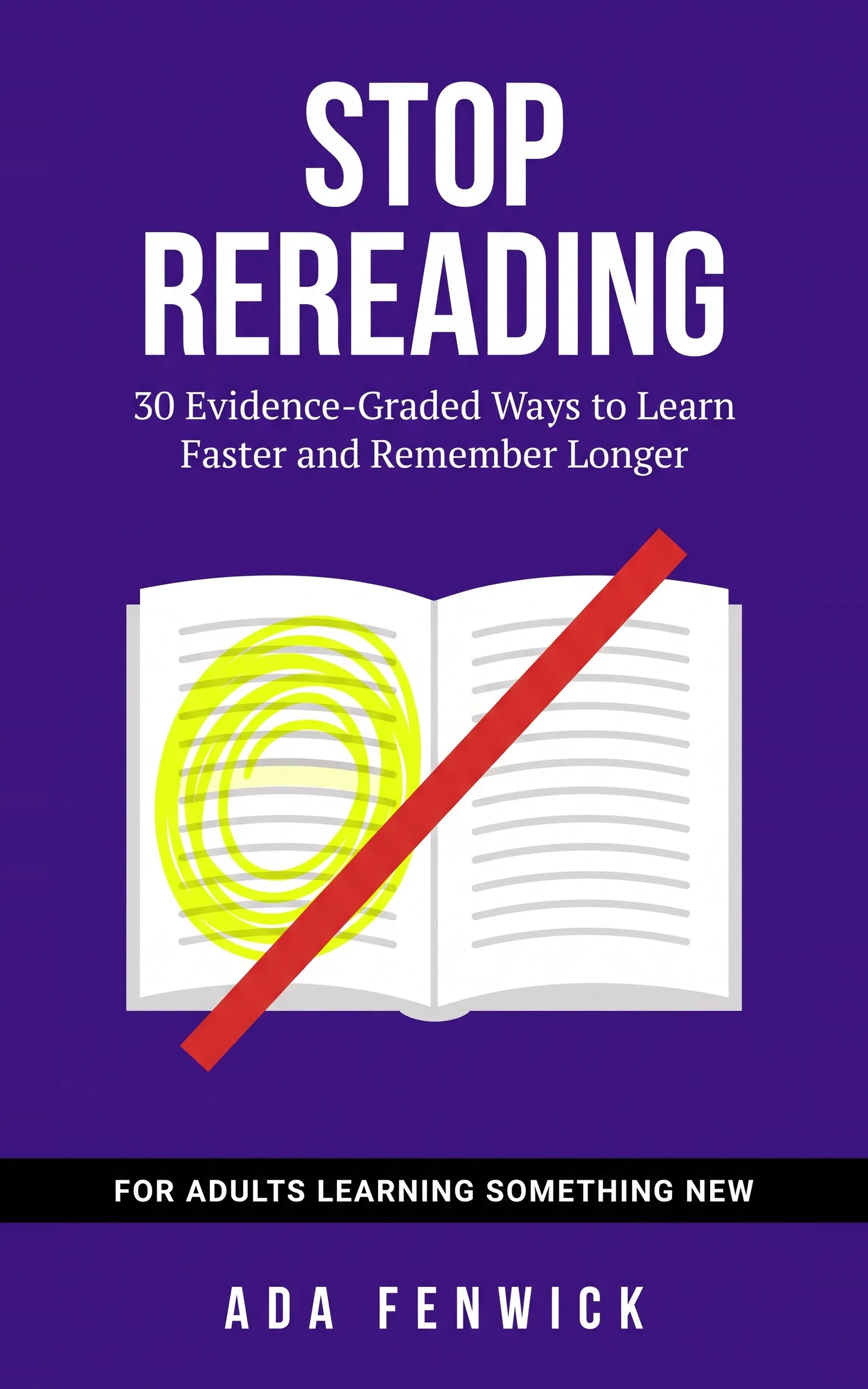
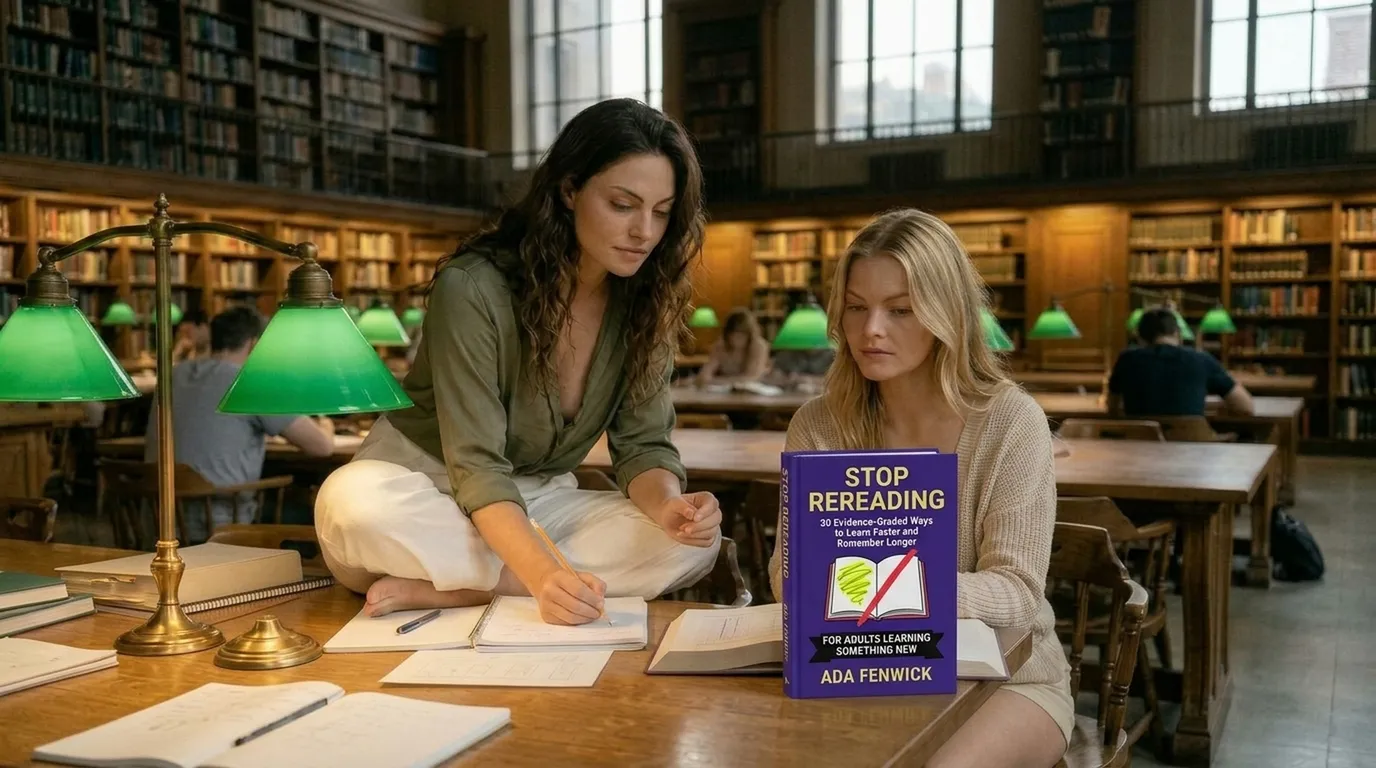
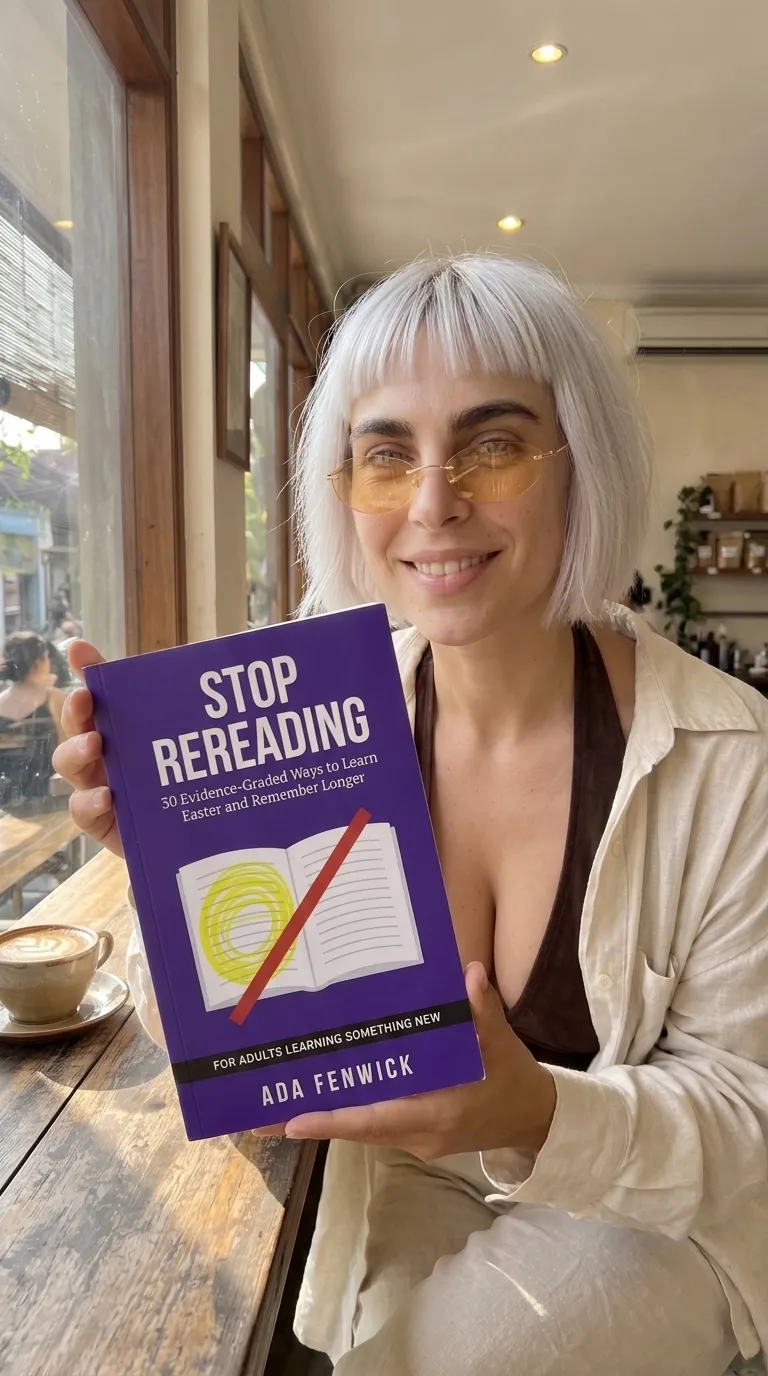
Stop Rereading
30 Evidence-Graded Ways to Learn Faster, Remember Longer, and Use What You Study, for Adults Learning Something New. By Ada Fenwick, 224 pages.
Where this problem is in the book:
- Use AI as a Coach, Not a Crutch
- Your Own Learning System
Links go to Amazon. ToolGenX publishes this book under a pen name and earns from every sale. Amazon sets the price and handles delivery and returns.
Is Stop Rereading the right book for you?
Yes, if
- You paste homework or practice problems into a chatbot when they look hard
- You understand the answer on the screen and cannot write it yourself later
- You want to keep using AI without it doing the learning
Skip it if
- You want a verdict that AI is good or bad for your brain in general
- You use AI at work to finish tasks, not to learn a skill you will need on your own
Fair doubts before you buy
If the AI explains it clearly, have I not learned it?
Understanding an answer while you look at it is a long way from producing your own. In the 2025 trial by Bastani and colleagues, students who copied chatbot solutions did not perceive any loss, yet scored 17 percent lower on the exam. Feeling productive is not a measure. A retry with no AI a few days later is.
Is this research not paid for by AI companies?
One study here is closely tied to one. Tamkin, a co-author of the 2026 coding study, works at Anthropic, the company that makes the Claude chatbot, and that study is a preprint. The larger 2025 trial by Bastani and colleagues was published in PNAS. The book names that tie so you can weigh it.
Get Stop Rereading
Thirty study tools for adults learning something new, each traced to its research and badged SOLID, PROMISING or STORY ONLY, from the Closed-Book Check to a weekly learning system.
Links go to Amazon. ToolGenX publishes this book under a pen name and earns from every sale. Amazon sets the price and handles delivery and returns.
This book is for general education about learning methods. It is not medical or psychological advice. If you have ongoing trouble with sleep, attention or memory, talk to a health care provider.
Questions people ask about this
- Does using ChatGPT make you dumber?
- No study shows AI lowers general intelligence. The randomized studies show something narrower: if AI does the practice for you, you learn less of that skill. Used for hints, the harm mostly goes away. In the trial authors' words: "These negative learning effects are largely mitigated by the safeguards in GPT Tutor."
- Did a brain scan study prove ChatGPT rots your brain?
- No. "Your Brain on ChatGPT" by Kosmyna and colleagues (2025) is a preprint, not peer reviewed. It started with 54 people, and only 18 finished the key fourth session. A formal comment by Stankovic and colleagues raised concerns about its sample size and analysis. It is a question worth studying, not a proven result.
- Can an AI tutor help you learn more?
- A carefully built one did, in one study. Kestin and colleagues (2025) found students in a university physics course learned more in less time with a custom AI tutor than in an active-learning class. It was one course, the tutor was built to guide rather than tell, and learning was tested soon after the lessons.
- How do I check if what the AI told me is right?
- Let your textbook or course notes decide what is correct. Paste the page you are studying and ask the AI to work only from it. Ask where each fact came from, then look it up. Run the code or plug in a simple case. Be extra careful with numbers, names and dates.
Related problems
- You studied it last night and it is gone today. Why that happens, and what fixes it
Read your notes three times and still blank on the first question? Familiar is not the same as remembered. Here is why, and a five-minute fix.
- Does having your phone nearby hurt studying? The brain drain study, checked again
A 2017 study said a silent phone on your desk drains your thinking. A careful 2022 repeat did not find it. Here is what does cost you when you study.
- Are learning styles real? What the research says about visual and auditory learners
Are you a visual learner? People have preferences, but teaching to a style has not held up. Here is what the research supports instead.
- A gift for an adult going back to school or studying for a big exam
Shopping for an adult student or someone facing a licensing exam? Give study tools with real evidence behind them, plus a few cheap extras and one offer.
- Everything inside Stop Rereading
Every chapter, who the book is for, and every problem it helps with.
// Also on this topic
- guideA gift for an adult learning an instrument or a new skill, beyond one more gadget
Shopping for a grown-up who just took up piano, guitar or pickleball? Give drills that show what works, plus an offer to be their first listener.
- guideIs the 10,000-hour rule true? What the violin study really found
The 10,000-hour rule came from one violin study and a best-known retelling. Here is what the hours really showed, and what predicts progress better.
- bookThe Practice Lab
30 Evidence-Graded Drills to Learn Any Skill Faster, Break Through Plateaus, and Make It Stick