Last updated
Is the 10,000-hour rule true? What the violin study really found

The night you did the division
Say you bought a used acoustic guitar the spring you turned 47. You keep a note on your phone. Every session goes in: the date, the minutes, the song.
Eight months in, the note says 140 hours. One night, after a rough session, you open the calculator. You divide 10,000 by 140 and multiply by eight months.
The answer is a number of years you do not want to say out loud.
Meanwhile, the same chord change in the same song still buzzes in the same spot. All those minutes, and the one thing you want to fix has not moved.
Here is the good news, and we mean it plainly. The 10,000 was never a rule. The column you have been so careful to fill in may be the one that tells you least.

Where 10,000 came from, and what the violinists actually logged
In 1993, Ericsson and two colleagues published a long paper on how experts get that way. The main study looked at 30 violin students at a music academy in Berlin. They fell into three groups: the best students, the good ones and students training to teach music.
The team worked out how many hours each player had practiced over the years. By age 18, the best violinists averaged 7,410 hours. The good ones averaged 5,301. The future teachers had 3,420.
So the best young players were well short of 10,000 at 18. The paper does use the phrase "10,000 h of deliberate practice extended over more than a decade." It describes experts. It does not set a line you cross.
Then came Gladwell's 2008 book Outliers. In his telling, 10,000 hours of practice makes you an expert. That version spread everywhere.
Ericsson pushed back. In a 2016 excerpt from his book Peak, written with Pool, he wrote that "there is nothing special or magical about ten thousand hours." He added that the figure for the best players at age twenty "was only an average." Half of the ten violinists in that group had not reached it.
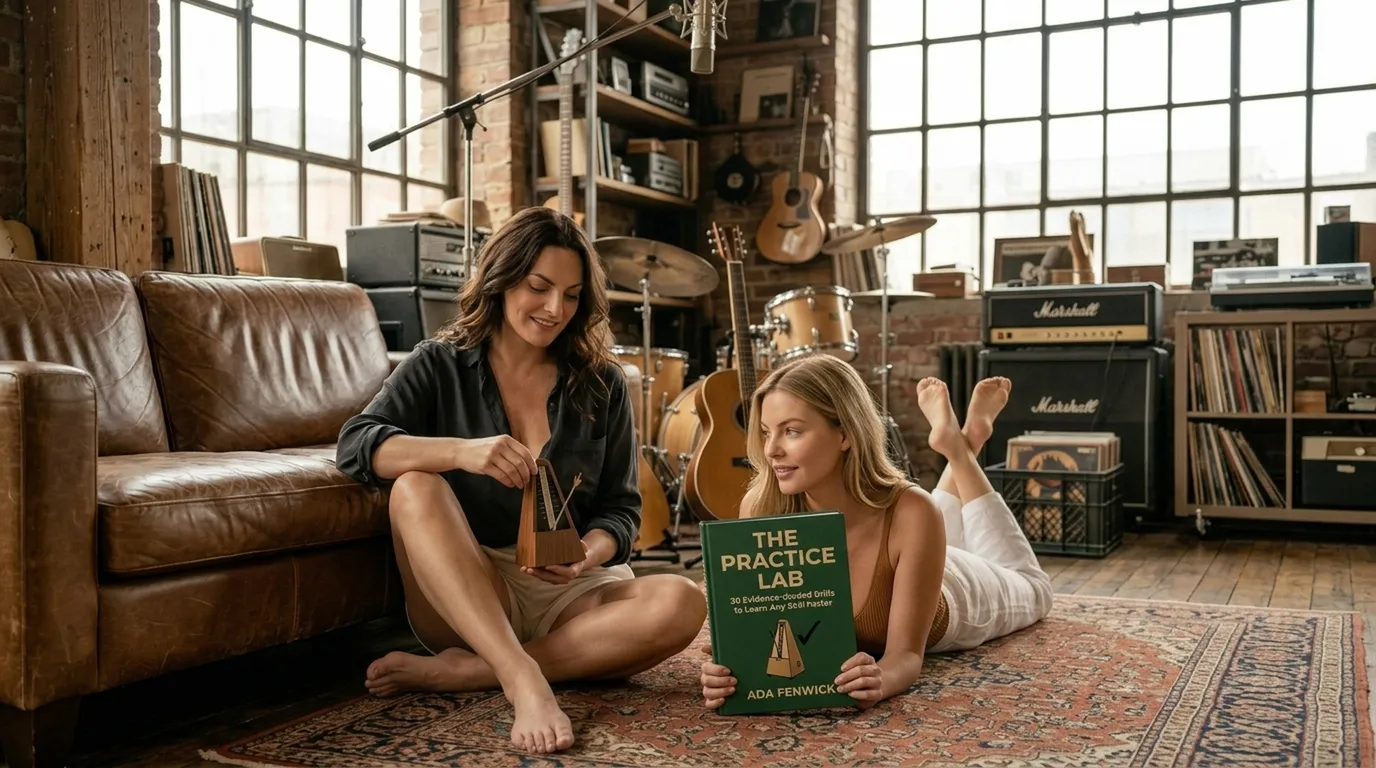
The study itself has been checked too. In 2019, Macnamara and Maitra re-ran the violin study with 39 violinists. They locked in their plan before the data came in. They "did not replicate the core finding" that practice hours lined up with each skill level. Practice alone explained 26 percent of the differences, compared with 48 percent in the original.
How much of the gap does practice explain?
A fair question follows. If the number is shaky, does practice matter at all?
It matters a lot. In 2014, Macnamara, Hambrick and Oswald pooled the research on deliberate practice across five areas. Here is how much of the difference between people practice explained:
- games: 26 percent
- music: 21 percent
- sports: 18 percent
- education: 4 percent
- professions: less than 1 percent
Their summary: "deliberate practice is important, but not as important as has been argued."
You may have seen the claim that practice explains "only 12 percent." The book traces that figure to a press release, not to the paper. It sticks to the per-area numbers, and so do we.
The fight did not end there. In 2019, Ericsson and Harwell argued that the 2014 analysis counted too many kinds of practice. With only studies that fit their stricter definition, practice explained 29 and 61 percent of the differences after a statistical correction. A 2014 music-only analysis by Platz and colleagues, pooling 13 studies and 788 musicians, also found a stronger link than 21 percent.
Much of the argument is about what counts as "deliberate" practice. You do not need to pick a side. Both camps agree on the part you control: how you practice matters, not only how long.
One more finding helps adult beginners. A review of sports studies found that highly skilled athletes "did not begin their sport earlier in childhood" than others. A late start is not a closed door.
Count clean attempts, not minutes
What does "how" look like? A small study of pianists gives a clear picture.
In 2009, Duke, Simmons and Cash gave 17 advanced piano students a hard three-bar passage by Shostakovich. The next day, they played it again. How well they played had no significant link to how long they practiced, or how many times they played it through. What went with good results was the share of attempts that came out right.
The authors wrote that strategies "were more determinative of performance quality at retention than was how much or how long the pianists practiced." It is 17 people and one passage, and it shows a link, not proof of cause. Still, it points straight at the hours column. That was the one that predicted least.
This is where The Practice Lab starts. Its first chapter, The 10,000-Hour Story, Checked, walks through every number above. Then it hands you two drills.
The Practice Audit (PROMISING) takes three minutes a session. You write one task before you start, like "bars 9 to 16, hands together." You make a tally mark per attempt and circle the clean ones. You write the minutes last, if at all. Once a week, any task whose clean count is not moving goes to the top of next week's list.
Find the Edge (PROMISING) keeps each task at the right difficulty. Do five attempts. If all five are clean, make it one notch harder. If one or none is clean, make it easier. In between, stay put. The book is honest that the five-attempt cutoffs are a rule of thumb. It also notes that the popular "85 percent success" figure came from a computer model of learning algorithms, not from people practicing a skill.
If you want the whole picture first, How to Use This Lab explains the three badges. Of the 30 drills, 5 are SOLID, 23 are PROMISING and 2 are STORY ONLY.
Counting clean attempts raises a harder problem, though. A clean attempt at the end of a session can still be gone by morning. Our page on practicing it perfectly and then messing it up covers that next.
The book for this problem
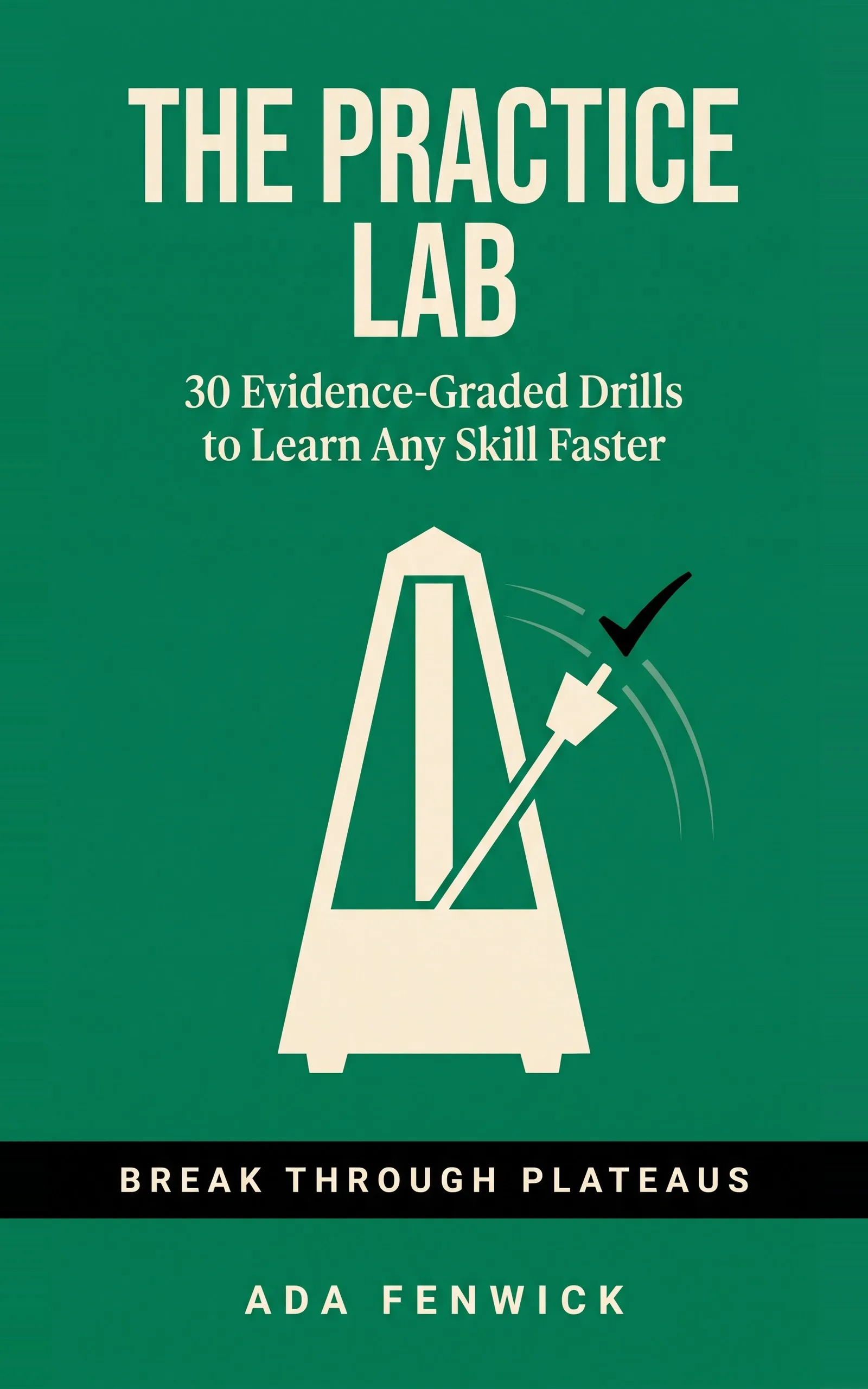
The Practice Lab
30 Evidence-Graded Drills to Learn Any Skill Faster, Break Through Plateaus, and Make It Stick. By Ada Fenwick, 225 pages.
Where this problem is in the book:
- The 10,000-Hour Story, Checked
- How to Use This Lab
Links go to Amazon. ToolGenX publishes this book under a pen name and earns from every sale. Amazon sets the price and handles delivery and returns.

Is The Practice Lab the right book for you?
Yes, if
- You keep a log of practice hours and the total feels hopeless
- You have read that talent is a myth, or that it is everything, and want the numbers
- You want a way to tell whether your practice time is working
Skip it if
- You want proof that anyone can become world class with enough hours
- You are studying facts for an exam (the companion book Stop Rereading covers that)
Fair doubts before you buy
If the number is wrong, doesn't that mean practice doesn't matter much?
No. Even the researchers most skeptical of the rule call practice important. In their 2014 analysis it explained 26 percent of the differences in games, 21 percent in music and 18 percent in sports. That is a large share for one thing you control. It just is not the whole story.
Is the book just against Ericsson?
No. The book gives both sides. Ericsson and Harwell argued in 2019 that a stricter definition of practice explains far more, 29 and 61 percent after a correction. The other camp says the definition keeps shifting. On the part that matters for you, both agree: how you practice counts, not only how long.
Get The Practice Lab
Thirty practice drills for adults learning a skill, each traced to its research and badged SOLID, PROMISING or STORY ONLY, from the Next-Day Test to shaking off the rust.
Links go to Amazon. ToolGenX publishes this book under a pen name and earns from every sale. Amazon sets the price and handles delivery and returns.
This book is for general education about practice methods. It is not medical, physical therapy or coaching advice. If practice hurts, stop and see a qualified professional.
Questions people ask about this
- Where did the 10,000-hour rule come from?
- From a 1993 paper by Ericsson and two colleagues on violin students at a music academy in Berlin. The paper described experts as having about 10,000 hours of deliberate practice over more than a decade. Malcolm Gladwell turned that into the "10,000-hour rule" in his 2008 book Outliers.
- How many hours did the best violinists actually have?
- By age 18, the best students averaged 7,410 hours, the good students 5,301 and the future music teachers 3,420. Ericsson and Pool later pointed out that the figure at age 20 was only an average, and that half of the best group had not reached 10,000 hours at that age.
- Did the violin study replicate?
- Not fully. In 2019, Macnamara and Maitra re-ran it with 39 violinists and a plan locked in before the data came in. They did not replicate the core finding that practice hours lined up with each skill level. Practice alone explained 26 percent of the differences, down from 48 percent in the original.
- Is it too late to get good if I start as an adult?
- Starting late does not rule you out. A review of sports studies found that highly skilled athletes did not begin their sport earlier in childhood than others. And in the pianist study, what predicted next-day playing was how the practice went, which you can change at any age.
- What predicts progress better than hours?
- In a 2009 study by Duke and colleagues, 17 advanced pianists practiced a hard passage and played it again the next day. Time spent and number of run-throughs had no clear link to the result. The share of attempts that came out right did. It is a small study, but it points at a better number to track.
Related problems
- How long should a practice session be, and how often should you practice?
No study backs 20 or 45 minutes. The evidence points to about an hour or less per sitting, most days, rather than one long weekend session.
- You had it perfect last night. Why did it fall apart when it counted?
You played it clean ten times last night and lost it today. The research on practice versus learning explains why, and a three-minute check fixes it.
- Too old to learn an instrument or a sport at 50, 60 or 70? What the studies say
A 2008 review found older adults keep the ability to learn new movement skills. Here is what does change with age, and how to adjust your practice.
- Everything inside The Practice Lab
Every chapter, who the book is for, and every problem it helps with.
// Also on this topic
- guideHow to use ChatGPT to study without letting it do the learning for you
In a trial with nearly 1,000 students, a plain chatbot raised practice scores and lowered exam scores. Here is how to use AI for hints, not answers.
- guideHow far apart to space your study sessions, based on when the test is
The best gap between reviews grows with the time until your test: about 1 to 3 days for next week, 3 to 5 weeks for next year. Here is the rule.
- bookStop Rereading
30 Evidence-Graded Ways to Learn Faster, Remember Longer, and Use What You Study, for Adults Learning Something New