Last updated
You feel dumber, or less sure of yourself, since you started relying on AI. You are not imagining it.

It is 6pm and you cannot remember the last thing you decided
You close the laptop. It was a busy day. Emails went out, a proposal got sent, a client said thanks.
Then a small question shows up. When did you last really decide something? Not approve. Decide. You sit there and you cannot find it.
You used to look at a messy problem and feel your way to an answer. Now you type it in, read the reply and think "yes, fine, send." It works. That is the strange part.
Nobody else can tell. The work looks good. But you feel like a guest in your own chair.

Why "just trust yourself more" does not help
The usual advice is to have more confidence. Believe in your own thinking. Take breaks from screens.
None of that touches the cause. You are not low on self-belief. You are low on practice. Confidence in your judgment came from using it, over and over, being right or wrong and adjusting. When the AI answers first every time, you skip the step where your own answer forms.
There is a second trap. Offloading feels good. The work goes out faster and the client says thanks. Skip the gym and your body tells you. Skip thinking and the feedback is positive. So nothing tells you to stop.
The book puts it in one line, and I agree with it. You do not disappear into a bad tool, because a bad tool fights you. You disappear into a good one.

What the research does and does not say
A 2025 study in the journal Societies asked 666 people about their AI use and tested their critical thinking. Frequent AI use was linked with lower scores, and the link ran through cognitive offloading, the habit of handing your thinking to the tool (Gerlich, Societies).
Read the word "linked" slowly. This is a link at one point in time, based partly on what people said about themselves. It does not prove AI causes the drop. The book is careful about this, and so should you be.
Here is why it still matters. Judgment is the thing that tells you when AI is wrong, and AI is sometimes wrong in a calm, sure voice. In a study of 758 consultants, people using AI on a task just past its range were about 19% less likely to get it right than people working alone (Dell'Acqua et al., Organization Science). The more you lean on the tool, the duller the one sense you need to catch that.
What about the MIT "Your Brain on ChatGPT" study?
If you searched this feeling, you have probably seen headlines about an MIT study. Here is what it did, in plain terms.
Researchers at the MIT Media Lab had 54 people write essays while their brain activity was measured with EEG (Kosmyna et al., arXiv). One group used ChatGPT, one used a search engine and one used no tools. The ChatGPT group showed the weakest brain connection patterns. They also had trouble quoting from essays they had just written, and felt the least ownership of them. The authors call this "cognitive debt."
Two cautions. It is a preprint, which means it was posted before full peer review, and it is small. Only 18 people did the last session. So treat it as a warning sign, not settled science. The book does not build on it for that reason. It leans on the larger survey of 666 people above.
One detail in it fits this page well. In that last session, people who had first written on their own and then switched to ChatGPT did better on recall than those who had used ChatGPT from the start. Thinking first, then using the tool, is the same order this page suggests.
Do your own thinking first, a few times a week
The shift is small. On calls that matter, take thirty seconds to write your own rough answer before you read the AI's. Where do you think this lands? What would you do?
Then read the AI's answer. Now you are comparing two views instead of taking one. When they agree, you go ahead with more confidence. When they do not, you have found something worth checking.
You cannot do this after you read the AI's reply. Its answer fills the space where yours would have formed. So the order matters.
The book adds one more habit. Once a week, pick one real decision and do it the long way, with the AI off until you have your own answer. It compares this to a pilot who flies by hand now and then, so the autopilot is not the only thing that knows how. Jonah did this and felt his old instinct come back, stiff at first, then strong. He did not use AI less after that. He used it more, and he was in charge of it again.
The book written for this feeling
This is the problem AI Won't Run Your Business. You Will. was written for.
The Jagged Edge: Knowing When the Confident Machine Is Wrong explains why judgment rusts when you stop using it, and gives you three habits to keep it sharp while still using AI for most of your work.
The Person You Become: Don't Disappear Into the Tools is the chapter for the guest-in-your-own-chair feeling. It ends with the Agency Audit, three lines that show where you are still deciding and where you have slipped into approving without thinking.
The free Judgment Workbook has the Hand-on-the-Wheel Check, five questions scored 0 to 3. Your lowest score tells you which chapter to read first. If doubt is the part that feels worst, see using ChatGPT to calm business doubt.
The book for this problem
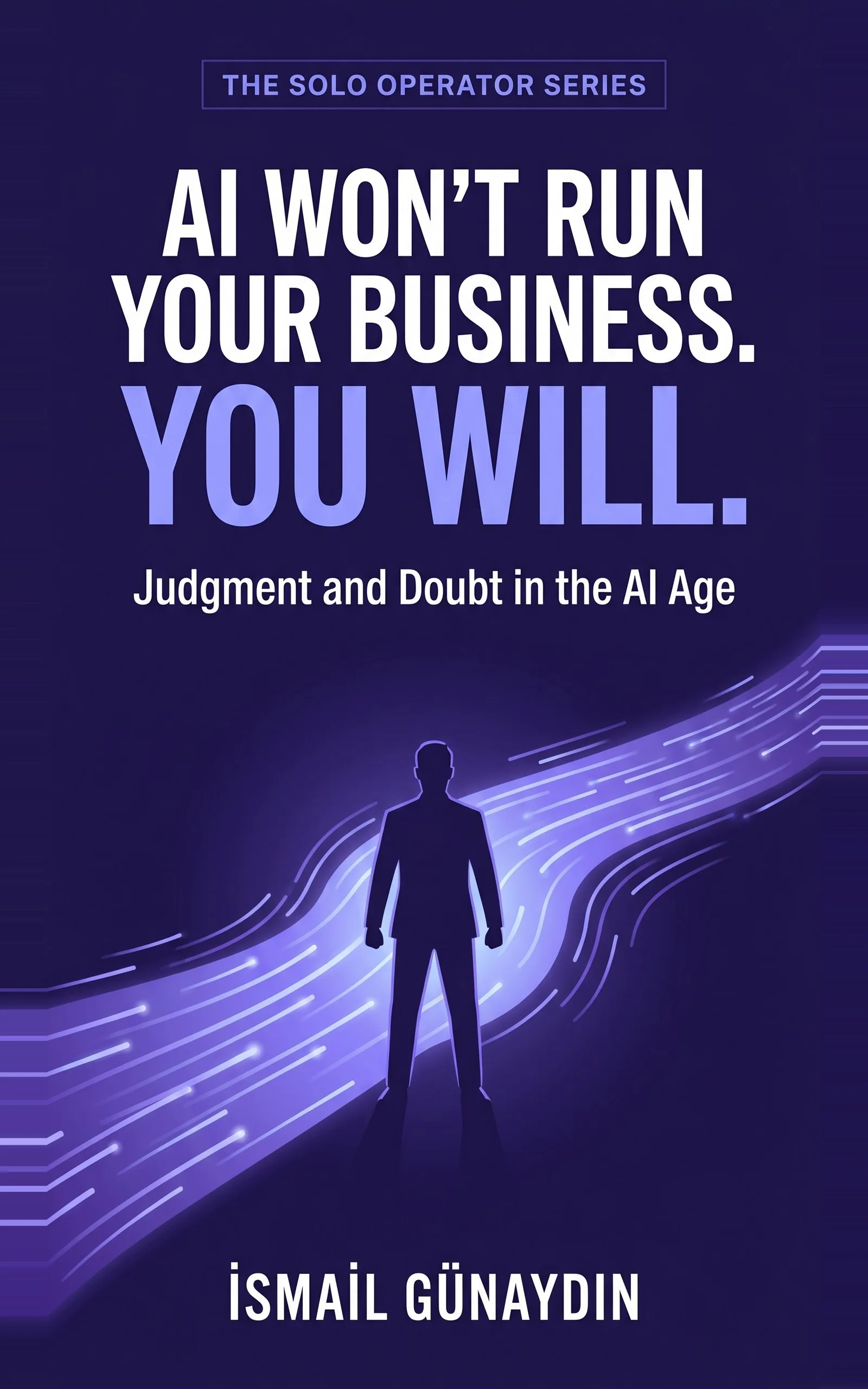
AI Won't Run Your Business. You Will.
Judgment and Doubt in the AI Age. By İsmail Günaydın, 60 pages.
Where this problem is in the book:
- The Jagged Edge: Knowing When the Confident Machine Is Wrong
- The Person You Become: Don't Disappear Into the Tools
Links go to Amazon. I wrote this book and earn a royalty on every sale. Amazon sets the price and handles delivery and returns.
Is AI Won't Run Your Business. You Will. the right book for you?
Yes, if
- You catch yourself asking ChatGPT before you have even thought about the question
- You feel less sure of your own read than you did a year ago
- Your work looks fine but you feel like a guest in it
Skip it if
- You want medical or mental health advice (the book is not that)
- You want to be told to stop using AI
Fair doubts before you buy
Isn't this just a moral panic about new tech?
The book is careful here. It says the main study shows a link, not a cause, and it does not claim AI rots your brain. Its point is smaller and harder to argue with. A skill you stop practicing gets rusty. You already know this from phone numbers and driving routes.
I have read articles about this. Why a book?
Articles tell you the problem exists. The book gives you sheets to fill. One is a quick check of where you have handed things over. Another is a 30-day practice of five small daily reps. The point is to rebuild the habit, not just to worry about it.
Get AI Won't Run Your Business. You Will.
AI is right often enough that you stop checking; five human jobs keep your hand on the wheel when it is confidently wrong.
Links go to Amazon. I wrote this book and earn a royalty on every sale. Amazon sets the price and handles delivery and returns.
Part of The Solo Operator Series, five short books that can be read in any order.
Questions people ask about this
- Does using ChatGPT make you dumber?
- The research does not show that it causes it. A 2025 study of 666 people found frequent AI use was linked with lower critical thinking scores, mostly through handing your thinking to the tool. People who already think less critically may simply use AI more. The honest reading is that heavy offloading and weaker thinking travel together.
- What is cognitive offloading?
- It means handing a mental job to something outside your head. Saving phone numbers in your phone is offloading. With AI, it is letting the tool form the judgment and you just forward it. A little is fine. A lot, every day, means the skill you stopped using gets weaker.
- How do I stop relying on AI so much?
- You do not have to use it less. The book's main character ended up using AI more than ever. What changed was who decided. Start by forming your own rough answer before you read the AI's on calls that matter. Then compare the two.
- Why do I feel less confident at work since using AI?
- Often because you have stopped doing the part that built your confidence: looking at a hard problem and reaching your own answer. When the AI always answers first, you skip that step. The confidence came from the reps, and the reps stopped.
- Can I get my critical thinking back after using AI a lot?
- The book says yes, through practice, not quitting. In it, Jonah began forming his own read first a few times a week, and he felt the old instinct come back. Judgment is kept by using it, the way a language is.
- Should I stop using ChatGPT so I do not lose my edge?
- The book says no. Quitting throws away a useful tool and does not fix the real cause, which is skipping your own thinking. Keep using it, but on calls that matter, form your own rough answer first. Once a week, do one real decision with the AI off until you have your own view. Then use the AI to check and improve it.
Related problems
- Automation bias explained simply: why you go along with the AI even when you know better
Automation bias is the pull to follow a confident tool over your own facts. The two errors it causes, why it gets worse with AI, and what cuts it.
- Can I trust ChatGPT for business decisions, or only for advice?
ChatGPT is a great advisor and a risky decider. See the difference side by side, and the four-line check that keeps the decision yours.
- You keep asking ChatGPT if a business decision is right, just to make the doubt stop
Using AI to quiet a bad feeling about a decision can erase a real warning. How to tell a warning from tiredness or fear before you ask.
- Everything inside AI Won't Run Your Business. You Will.
Every chapter, who the book is for, and every problem it helps with.