Last updated
Are learning styles real? What the research says about visual and auditory learners

The quiz that told you how you learn
Picture a man in his forties signing up for a night class in accounting. On the first evening the instructor hands out a short quiz. Twenty questions later, he has a label: visual learner.
It feels like a key. It explains why lectures always slid off him. So he skips the reading, hunts for videos and color-codes every page. Five weeks in, he still freezes on the practice problems.
Many adults carry a label like this from school or a work training day. It is worth asking whether it holds up, because it decides which methods you try and which you skip.

What the big review found
The idea behind learning styles has two parts. First, people differ in how they like to take in information. Second, they learn best when teaching matches that liking. The second part is called the matching idea, and it is the part that matters for how you study.
Think about what a fair test of that would look like. You would sort people by style, teach some of each group one way and some the other, then compare. If the matching idea were right, each group would do best with its own method.
In 2008, a team of four researchers led by Pashler reviewed the evidence on learning styles.
Their verdict was blunt. They found "no adequate evidence base to justify incorporating learning-styles assessments into general educational practice." You can read the review by Pashler and colleagues yourself.
The book sums it up with care. People do have preferences, and they differ in abilities. Several studies with a proper design flatly contradict the matching idea. Many versions of learning styles have never been tested at all. So the honest answer is not "you have no style." It is "teaching to your style has not been shown to help."
What does hold up: match the method to the material
Here is the part we find more useful. Some methods help nearly everyone, and the right one depends on what you are learning.
Pictures and words together are a good example. Mayer studies how people learn from lessons. In his book Multimedia Learning (2009), his multimedia principle is simple: "People learn better from words and pictures than from words alone." He reported that this held in eleven out of eleven tests, with a median effect of d = 1.39. Those tests were about learners in general, not a group with a "visual" label. Mayer also noted it may apply more strongly to people new to a topic.
Timing matters too. In a 1991 study by Mayer and Anderson, people learned how a bicycle pump works. Some got the spoken words and the animation together. Others heard the words first and saw the pictures after. The together group did better on tests of creative problem solving. That study tested a dual-coding idea from Paivio: memory uses both a word code and an image code. The book points out that dual coding says nothing about some people being visual learners.
Not every kind of picture helps. Forming images in your head while you read was rated low in usefulness in the 2013 review by Dunlosky and colleagues. Drawing is better supported. For single words, drawing reliably helped memory in seven experiments by Wammes, Meade and Fernandes (2016). For real course material, Fiorella and Zhang (2018) found drawing beat reading alone, with mixed results against other active methods.
Another popular chart is worth naming here. The "learning pyramid" says we remember 10 percent of what we read and 90 percent of what we teach. Letrud and Hernes (2018) traced its history and found versions going back more than 160 years. They concluded that "the models did not originate from empirical research."

Two tools to use instead of a style quiz
The chapter Examples, Pictures and Words Together in Stop Rereading gives two tools that fit the material, not the learner.
Three Examples Rule (PROMISING) is for a definition you can recite but miss in a real question. Find three examples that look different on the surface. Put them side by side and write one sentence on what they share. Add one example of the neighbor idea you keep confusing it with. Only then read the textbook definition. The badge rests on Rawson, Thomas and Jacoby (2015), where examples beat extra study of definitions. It also draws on a review by Alfieri and colleagues (2013) of learning by comparing cases. The number three is the book's rule of thumb, which is why it is PROMISING.
Draw It, Then Say It (PROMISING) is for an idea with parts or steps. Close the book and draw it as boxes and arrows in three minutes. Explain the drawing out loud. Then open the book, compare and fix it in a second color. Redraw it from memory the next day.
Reading So It Sticks covers the learning pyramid and a better way to read a chapter: questions before pages, then one paragraph of recall.
Back to the man in the accounting class. He does not need a new label. He needs to work the practice problems with the book closed, then check. For that, our page on why you cannot remember what you study is the next step.
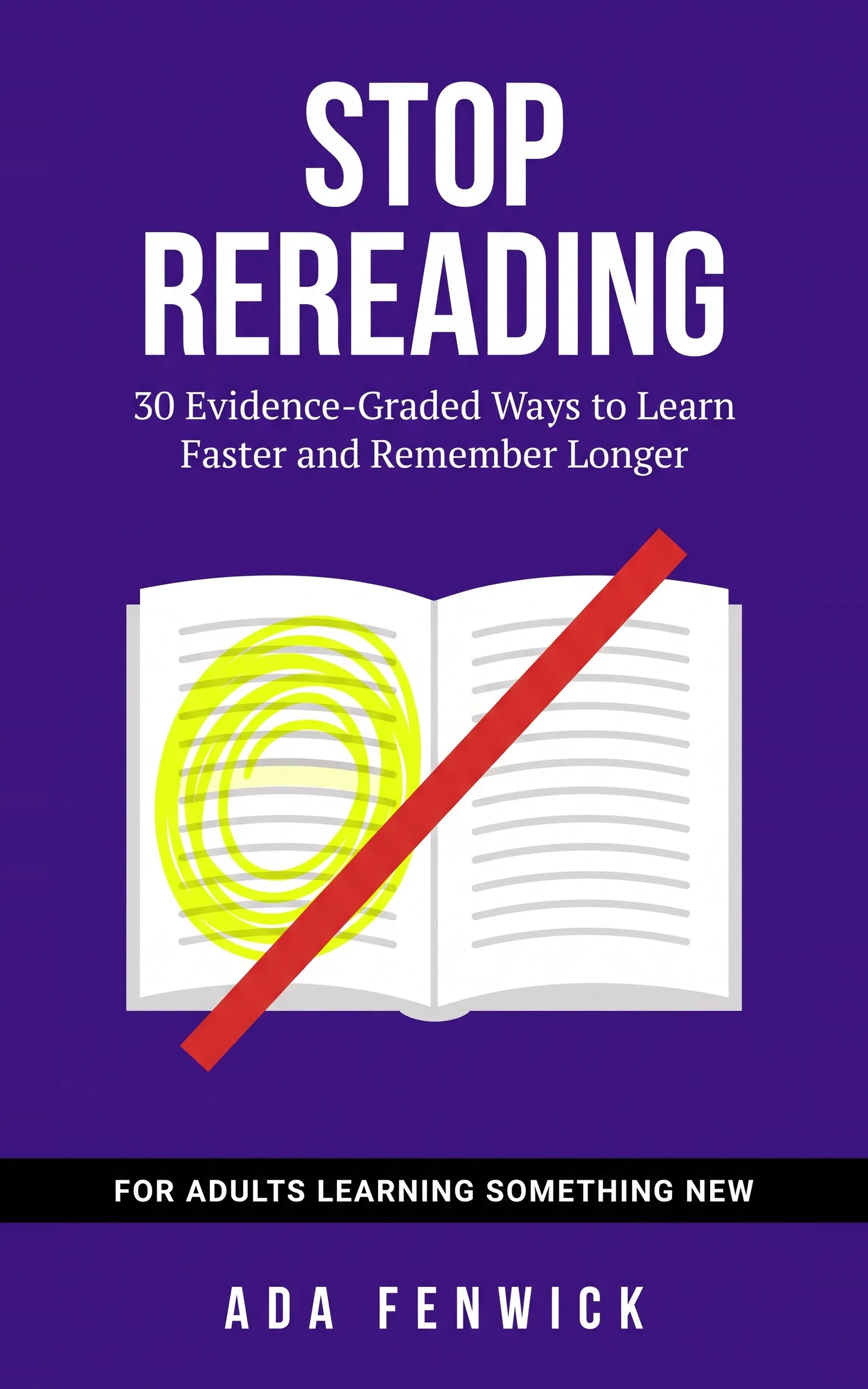
The book for this problem
Stop Rereading
30 Evidence-Graded Ways to Learn Faster, Remember Longer, and Use What You Study, for Adults Learning Something New. By Ada Fenwick, 224 pages.
Where this problem is in the book:
- Examples, Pictures and Words Together: Making an Abstract Idea Concrete
- Reading So It Sticks
Links go to Amazon. ToolGenX publishes this book under a pen name and earns from every sale. Amazon sets the price and handles delivery and returns.

Is Stop Rereading the right book for you?
Yes, if
- A quiz once told you that you are a visual, auditory or hands-on learner
- You avoid some study methods because they do not suit your style
- You want to know what the research supports instead
Skip it if
- You are looking for a learning-styles test
- You want to learn a skill you do with your hands, voice or body (the companion book The Practice Lab covers that)
Fair doubts before you buy
But I really do like pictures better than reading. Is that not a style?
It is a preference, and it is real. The open question was never whether people have likes. It was whether teaching to those likes makes them learn more. The 2008 review by Pashler and colleagues found no good evidence that it does. Liking pictures is a fine reason to add pictures. It is not a reason to drop words.
So pictures do not help at all?
They often help. Mayer found people learn better from words and pictures together than from words alone, in eleven out of eleven tests. That finding is about learners in general, not a group with a "visual" label.
Get Stop Rereading
Thirty study tools for adults learning something new, each traced to its research and badged SOLID, PROMISING or STORY ONLY, from the Closed-Book Check to a weekly learning system.
Links go to Amazon. ToolGenX publishes this book under a pen name and earns from every sale. Amazon sets the price and handles delivery and returns.
This book is for general education about learning methods. It is not medical or psychological advice. If you have ongoing trouble with sleep, attention or memory, talk to a health care provider.

Questions people ask about this
- Are learning styles a myth?
- The matching idea is, as far as the evidence goes. A 2008 review by Pashler and colleagues found no adequate evidence base for using learning-styles tests in general teaching. People still have real preferences, and they differ in abilities.
- What is the matching idea?
- It is the claim that you learn best when teaching fits your style: pictures for visual learners, talk for auditory learners. Testing it needs a careful design. Several studies that used one flatly contradict it, and many versions of learning styles have never been tested.
- What should I do instead of studying to my style?
- Match the method to the material. Use a diagram for a process with parts, words for an argument and examples for an abstract idea. Then test yourself on it with the book closed, since recall practice helps across the board.
- Is the learning pyramid true, that we remember 90 percent of what we teach?
- No. Letrud and Hernes (2018) traced versions of that chart back more than 160 years. Their verdict: "These findings demonstrate that the models did not originate from empirical research." How much you keep depends on what you do with the page, not a fixed percentage.
- Does picturing things in your head help you learn?
- Less than people hope. The 2013 review of study methods by Dunlosky and colleagues rated imagery for text learning low. Dunlosky wrote that its benefits are "limited to imagery-friendly text." Pictures on paper, given or drawn, have better evidence than pictures you only imagine.
Related problems
- Taking notes by hand or on a laptop: what the repeat studies found
The famous laptop note-taking study did not hold up when it was repeated. Here is what the newer studies found, and what matters more than the pen.
- You studied it last night and it is gone today. Why that happens, and what fixes it
Read your notes three times and still blank on the first question? Familiar is not the same as remembered. Here is why, and a five-minute fix.
- How to use ChatGPT to study without letting it do the learning for you
In a trial with nearly 1,000 students, a plain chatbot raised practice scores and lowered exam scores. Here is how to use AI for hints, not answers.
- A gift for an adult going back to school or studying for a big exam
Shopping for an adult student or someone facing a licensing exam? Give study tools with real evidence behind them, plus a few cheap extras and one offer.
- Everything inside Stop Rereading
Every chapter, who the book is for, and every problem it helps with.
// Also on this topic
- guideA gift for an adult learning an instrument or a new skill, beyond one more gadget
Shopping for a grown-up who just took up piano, guitar or pickleball? Give drills that show what works, plus an offer to be their first listener.
- guideYou had it perfect last night. Why did it fall apart when it counted?
You played it clean ten times last night and lost it today. The research on practice versus learning explains why, and a three-minute check fixes it.
- bookThe Practice Lab
30 Evidence-Graded Drills to Learn Any Skill Faster, Break Through Plateaus, and Make It Stick