Last updated
A gift for an adult learning an instrument or a new skill, beyond one more gadget

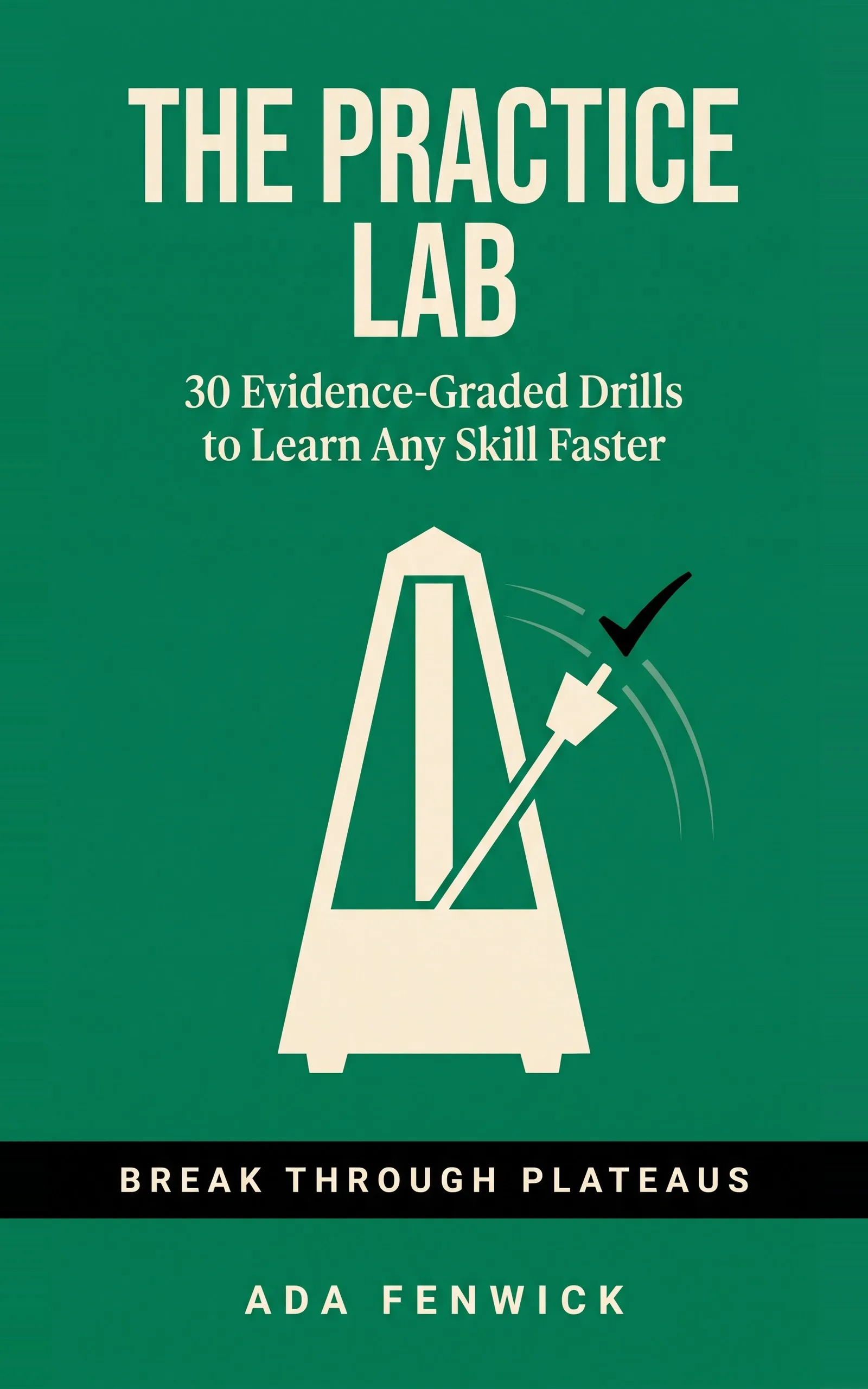
The book for this problem
The Practice Lab
30 Evidence-Graded Drills to Learn Any Skill Faster, Break Through Plateaus, and Make It Stick. By Ada Fenwick, 225 pages.
Where this problem is in the book:
- How to Use This Lab
- Practice Is Not Performance
- Short Sessions, Spread Out
- Practice Plans
Links go to Amazon. ToolGenX publishes this book under a pen name and earns from every sale. Amazon sets the price and handles delivery and returns.
The short version of this gift
- Give drills, not more gear. They likely have the instrument. Give them a way to tell whether their practice is working.
- Write one line inside. Something like: "For every night you sit down and practice anyway. Can't wait to hear the next run-through."
- Offer to be the listener. Once before their next lesson, recital or match, hear one full run-through with no restarts.
- Then stay quiet. No grading, no tips, no asking how many hours they put in this week.
That is the whole gift. The book does the rest.
The keyboard in the spare room
You know the scene. Your partner bought a keyboard last winter. Most nights after dinner you hear the same eight bars from down the hall, over and over.
Some nights it sounds better. Some nights it sounds worse, and the bench scrapes back early. They keep a note of practice minutes on their phone. Once they told you, half joking, that at this rate they would be good by age 100.
You cannot practice for them. You can hand them something better to do with the next twenty minutes.

Why a drill book helps more than another accessory
Most practice advice comes as slogans: put in 10,000 hours, practice makes perfect. The Practice Lab checks those slogans against the research. The hours story is weaker than people think. In a 2014 analysis by Macnamara and colleagues, practice explained 21 percent of the differences between people in music and 18 percent in sports. It matters a lot, and how you practice matters as much as how long.
The book gives 30 drills, each with an honest badge: 5 SOLID, 23 PROMISING and 2 STORY ONLY. We like that it does not hide the PROMISING count. Several famous findings shrank when better studies came in, and each chapter says which.
Three drills tend to help a stuck adult learner fast:
- The Next-Day Test (SOLID). Before any warm-up, play yesterday's task cold and score the first try. A 2015 review by Soderstrom and Bjork found practice performance "often an unreliable index" of learning, so this check shows what actually stuck.
- The Practice Week Map (SOLID). Split the same weekly time into short sessions on separate days. In a 2025 review of surgical training, 15 of 19 direct comparisons favored spreading practice out, and none favored one long block.
- Watch a Model, Then Try (SOLID). Watch one short clip of the exact skill, then try a few reps right away. For adults, watching mostly improved form before results.
There is one honest line for older learners too. The book cites a 2008 review by Voelcker-Rehage that found older adults' "learning capabilities remain intact." Gains on fine finger work may be smaller, and smaller is not zero.

What they will find inside
This is the problem The Practice Lab was written for. Ada Fenwick wrote it for adults picking up a skill, or coming back to one, on top of a full life.
How to Use This Lab explains the badges and gives a fast path: four chapters that hold all five SOLID drills. It also sets the one safety rule. Pain is not part of the method. Stop and ask a professional.
Practice Is Not Performance has the Next-Day Test and a drill for splitting practice days from show days. Your offer to listen fits right into its dress rehearsal step.
Short Sessions, Spread Out turns one long weekend sitting into a week of short ones.
Practice Plans gives four sample four-week plans, for an instrument, a sport, a spoken language and drawing, with Practice Log pages after them. The book says plainly that nobody has tested those exact plans. They are a starting template.
If they are studying facts for a course as well, the companion book Stop Rereading covers memory and study. And if they keep asking whether they started too late, send them our page on being too old to learn an instrument.
Is The Practice Lab the right book for you?
Yes, if
- Someone you love took up piano, guitar, golf or pickleball as an adult
- They practice a lot and say they feel stuck
- You want a gift they will use with a pen, not one more accessory
Skip it if
- They are a child taking lessons (the book is written for adults)
- They are studying for an exam or memorizing facts (the companion book Stop Rereading fits better)
Fair doubts before you buy
Will a practice book feel like criticism of how they practice?
It can if it comes with a lecture. It lands better with a note about how much you admire them starting at all. The book is kind on this point. Its first scene is an adult whose drum fill falls apart at rehearsal, and it says plainly that she did not lose it because of her age.
Is the paperback good as a gift?
Yes. Each drill has a few lines to fill in, and the back has Practice Log pages for a week plan, next-day tests, film notes and a four-week review. In the Kindle edition they would copy the fields into a notebook instead.
Get The Practice Lab
Thirty practice drills for adults learning a skill, each traced to its research and badged SOLID, PROMISING or STORY ONLY, from the Next-Day Test to shaking off the rust.
Links go to Amazon. ToolGenX publishes this book under a pen name and earns from every sale. Amazon sets the price and handles delivery and returns.
This book is for general education about practice methods. It is not medical, physical therapy or coaching advice. If practice hurts, stop and see a qualified professional.

Questions people ask about this
- What do you get an adult who is learning an instrument?
- Something that helps them practice better. Most adult learners already own the instrument. A book of short, evidence-graded drills and a sample month-long plan gives them a way to see what is working. Pair it with your time as a listener.
- What is a good gift for someone taking up a sport later in life?
- The same idea works for pickleball, golf or tennis. The book has a sample four-week sport plan built on short sessions, mixing shots once they work and watching a model. A small offer, like being their filming partner once a week, adds a lot.
- How can I support a partner who is learning an instrument?
- Be a listener, not a judge. Offer to hear one full run-through before a lesson or recital, with no restarts. A 2021 analysis the book cites found practice under simulated pressure helped later performance under pressure. Do not grade it. Just listen and say thanks.
- Is it too late for them to learn at 50 or 60?
- No. The book cites a 2008 review that found older adults keep their ability to learn new movement skills, even though gains on fine finger work may be smaller. Smaller is not zero.
Related problems
- Too old to learn an instrument or a sport at 50, 60 or 70? What the studies say
A 2008 review found older adults keep the ability to learn new movement skills. Here is what does change with age, and how to adjust your practice.
- How long should a practice session be, and how often should you practice?
No study backs 20 or 45 minutes. The evidence points to about an hour or less per sitting, most days, rather than one long weekend session.
- Does practicing in your head work? What three reviews of mental practice found
Mental practice helps a skill, but less than real practice. Three reviews over 27 years agree on a small to medium effect, best added to real reps.
- Everything inside The Practice Lab
Every chapter, who the book is for, and every problem it helps with.
// Also on this topic
- guideA gift for an adult going back to school or studying for a big exam
Shopping for an adult student or someone facing a licensing exam? Give study tools with real evidence behind them, plus a few cheap extras and one offer.
- guideAre learning styles real? What the research says about visual and auditory learners
Are you a visual learner? People have preferences, but teaching to a style has not held up. Here is what the research supports instead.
- bookStop Rereading
30 Evidence-Graded Ways to Learn Faster, Remember Longer, and Use What You Study, for Adults Learning Something New