Last updated
Does having your phone nearby hurt studying? The brain drain study, checked again

An hour at the table, and one buzz after another
Picture a man training to be an electrician, with a licensing exam in nine weeks. He gets home after ten hours on a job site and opens the code book at the kitchen table. His phone lies face down next to it.
It buzzes. The group chat is arguing about a game. He answers once, then twice, then watches a short video someone sent. When he gets back to the page, he reads the same paragraph again.
An hour later he closes the book. He was at the table the whole time. He could not tell you one rule without opening it.
Two small choices shape every study session like this one. Where is the phone? And what do you do in the ten minutes after you stop? One of them has better evidence than you might expect. The other has worse evidence than the headlines claimed.

The 2017 brain drain study, and the 2022 repeat
You may have heard that a phone nearby makes you think less clearly, even when it is silent. That idea comes mostly from one paper.
In 2017, Ward and three colleagues ran two experiments on what they called "brain drain." In the second, people did tests of working memory and attention. Their phone sat on the desk, in a pocket or bag, or in another room. The authors reported that "the mere presence of these devices reduces available cognitive capacity." They said the cost was highest for people who depended most on their phones.
In 2022, Ruiz Pardo and Minda ran a direct repeat of that second experiment. It was preregistered, which means they published their plan before collecting data, so they could not tweak the analysis later. They used the same phone locations. Their verdict: "the 'brain drain' effect did not replicate."
A 2020 study by Hartmann and colleagues tested a phone on the desk against short-term memory. It also tested remembering to do something later. They "found no overall effect of smartphone presence."
So here is where it stands. One 2017 study found an effect of a phone just being there. A careful repeat in 2022 did not.
What does cost you: picking it up
The finding that holds up matters more than the headline did.
Glass and Kang (2019) ran their study in a real college course. In half the lectures, students could use laptops and phones. In the other half, they could not. The same students sat through both kinds, which makes the comparison fair.
On quick quiz questions during class, devices made no difference. Students seemed to follow fine. The cost showed up later, on the unit exams and the final. Divided attention "reduced long-term retention of the classroom lecture." And scores were lower for material from device lectures "both for students who did and did not use electronic devices during that class."
An earlier lab study points the same way. In a simulated classroom, Sana, Weston and Cepeda (2013) found that students who multitasked on a laptop scored lower on a later test. So did students who could simply see a multitasking classmate.
Notice the shape of that result. In the moment, nothing seemed wrong. The loss showed up later, on the exams. We think that is the most useful thing on this page: a session can feel fine and still not stick.
This describes study research only. If you have ongoing trouble focusing that goes beyond phone habits, talk to a health care provider.

Where to put the phone, and what to do after the block
The chapter Attention, Phones and Breaks in Stop Rereading turns this into two tools, both badged PROMISING.
The Phone in Another Room is the first.
- Choose your block length before you start, somewhere from 25 to 50 minutes.
- Tell anyone who might need you when you will check messages next.
- Put the phone in another room. If you cannot, zip it into a bag out of reach.
- Time the block with a kitchen timer or the stove clock.
- Keep a scrap of paper for things to look up later. Write the urge down instead of grabbing the phone.
- Check the phone during your break, not before.
The After-Study Walk covers the ten minutes after. Scrolling feels like rest, but it is new input. In a 2019 review, Loprinzi and colleagues found exercise in the period after learning helped memory, while exercise during learning slightly hurt. In a 2012 study by Dewar and colleagues, people who rested quietly for 10 minutes after hearing a story recalled more than people who played a game. A 2026 review by Parra, Zhang and Radvansky adds a caution: many studies found nothing in healthy young adults, and the pooled effect was small. So the tool is a 10 to 15 minute easy walk with no earbuds, or ten quiet minutes with your eyes closed. If you have a health condition that affects exercise, ask your doctor what kind of walk suits you.
One study often quoted for walking breaks is about something else. Oppezzo and Schwartz (2014) found walking boosted creative ideas. It did not test memory.
If the phone is not your only screen, our page on using ChatGPT to study covers the newer kind of distraction, one that does not feel like a distraction at all.
The book for this problem
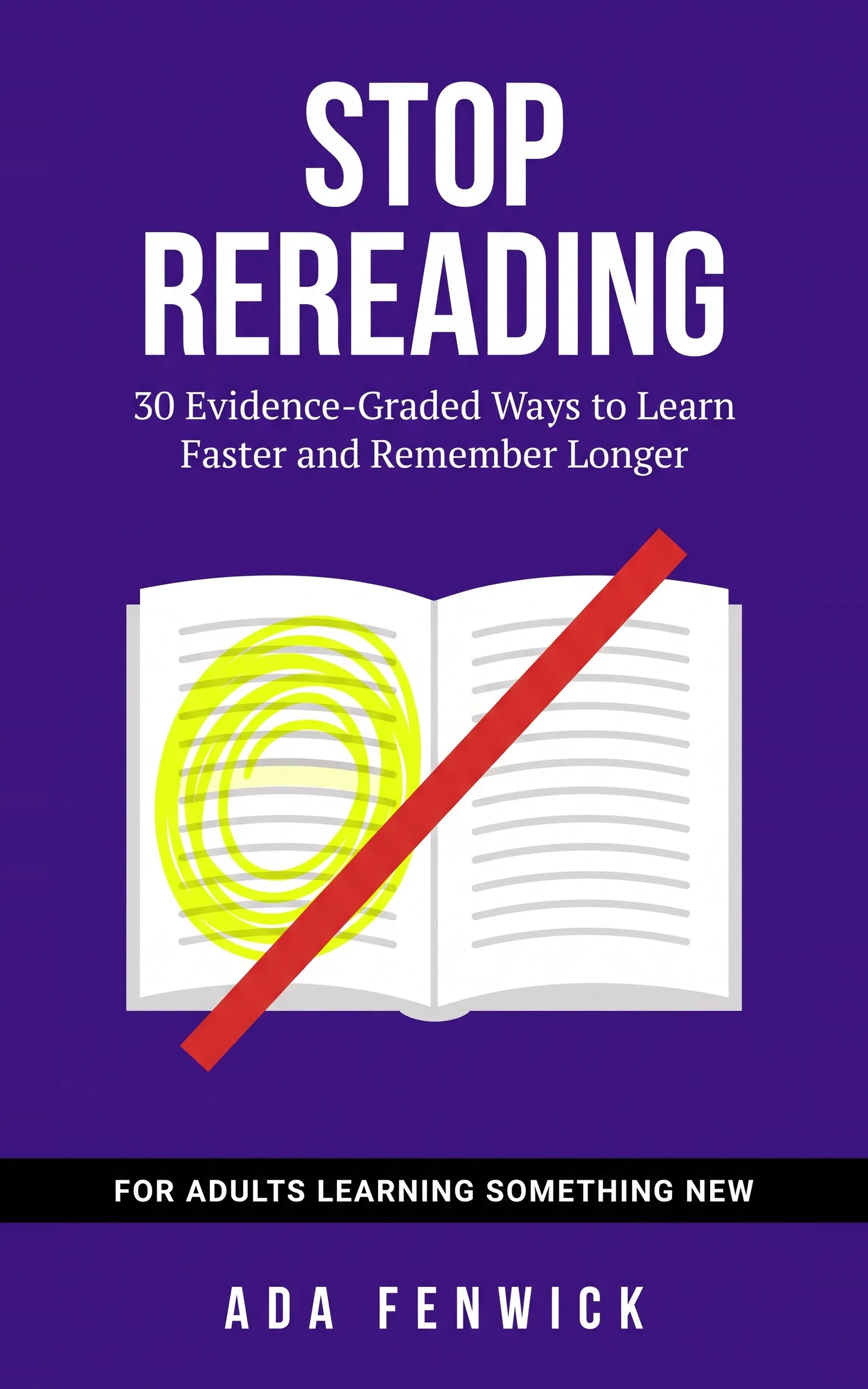
Stop Rereading
30 Evidence-Graded Ways to Learn Faster, Remember Longer, and Use What You Study, for Adults Learning Something New. By Ada Fenwick, 224 pages.
Where this problem is in the book:
- Attention, Phones and Breaks
Links go to Amazon. ToolGenX publishes this book under a pen name and earns from every sale. Amazon sets the price and handles delivery and returns.

Is Stop Rereading the right book for you?
Yes, if
- You study with your phone face down next to the book
- You read the same paragraph twice after every buzz
- You want to know which phone advice has evidence behind it
Skip it if
- You have ongoing trouble focusing that goes beyond phone habits (talk to a health care provider)
- You want a verdict on whether phones are bad in general
Fair doubts before you buy
If the brain drain effect did not repeat, why move the phone at all?
Because the part with clear evidence is picking it up. Glass and Kang (2019) found that allowing devices in lectures lowered later exam scores. Putting the phone in another room removes the chance to use it mid-session. That is why the book badges the tool PROMISING: good reason not to use it, weak evidence that location alone matters.
A 2023 meta-analysis found phones do hurt. Does that not settle it?
Not for the silent phone on the desk. Boettger, Poschik and Zierer pooled 22 studies with 43 effects and found an overall negative effect. But they lumped phone use together with phone presence, and results varied a lot from study to study. It does not rescue the claim that a phone drains you just by sitting there.
Get Stop Rereading
Thirty study tools for adults learning something new, each traced to its research and badged SOLID, PROMISING or STORY ONLY, from the Closed-Book Check to a weekly learning system.
Links go to Amazon. ToolGenX publishes this book under a pen name and earns from every sale. Amazon sets the price and handles delivery and returns.
This book is for general education about learning methods. It is not medical or psychological advice. If you have ongoing trouble with sleep, attention or memory, talk to a health care provider.

Questions people ask about this
- Does a phone on the desk make you less focused?
- One 2017 study said yes, but a preregistered repeat in 2022 did not find it. A 2020 study by Hartmann and colleagues also found no overall effect of a phone on the desk. The firmer finding is about use: checking a phone or laptop during learning lowers later exam scores.
- Is it true our attention span is shorter than a goldfish?
- No. A BBC investigation in 2017 traced the eight-second figure to a 2015 Microsoft Canada report. The number came from a website called Statistic Brain, and its listed sources could not back it up. The BBC piece concluded: "There is no evidence human attentions spans are shrinking."
- What should I do on a study break instead of scrolling?
- Take a short, easy walk without earbuds, or sit quietly with your eyes closed for ten minutes. Exercise after learning helped memory in a 2019 review by Loprinzi and colleagues. Quiet rest helped a little in some studies, though many found nothing in healthy young adults.
- How long should a study block be?
- The book suggests 25 to 50 minutes with a timer that is not your phone, and says plainly that the length is a suggestion, not a tested number. Pick the length before you start and keep a scrap of paper for things to look up later.
Related problems
- Your exam is in a week. How to spend the seven days so it sticks
One week left and a pile of material? Test yourself instead of rereading, come back to each topic twice and keep your sleep. Here is the plan.
- Taking notes by hand or on a laptop: what the repeat studies found
The famous laptop note-taking study did not hold up when it was repeated. Here is what the newer studies found, and what matters more than the pen.
- How to use ChatGPT to study without letting it do the learning for you
In a trial with nearly 1,000 students, a plain chatbot raised practice scores and lowered exam scores. Here is how to use AI for hints, not answers.
- Everything inside Stop Rereading
Every chapter, who the book is for, and every problem it helps with.
// Also on this topic
- guideIs the 10,000-hour rule true? What the violin study really found
The 10,000-hour rule came from one violin study and a best-known retelling. Here is what the hours really showed, and what predicts progress better.
- guideDoes practicing in your head work? What three reviews of mental practice found
Mental practice helps a skill, but less than real practice. Three reviews over 27 years agree on a small to medium effect, best added to real reps.
- bookThe Practice Lab
30 Evidence-Graded Drills to Learn Any Skill Faster, Break Through Plateaus, and Make It Stick