Last updated
Stuck in analysis paralysis? Check whether you are thinking or just spinning

It is Tuesday, a little after eleven, and the list has not moved
The job offer came in on Friday. It pays more. It also means a longer commute, a new boss you have met once and leaving a team you like.
You made a pros-and-cons list on Saturday. You have opened it nine times since. You changed one word.
You asked your partner, your sister and a friend from your old job. Two said take it. One said it depends. You read four articles that also said, in different fonts, that it depends.
Here is the thought most people keep to themselves. All this thinking feels like the responsible thing to do. It is also going nowhere. Both of those are true at once.

Why "just stop overthinking" never works
From the inside, careful thinking and anxious looping feel the same. Both take time. Both feel responsible. Both leave you tired.
So "stop thinking" is the wrong advice. It never works, and it is not what the research says anyway. The better move is to check what kind of thinking you are doing.
A 2008 review by Edward Watkins found that going over the same thing again and again can help or hurt. One clue is easy to use. Concrete questions tend to help: what would the commute actually be, who could you ask about this boss? Abstract questions tend to hurt: why can you never just decide, what does this say about you?
If most of your late-night questions start with "why," that is a sign.

Looping makes the plan feel worse, not better
You might think all that extra time at least buys a better answer. The research says probably not.
In a 2020 experiment by Sandra Llera and Michelle Newman, 185 people thought about a real problem in their lives. Each was randomly told to worry about it, think about it plainly or do a breathing exercise. Worrying led to less effective solutions than plain thinking. That held for everyone, not just people who worry a lot.
A 2003 study by Andrew Ward, Sonja Lyubomirsky and colleagues looks even closer to your Tuesday. People who tend to ruminate made plans, then felt less sure of them and were less likely to commit. That study shows a link, not proof of cause.
Put the two together and the trap is plain. Looping does not improve the plan. It makes you trust the plan less, so you do not act on it, so you keep looping.
The five-minute test: has anything new come in?
The book's first tool is called the New-Information Test. It carries a PROMISING badge, because the research behind it is real but the test itself has never been studied as a named method.
- Write the decision as one plain sentence: "Take the new job or stay."
- Write the date you started thinking about it seriously.
- List every fact you have learned since then. Facts only: numbers, answers, things you saw or tested. Feelings and reworded pros do not count.
- If the list is empty or nearly empty, circle one word: looping.
- Write one concrete action that would bring in a real new fact within 48 hours. "Ask the hiring manager what a normal week looks like." "Drive the commute at 8 a.m."
- If you cannot think of one, write "enough" instead. Then stop gathering and move on to choosing.
New means a fact you did not have last time. It does not mean a new feeling about an old fact. It does not mean a fourth opinion that matches the first three.
What we like about this test is that it is honest about what it can do. It will not make the choice for you. It tells you whether you are working on the decision or just walking around it.
When you have the facts and still want the best
Some people loop because they lack facts. Others have plenty, and none of the options feels like the best one.
In a 2002 study by Barry Schwartz and colleagues, across seven samples and 1,747 people, the more someone leaned toward hunting for the best, the more regret they reported. A later study of 548 job seekers found the hardest hunters got starting pay about 20 percent higher, and felt less satisfied with the jobs they took.
The book is careful here. These are links, not causes, the scale used to measure "maximizing" has critics, and the link did not appear in a sample from China. The useful part is narrow. Wanting something good is fine. Endless searching and comparing seems to be what costs people.
The book's second tool, Maximizer or Satisficer? (PROMISING), is a short yes-or-no check. The first line asks whether you have already found one option that would be fine. The other four ask things like whether you keep looking anyway. If three or more of those four are yes, the search for the best is running this decision. The next step is to write the one thing a good-enough choice must do.
Waiting is also a choice
While you loop, it feels as if nothing is being chosen. That is not quite true. The option you have now wins by default every day you wait.
Researchers call this status quo bias. A 2021 replication by Xiao and colleagues with more than 600 people found strong support for it in three of four scenarios.
The economist Steven Levitt ran a large online coin flip for people stuck on a big choice. People the coin sent toward a change were more likely to make it, and reported being happier six months later. The people chose to visit his site and rated their own happiness, so it proves nothing about everyone. It does hint that people on the fence give "stay put" more credit than it earns.
Where Done Deciding takes the loop from here
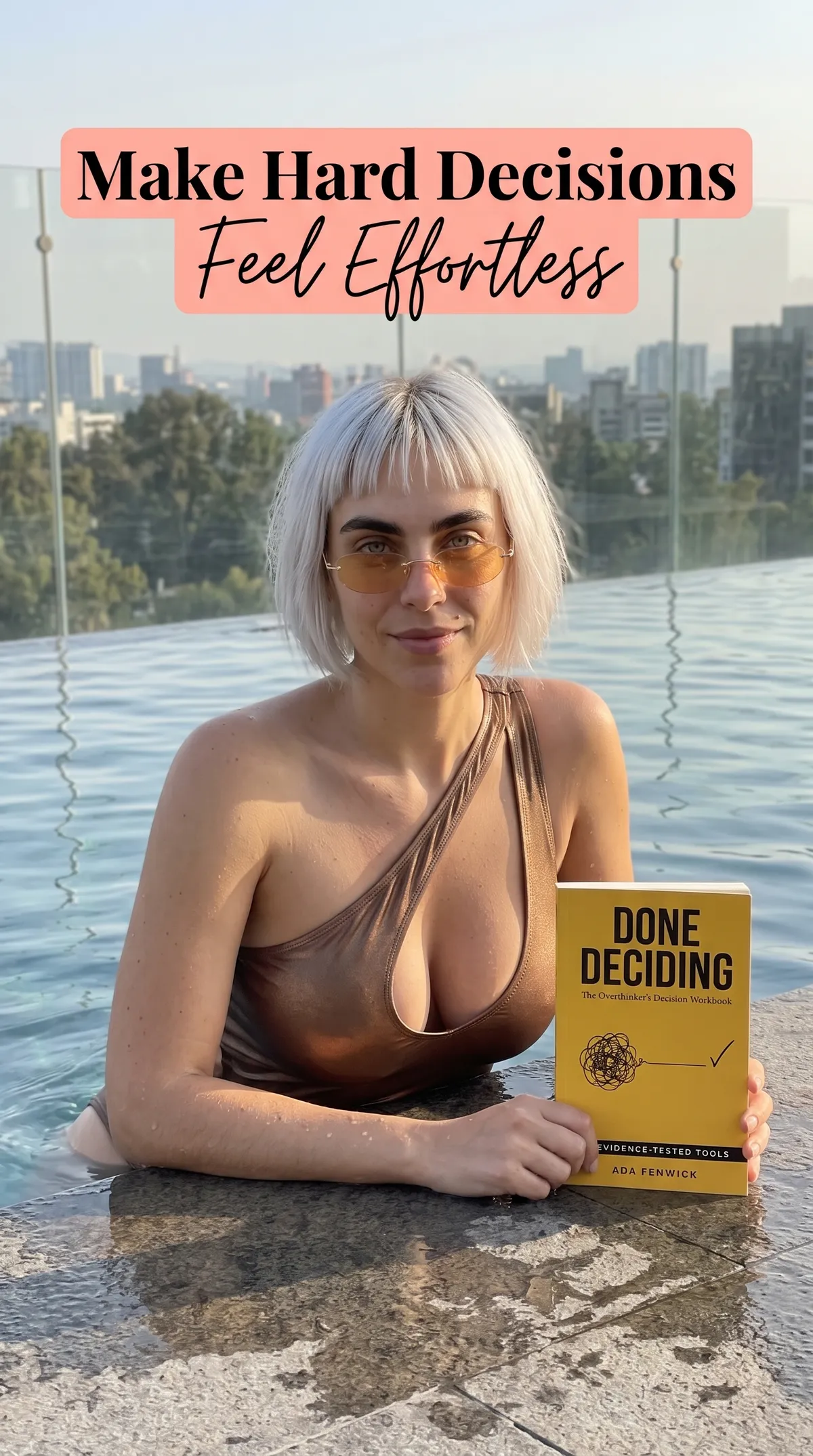
This is the problem Done Deciding was written for.
The Loop: Are You Thinking, or Just Spinning? gives you the New-Information Test and the Maximizer or Satisficer? check, with every study behind them and where each one falls short.
Not Deciding Is a Decision: What Waiting Chooses for You has two more tools. The Camera Test (STORY ONLY) asks what a stranger would conclude from what you actually did about this decision. The Unchanged Tuesday (PROMISING) has you write an ordinary day five years from now if nothing changes, so "stay" stops being a blank.
If the facts are all in and you still cannot move, the block is usually a fear, not a gap. Our page on being afraid of making the wrong decision is the next step.
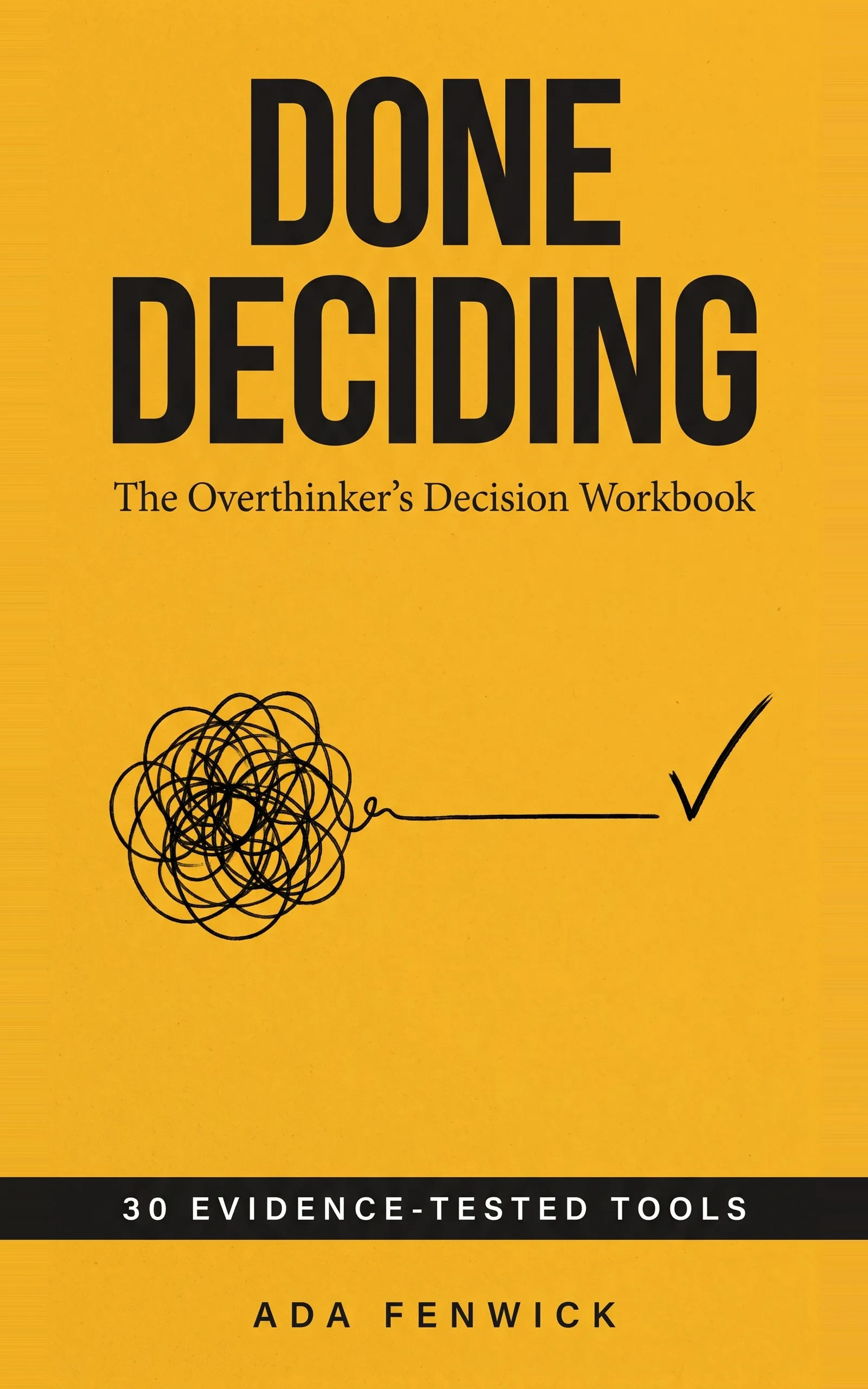
The book for this problem
Done Deciding
The Overthinker's Decision Workbook. 30 Evidence-Tested Tools to Make Hard Choices Faster, Quiet the What-Ifs, and Stop Second-Guessing. By Ada Fenwick, 207 pages.
Where this problem is in the book:
- The Loop: Are You Thinking, or Just Spinning?
- Not Deciding Is a Decision: What Waiting Chooses for You
Links go to Amazon. ToolGenX publishes this book under a pen name and earns from every sale. Amazon sets the price and handles delivery and returns.

Is Done Deciding the right book for you?
Yes, if
- You have reread the same pros-and-cons list for days and nothing on it has changed
- You keep reading one more article and feel no closer
- You want a quick test you can run tonight, not a pep talk
Skip it if
- You want someone to tell you which option to pick
- Worry has been hard to control most days for months (a health care provider can help more than a workbook)
Fair doubts before you buy
Isn't thinking longer just being careful?
Careful thinking brings in new facts and ends in a plan. Looping brings in nothing and ends where it started. In a 2020 experiment by Llera and Newman, worry led to worse solutions than plain thinking, even for people who do not usually worry. The test on this page tells you which one you are doing.
I have read ten articles about analysis paralysis. Why a book?
Most articles stop at "set a deadline" or "trust your gut." The book gives 30 short tools, each with an honest badge for how strong the evidence is. A one-page Decision Map at the back tells you which tool to open for the stuck moment you are in.
Get Done Deciding
Thirty small decision tools for overthinkers, each traced to its research and badged SOLID, PROMISING or STORY ONLY, from the first loop test to closing the door after you choose.
Links go to Amazon. ToolGenX publishes this book under a pen name and earns from every sale. Amazon sets the price and handles delivery and returns.
Questions people ask about this
- What causes analysis paralysis?
- Often it is looping, not missing facts. You go over the same points again, and each pass makes you trust your plan a little less. A 2003 study found that people who tend to ruminate felt less sure of their plans and were less likely to commit to them. A second cause is hunting for the very best option when a good one is already in front of you.
- How do I know if I'm overthinking or being careful?
- Look at what came in. Careful thinking adds facts: a number, an answer, a test. Overthinking adds new feelings about old facts, the same pro in new words, or a fourth opinion that matches the first three. If nothing new arrived in the last few days, you are spinning.
- How do you break analysis paralysis fast?
- Write the decision in one sentence and the date you started on it. List every fact you learned since then. If the list is empty, pick one action that would bring in a real new fact within 48 hours, like driving the commute at 8 a.m. If you cannot think of one, write that you have enough, and move on to choosing.
- Is analysis paralysis a sign of anxiety?
- Not on its own. Everyone overthinks sometimes, and the book does not diagnose anything. It quotes the US National Institute of Mental Health: to be diagnosed with GAD, a person must find it hard to control worry on most days for at least 6 months. If that sounds like you, or worry is wearing down your sleep or work, talk to a health care provider.
- Is it bad to wait until I'm sure before I decide?
- Waiting has a cost too, it just is not written down. People favor the option they already have, and a 2021 replication with more than 600 people found strong support for that pull in three of four scenarios. Waiting is fine when new facts are coming. When they are not, waiting quietly chooses the status quo for you.
Related problems
- Afraid of making the wrong decision? Find out what you are scared of losing
When the facts point one way and you still cannot move, a fear is usually holding the door. Name it in five minutes, then size the regret.
- You have to make a decision by tomorrow and you still can't choose
A decision is due tomorrow and you are stuck. Size it in two minutes, set a default, make one call, and break a true tie with a coin.
- Small decisions take you forever? How to make everyday choices faster
Fourteen tabs for one laptop? Write a good-enough bar before you look, turn repeat choices into rules, and see what the decision fatigue research found.
- Everything inside Done Deciding
Every chapter, who the book is for, and every problem it helps with.
// Also on this topic
- guideFirst principles thinking explained simply, with a way to try it today
First principles thinking means splitting a problem into what is true and what is habit, then rebuilding. Plain steps and an honest evidence note.
- guideWhich mental models actually work, and which are just famous quotes?
Which mental models actually work? See which tools have real studies behind them, and which famous quotes, like Munger's incentive line, have no source.
- bookMental Models That Actually Work
40 Thinking Tools from Munger, Bezos, Feynman, and Kahneman, Tested Against the Evidence, for Clearer Thinking and Better Decisions