Last updated
Which mental models actually work, and which are just famous quotes?

| Popular claim | What the source shows | Badge or label |
|---|---|---|
| Munger said 'Show me the incentive and I'll show you the outcome' | Not in the 1995 talk or the 2005 rewrite; no primary source found | MYTH (the quote) |
| Einstein called insanity doing the same thing and expecting different results | Earliest strong match is a 1981 Al-Anon report in Knoxville | MYTH (the quote) |
| Pre-mortems make you 30% better at spotting reasons for failure | The 1989 study counted reasons, not correct ones | MYTH (the number); tool is PROMISING |
| Kahneman told people to keep a decision journal | A 2012 retelling by Michael Mauboussin, not Kahneman's own writing | MYTH (the credit); tool is PROMISING |
| People mostly regret what they did not do | A 2023 study of about 2,600 people found long-term regrets split 51 to 49 | MYTH (overstated) |
| Ask yourself why you might be wrong | Helped in many separate experiments; stop at three reasons | SOLID |
| Write 'if this happens, I will do that' plans | Tested in hundreds of experiments | SOLID |
| One-way and two-way doors | Real, from Bezos's 2015 letter; never tested as a method | STORY ONLY |
What the badges and the myth label mean
Each row puts a claim you will see online next to what its source says. The last column gives the book's label.
The book uses three badges for tools. SOLID means tested on people more than once, or backed by a review of many studies, and it helps. PROMISING means real evidence that is thin or indirect. STORY ONLY means a real, documented habit that nobody has tested.
A fourth label, MYTH, is never given to a tool. It is given to the story told about a tool: a quote that was never said, or a number that does not mean what people think. That is why the pre-mortem row says MYTH for the 30 percent figure but PROMISING for the tool.

The incentive quote that is not in the talk
Start with the line on a thousand slides:
"Show me the incentive and I'll show you the outcome."
It is pinned to Charlie Munger, often to his 1995 Harvard talk, "The Psychology of Human Misjudgment."
The book searched both versions. The 1995 transcript and the 2005 rewrite in Poor Charlie's Almanack. Neither has that sentence. No primary source has turned up.
Munger did care about incentives. His real line, from the 2005 text, is this: "Never, ever, think about something else when you should be thinking about the power of incentives." It is a good line. It is just not the one people quote.
The idea itself holds up well. In a day-care study in Haifa, a small fine for picking children up late roughly doubled late pickups. Before, being late was a favor asked of a teacher. After, it was extra time you could buy, and cheaply.

It is late, and the twelfth list says the same things
You have read the posts. Fifty models. Ninety models. A latticework. Each one comes with a billionaire's name and a neat quote.
You tried a few. Some helped once. You cannot tell which ones are real and which ones just sound smart.
Here is the thing nobody says. Many of those lists copy each other, and each copy sands off a detail and adds a famous name. After enough rounds, nobody knows where a tool came from or if it does anything.

The tested ones are the boring ones
When the book sorted 40 tools, the count was 6 SOLID, 20 PROMISING and 14 STORY ONLY. Some famous tools landed low. Bezos's doors and Munger's circle of competence are both STORY ONLY. A track record is not a test.
Some plain tools landed high. Asking yourself why you might be wrong, then stopping at three reasons, worked across many separate experiments. Writing down an if-then plan ahead of time, "if this happens, then do that," has been tested in hundreds.
So if you only build two habits, we would start there. They are not exciting. That is part of why they get skipped.

The six SOLID tools, in one place
Most lists of mental models never say which ones were tested. Here are the six that earned the book's SOLID badge, with the small first step the book's 30-day plan gives each one.
| Tool | What it asks you to do | A first try |
|---|---|---|
| Consider the Opposite | Look for why you might be wrong | Write two reasons your current view could be wrong |
| If-Then Plans | Decide your response before the moment comes | Write three if-then plans for a habit you keep dropping |
| Keep Score | Write down forecasts as numbers and check how they turned out | Write one yes-or-no forecast with a deadline and a number from 0 to 100 |
| Count It Out, Then Nudge | Turn percentages into counts | Rewrite one percentage claim as "X out of 100" |
| The "Or What Else?" Question | Name what else the time or money could do | Ask it about one purchase or project |
| Guess Alone, Then Talk | Collect guesses before a group discussion | Ask two people for a guess before you share yours |
The book's plan puts these in the last week on purpose. The month starts with easy, low-stakes STORY ONLY tools and ends with the habits most worth keeping. Its last step is one question: which SOLID habit will you keep, and when, exactly, will you use it?

Where the book sorts the rest
This is the problem Mental Models That Actually Work was written for. Ada Fenwick traced each of 40 tools to its letter, talk, book or study, and every chapter ends with a myth check.
How to Use This Book explains the badges and gives the full count, including why STORY ONLY does not mean useless.
Consider the Opposite is the strongest single habit in the book, with the studies behind it and the limit that keeps it from backfiring.
Incentives: Who Gets Paid If This Happens? has the full Munger story, the Haifa fine and a ten-minute Incentive Check that includes a line for you.
The Decision Selector and the 30-Day Plan has all 40 tools in one table with their badges, so you can see the whole sort at a glance.
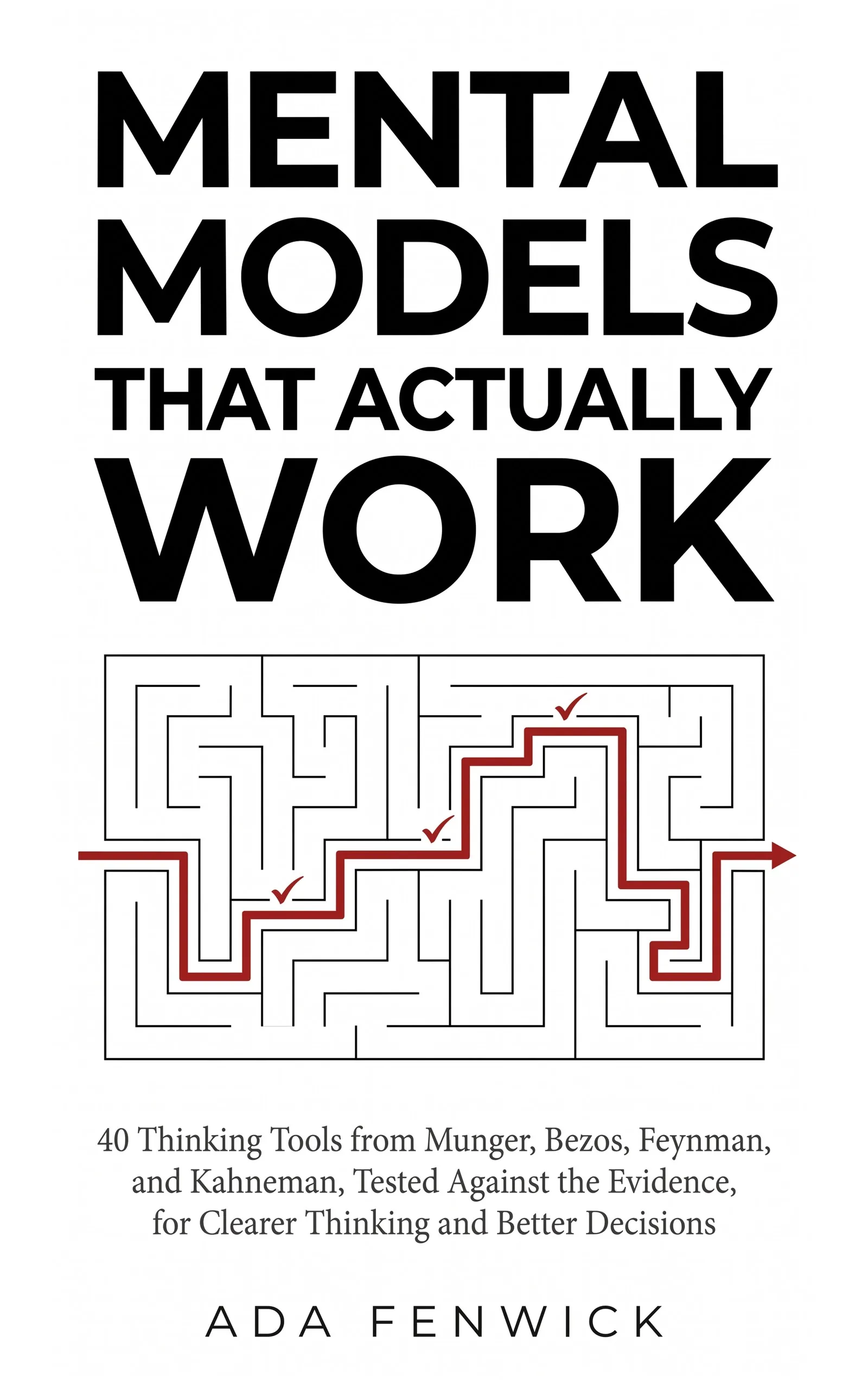
The book for this problem
Mental Models That Actually Work
40 Thinking Tools from Munger, Bezos, Feynman, and Kahneman, Tested Against the Evidence, for Clearer Thinking and Better Decisions. By Ada Fenwick, 288 pages.
Where this problem is in the book:
- How to Use This Book
- Consider the Opposite
- Incentives: Who Gets Paid If This Happens?
- The Decision Selector and the 30-Day Plan
Links go to Amazon. ToolGenX publishes this book under a pen name and earns from every sale. Amazon sets the price and handles delivery and returns.

Is Mental Models That Actually Work the right book for you?
Yes, if
- You read a mental models book and found quotes with no sources
- You want to know how much weight each tool can hold
- You would rather have six tested habits than fifty slogans
Skip it if
- You want the famous legends kept intact (the myth checks remove several)
- You want financial or investing advice from Munger's ideas
Fair doubts before you buy
Does it matter who said a quote if the idea is good?
For the idea, not much. For trust, yes. When a book gets a famous quote wrong, you cannot tell what else it got wrong. Munger did care a great deal about incentives, and that is on the record. The tidy line is not.
Is a STORY ONLY tool useless?
No. It means a real person used it and it is well documented, but nobody has put it through a proper test. Several STORY ONLY tools are among the most practical in the book. You just should not trust them more than the evidence allows.
I have read Farnam Street and other model lists. What is new here?
The badges. Each tool says how much evidence stands behind it and names the studies, including results that failed to repeat. Many lists give you the tool. This one also tells you how much weight it can hold.
Get Mental Models That Actually Work
Forty thinking tools, each traced to its source and labeled by how well it holds up, so you know which to use and when.
Links go to Amazon. ToolGenX publishes this book under a pen name and earns from every sale. Amazon sets the price and handles delivery and returns.

Questions people ask about this
- Did Charlie Munger say 'Show me the incentive and I'll show you the outcome'?
- There is no primary source for it. Blogs often date it to his 1995 Harvard talk on human misjudgment, but a text search of the 1995 transcript and the 2005 rewrite finds no such sentence. His documented line is from 2005: never, ever, think about something else when you should be thinking about the power of incentives.
- What are the most proven mental models?
- In the book, six tools have strong support. They include asking why you might be wrong, writing if-then plans, keeping score on your forecasts and having everyone guess alone before a group talks. The plain ones tend to test best.
- Are mental models backed by science?
- Some are, many are not. Of 40 tools checked, 6 had repeated studies or a pooled review behind them. Twenty had real but thin evidence. Fourteen had a good source but no test at all.
- Do incentives really change behavior?
- Yes, strongly, but not always the way you expect. In a day-care experiment in Haifa that began in 1998, a small fine for late day-care pickup roughly doubled late pickups, from about 8 to 16.4 per center a week. A fine can read as a price.
- Is the 37 percent rule a good way to choose?
- It is a proven math result for one strict puzzle, but even used perfectly it finds the single best option only about 37 percent of the time. When a very good option is almost as good as the best, the book says to look at far fewer options first.
- What is a mental model?
- A mental model is a simple picture of how something works that you carry in your head and use to think or decide. Lists online often mix two kinds: big ideas, like incentives or first principles, and small routines, like a pre-mortem. The book treats all 40 as thinking tools and asks one question of each: has it been tested?
Related problems
- How to make better decisions when you keep making the same kind of bad call
Want to make better decisions? Start with two tested questions, then keep a short written log so you can see your own patterns.
- First principles thinking explained simply, with a way to try it today
First principles thinking means splitting a problem into what is true and what is habit, then rebuilding. Plain steps and an honest evidence note.
- The plan launches soon. Here is how to run a pre-mortem in 20 minutes
Launch coming up? Run a pre-mortem in 20 minutes with your team or 10 alone. Plain steps, plus the one fix most guides leave out.
- One-way vs two-way door decisions: which kind is the choice in front of you?
One-way vs two-way door decisions compared: what each means, how much care each deserves, and the catch about keeping doors open.
- Everything inside Mental Models That Actually Work
Every chapter, who the book is for, and every problem it helps with.