Last updated
You have to make a decision by tomorrow and you still can't choose

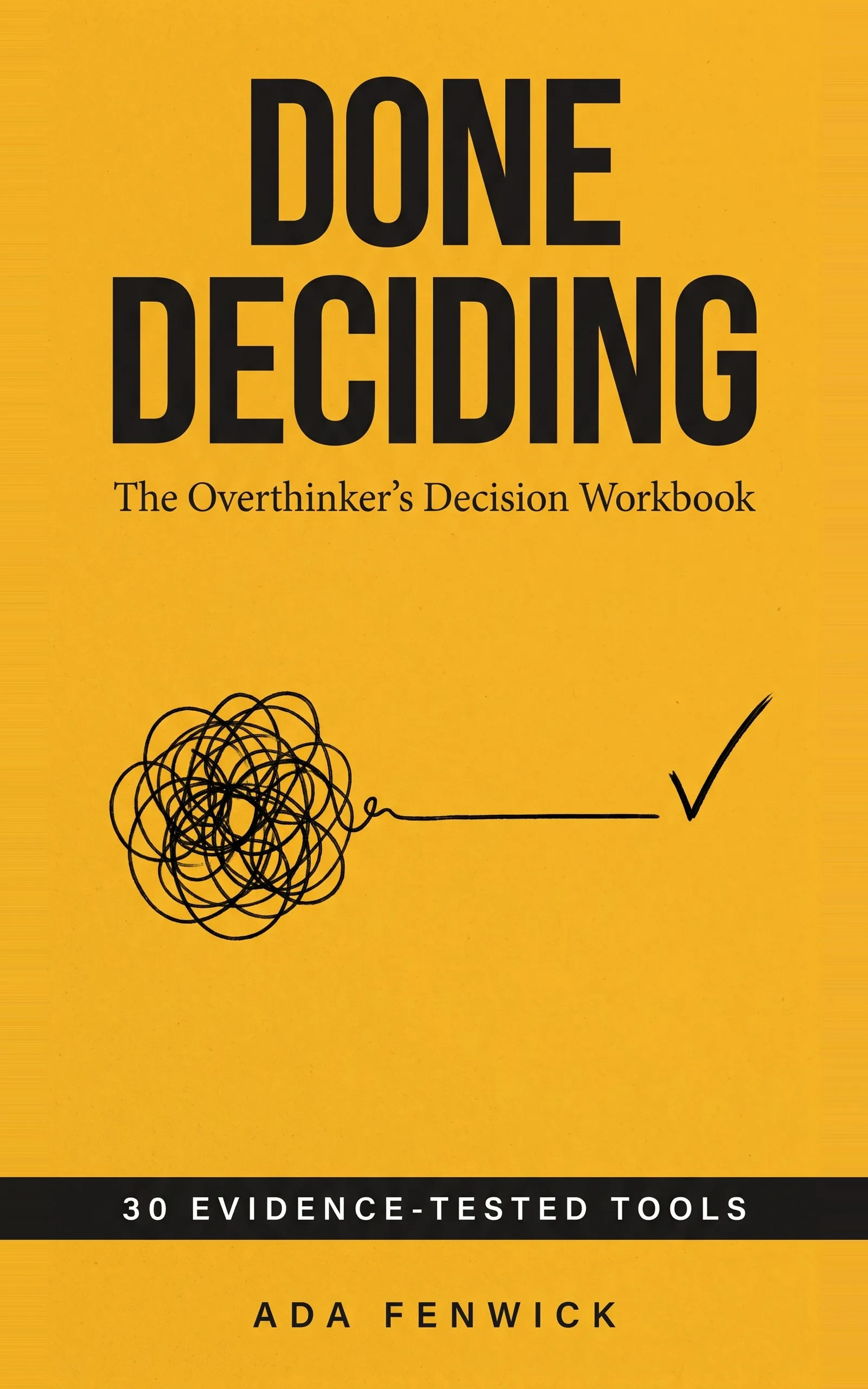
The book for this problem
Done Deciding
The Overthinker's Decision Workbook. 30 Evidence-Tested Tools to Make Hard Choices Faster, Quiet the What-Ifs, and Stop Second-Guessing. By Ada Fenwick, 207 pages.
Where this problem is in the book:
- How Big Is This, Really? Give Each Decision the Time It Actually Deserves
- Small Decisions, Fast: Three Ways to Stop Giving Little Choices Big-Decision Energy
Links go to Amazon. ToolGenX publishes this book under a pen name and earns from every sale. Amazon sets the price and handles delivery and returns.
Do these five things tonight, in this order
- Size it in two minutes. Write the decision in one sentence. Then three words. Undo: easy, costly or no? Matters: will you still feel it in a year? Due: the real hour, not the scary one.
- Set the budget. Easy to undo and small: decide in the next ten minutes. Hard to undo and big: use what is left of tonight for one real fact, then decide.
- Write your default. "Still undecided at 9 a.m.? Then the answer is yes." Pick a default you could live with. Now the deadline cannot trap you.
- Get one new fact, or admit you have enough. One call, one text with a specific question, one look at the number you have been avoiding. If you cannot name one, write "enough."
- If two good options still tie, flip a coin. Then notice your first reaction.
That last step has rules. More on those below.

It is 10:40 p.m. and the answer is due at nine
You told them you would let them know by tomorrow. That felt like plenty of time on Monday.
You have the two tabs open. You have the notes. You asked two people and got two answers. Every time you lean one way, the other side pulls you back.
And under all of it is a quiet thought you would not say out loud. If this goes wrong, it will be your fault, because you had all week.
You do not need a week tonight. You need a way to stop.

Why sizing it first saves you
Most overthinkers give every choice the same weight. A paint color gets the care of a career.
The book's Two-Minute Triage asks three things: can you undo it, does it matter, when is it due. Your answers set a time budget. The book badges it STORY ONLY. The undo question comes from a business letter by Jeff Bezos, not from an experiment, and nobody has tested the three questions as a set. Still, we think it is the right first move tonight, because it tells you whether this deserves ten minutes or the whole evening.
Writing a default comes from the next card, Set the Deadline Now (PROMISING). Its evidence is small but clean. In a 2010 study by Suzanne Shu and Ayelet Gneezy, 31 percent of people with a three-week gift card used it, against 6 percent of people with two months. That was 64 people and a slice of cake, not a hard choice. The book also notes that a more famous deadline study from 2002 was retracted, so it leaves that one out.

The coin flip, done the honest way
The coin is not a way to skip the hard part. It is for the end, when you have truly thought enough.
First check. Both options must be ones you could live with. Put the coin away if one option is clearly worse, or if safety, money you cannot afford to lose or someone else's welfare is at stake.
- Give heads to one option and tails to the other. Say it out loud.
- Flip. While it is in the air, notice what you are hoping for.
- When it lands, notice your first reaction: relief, or a small sinking feeling.
- Relief: go with the coin. Sinking: take the other option. No feeling either way: let the coin decide.
- Write the decision and the time. You are done.
In two small online studies by Jaffé, Reutner and Greifeneder, people who used a coin felt a stronger sense of what they wanted right after the toss. They did not just obey it. The coin worked as a catalyst. The study used restaurant dishes, so the book badges the tool PROMISING, not more.
The bigger study is Steven Levitt's online coin flip. People stuck on a major change were more likely to make it when the coin said so, and reported more happiness six months later. They chose to visit his site and rated their own happiness, which Levitt flagged himself.

In the morning, close it
Once you send the answer, the work changes. The urge to reread the other tab will come. That is normal, and it is not a sign you chose wrong.
Write one line: what you chose, the facts you had and how sure you were as a percent. If it goes badly later, that line protects you from the voice that says you should have known.
Where Done Deciding comes in
This is the problem Done Deciding was written for, at its most urgent.
How Big Is This, Really? Give Each Decision the Time It Actually Deserves has the Two-Minute Triage and Set the Deadline Now, with a worked example of a bakery owner who spent three evenings on a menu board and twenty minutes on a five-year lease.
Small Decisions, Fast: Three Ways to Stop Giving Little Choices Big-Decision Energy has the full Coin Flip card, plus a good-enough bar you write before you look at options.
If tomorrow goes badly, read bad decision or bad luck before you judge yourself.

Is Done Deciding the right book for you?
Yes, if
- Someone is waiting on your answer tomorrow and you are still split
- You have done the research and it keeps coming out even
- You want steps you can do tonight, in order
Skip it if
- The choice involves safety, money you cannot afford to lose or someone else in danger (get the right professional on the phone)
- You want a full system to read before you choose
Fair doubts before you buy
A coin flip for a real decision? That feels reckless.
The book only allows it when both options are ones you could live with and nothing new is coming in. It is not a way to skip thinking. In two small 2019 studies, a coin toss mostly helped people feel what they already wanted, and they did not simply obey it.
Should I just ask for more time?
Sometimes that is the right call, and it is worth one honest question to whoever is waiting. But a longer window does not always help. In one small study, people with a three-week deadline used a gift card far more often than people with two months, because the longer window gave them room to say "later."
Get Done Deciding
Thirty small decision tools for overthinkers, each traced to its research and badged SOLID, PROMISING or STORY ONLY, from the first loop test to closing the door after you choose.
Links go to Amazon. ToolGenX publishes this book under a pen name and earns from every sale. Amazon sets the price and handles delivery and returns.
Questions people ask about this
- How do I make a decision when I have no time?
- Size it first. Ask how hard it would be to undo a month from now, whether you will still feel it in a year, and when it is truly due. If it is easy to undo, decide in ten minutes. If it is hard to undo, use the time you have on one real fact and a default you could live with.
- What if I make the wrong choice under pressure?
- Judge it later by what you knew tonight, not by how it turns out. Write down the facts you had, why you chose and how sure you were. A bad result does not prove a bad decision. Studies on outcome bias show people grade the same choice worse when luck goes against it.
- Does flipping a coin really help you decide?
- It can, as a tie-breaker. In two small online studies from 2019, people who used a coin felt a stronger sense of what they wanted right after the toss. They used it as a catalyst, not a boss. In a large online study by Steven Levitt, people the coin nudged toward a change later reported more satisfaction on important choices, though the people chose to take part. The book badges the tool PROMISING.
- Is it OK to ask for more time to decide?
- Yes, if a real fact will arrive in that time. If not, more time often turns into more looping. Set a decision hour, write what you will do by default if you still cannot choose, and tell one person the time so it feels real.
Related problems
- Stuck in analysis paralysis? Check whether you are thinking or just spinning
Stuck in analysis paralysis? A five-minute test shows whether you are still learning or just looping, and what to do next in each case.
- Small decisions take you forever? How to make everyday choices faster
Fourteen tabs for one laptop? Write a good-enough bar before you look, turn repeat choices into rules, and see what the decision fatigue research found.
- Bad decision or bad luck? How to judge a choice that went wrong
A choice went wrong and you blame yourself. Split it into what you knew and what you could not control, then keep only the lesson about how you chose.
- Everything inside Done Deciding
Every chapter, who the book is for, and every problem it helps with.
// Also on this topic
- guideHow to keep a decision journal: what to write, and when to look back
How to keep a decision journal: the six fields to write before you decide, when to review, and how to judge the choice apart from how it turned out.
- guideYou read it three times and still can't explain it. The Feynman technique, done properly.
Feel like you understand something until you try to explain it? That gap is normal. Here is the explain-it test, the study behind it, and how to run it.
- bookMental Models That Actually Work
40 Thinking Tools from Munger, Bezos, Feynman, and Kahneman, Tested Against the Evidence, for Clearer Thinking and Better Decisions