Last updated
Afraid of making the wrong decision? Find out what you are scared of losing
The withdrawal form has been in your downloads since June
It is a Sunday in late August. Classes start again in nine days. You are halfway through a part-time master's degree you started two years ago, mostly at night, mostly after work.
You no longer want the career it leads to. You have known since spring. The numbers are clear too: two more semesters, more tuition and a degree you do not plan to use.
So the answer looks obvious on paper. And yet you have not sent the form.
You do not need more facts. You know that. Something else is holding the door shut, and it is not on any list you have made.

Why more pros and cons will not help here
When the facts are in and you still cannot move, the decision is usually not about the facts anymore. It is about something you are afraid of losing.
The trouble is that fear rarely says its own name. It shows up as a heavy feeling, or as one more reason to "think about it a bit longer." While it stays vague, you cannot argue with it. Adding another column to the list just gives it more places to hide.
Done Deciding offers a short list of five fears that come up again and again:
- Wasting time. The years you already put in, or the time a new path would take.
- Wasting money. Tuition paid, a deposit, a salary you would give up.
- Regret. You, a year from now, wishing you had gone the other way.
- Looking foolish. What your family, your coworkers or your group chat will say.
- Letting someone down. A proud parent, a boss who vouched for you, a partner who planned around this.
The book is upfront that this list is its own, not a tested scale. But most stuck decisions have at least one of these under them.

What putting a fear into words really does
There is real research on naming feelings. Psychologists call it affect labeling.
In a 2007 brain scan study, Matthew Lieberman and colleagues found that labeling the feeling in an upsetting picture calmed the brain's alarm areas. A 2012 study by Kircanski, Lieberman and Craske is the closest test. People afraid of spiders faced a live one, and some described their fear out loud. A week later, the labeling group showed less bodily alarm. But they did not say they felt less afraid.
So naming the fear calmed the body without making the fear go away. Newer studies from 2026 add that the benefit looks immediate rather than lasting. That is why the book gives the tool below a PROMISING badge and no more. We think that honesty is the point: it tells you what to expect before you try.
Name the fear in five minutes
This is the book's Name the Fear card.
- Write the decision in one plain sentence: "Finish the degree or withdraw."
- Read the five fears: wasting time, wasting money, regret, looking foolish, letting someone down.
- Rate how hard each one pulls on you right now, from 0 to 3.
- Circle the highest score. If two tie, circle both.
- For each circled fear, finish this sentence: "If you choose this, you are afraid that..." Make it specific. "Dad will think you gave up" beats "people will judge you."
- Read it out loud once. Then ask: is this a fact about the options, or a fear about you?
Many people find their sentence is not about money or time at all. It is about a label. The one who quits. The one who could not hack it.
The book has a second card for that, The Protection Question, with a STORY ONLY badge. Under each option you finish "this makes me someone who..." Then you ask whether you would say that about a friend who made the same choice for the same reasons. Usually you would not.
Regret looks bigger from here than it will later
Regret is the fear that drives most "what if" nights. Two findings help put it at its real size.
First, the old line that we mostly regret what we did not do is weaker than it sounds. A 1994 study found that 63 percent of people's biggest regrets were about not acting. But a 2023 replication by Richardson and Gilovich with about 2,600 people found a long-term split of 51 to 49. That is not a meaningful gap. Time changes which regret stings. It does not hand you a rule.
Second, people tend to guess high. In a 2004 study by Daniel Gilbert and colleagues, subway riders and students predicted more regret after a near miss than they actually felt. The authors wrote that people are less prone to regret than they imagine. Those were trains and contests, not careers, so hold it lightly.
The book's Regret Forecast (PROMISING) puts this to work. Write the worst realistic regret under each option, rate it from 1 to 10, then write one thing you would do if it came true. Mark both ratings "probably lower." If they land within a couple of points, regret is not the thing that should decide this.
Where Done Deciding goes with your fear
This is the problem Done Deciding was written for.
What You're Protecting: The Fear Underneath the Choice holds the Name the Fear card and The Protection Question, with the studies behind each one and the ones that did not hold up, such as a pre-exam writing trick that failed in a real classroom.
Weigh It Without Drowning: Fewer Columns, Smaller Regrets has the Regret Forecast, and a second card that cuts a sprawling list down to three things that matter.
If your fear has you texting everyone you know for a verdict, read our page on asking everyone for advice before you decide.
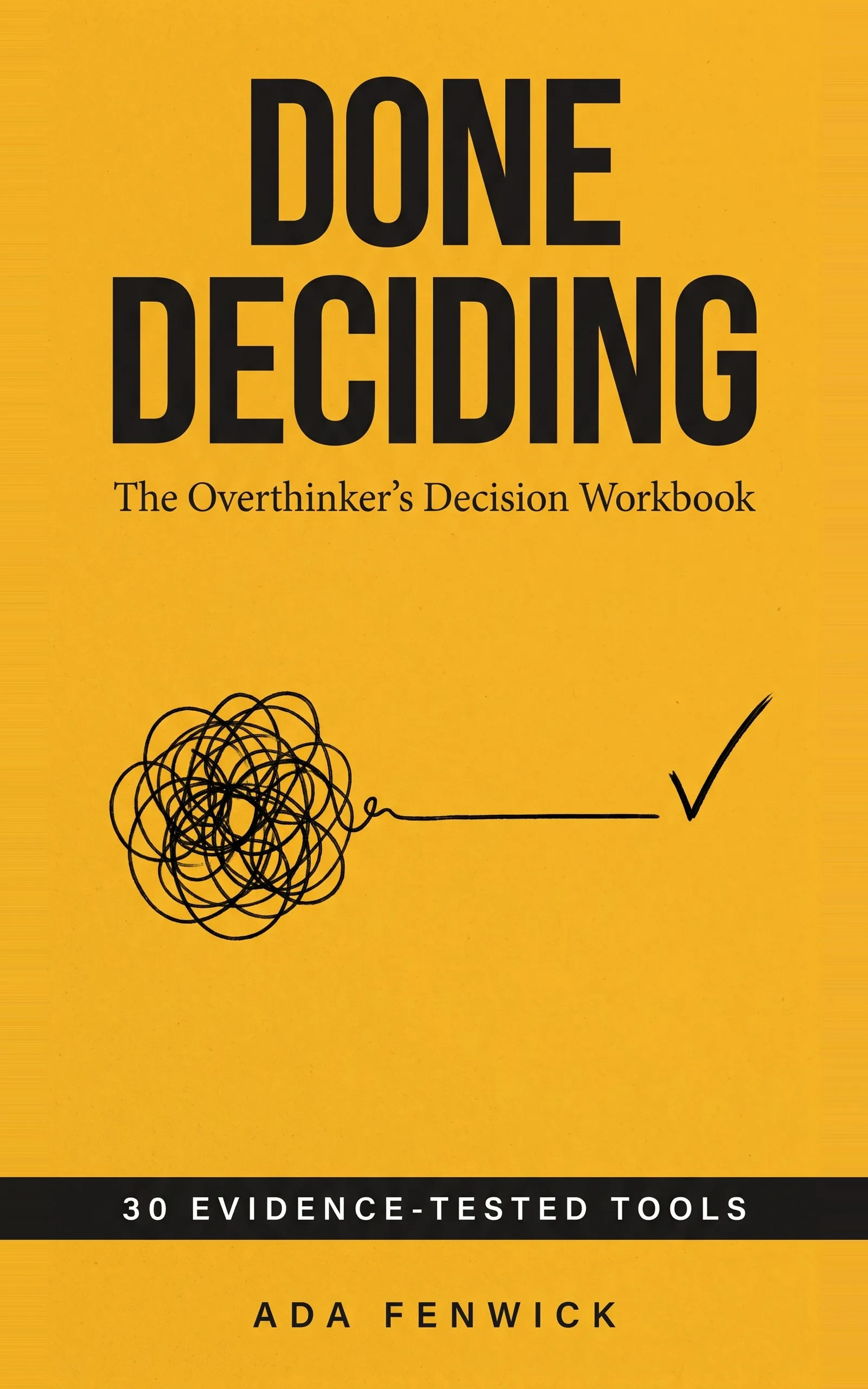
The book for this problem
Done Deciding
The Overthinker's Decision Workbook. 30 Evidence-Tested Tools to Make Hard Choices Faster, Quiet the What-Ifs, and Stop Second-Guessing. By Ada Fenwick, 207 pages.
Where this problem is in the book:
- What You're Protecting: The Fear Underneath the Choice
- Weigh It Without Drowning: Fewer Columns, Smaller Regrets
Links go to Amazon. ToolGenX publishes this book under a pen name and earns from every sale. Amazon sets the price and handles delivery and returns.
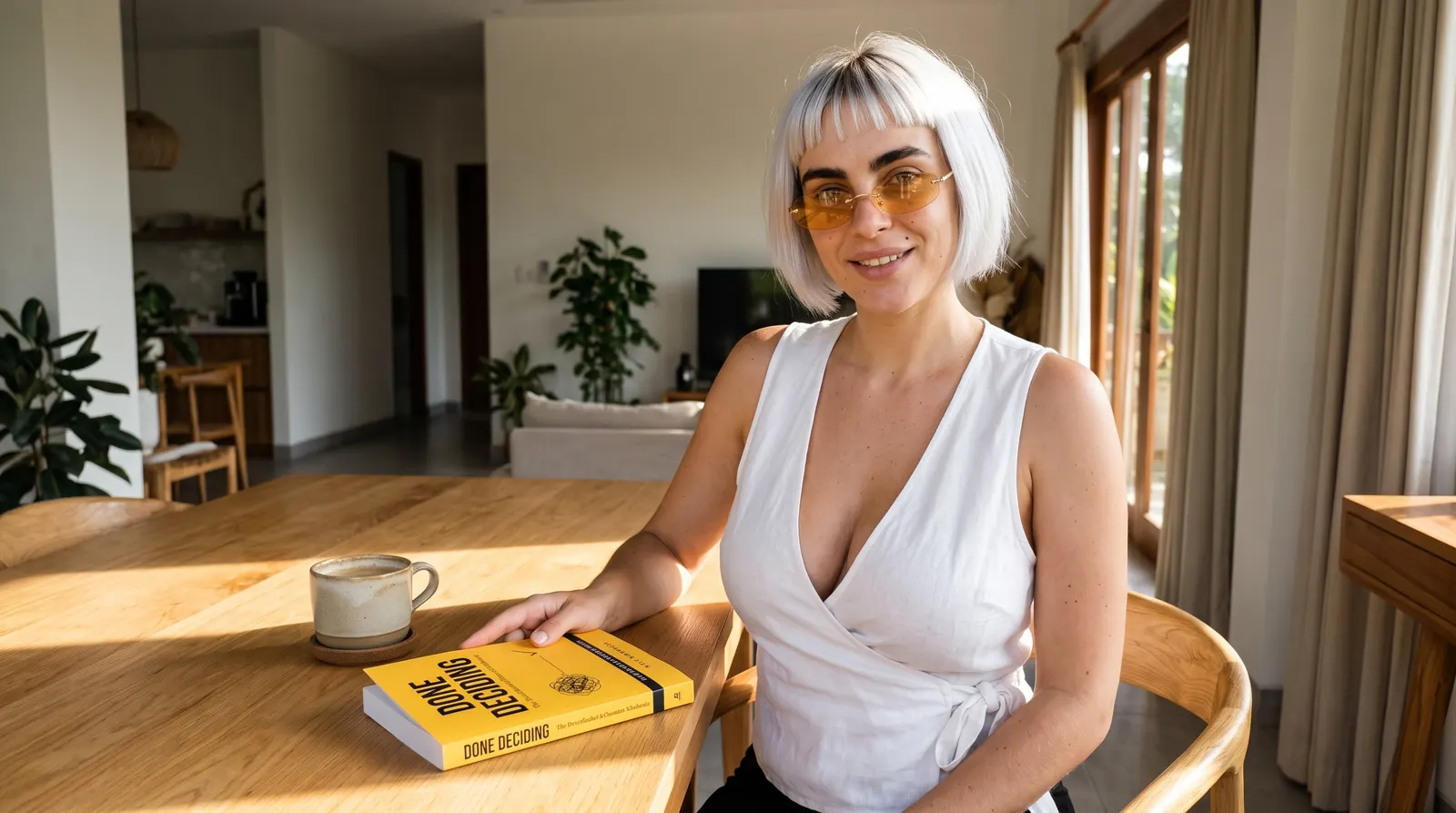
Is Done Deciding the right book for you?
Yes, if
- The answer looks obvious on paper and you still cannot act on it
- You are scared the choice will say something bad about you
- "What if I regret it" is the loudest voice in the room
Skip it if
- You need a treatment for anxiety (the book is not therapy)
- You want someone to make the choice for you
Fair doubts before you buy
Won't naming the fear just make me dwell on it more?
The book is honest about this. Lab studies found that putting a feeling into words calmed the body. People did not always say they felt less afraid, and the effect seems short-lived. So the tool is not meant to make the fear vanish. It turns a vague dread into one or two sentences you can look at and weigh like any other cost.
Isn't this just therapy homework?
No. The book is a set of decision tools, and it says plainly that it is not therapy. If worry has been hard to control most days for months, or it is wearing down your sleep or work, it points you to a health care provider.
Get Done Deciding
Thirty small decision tools for overthinkers, each traced to its research and badged SOLID, PROMISING or STORY ONLY, from the first loop test to closing the door after you choose.
Links go to Amazon. ToolGenX publishes this book under a pen name and earns from every sale. Amazon sets the price and handles delivery and returns.
Questions people ask about this
- Why am I so afraid of making the wrong decision?
- Often because the choice has started to stand for something bigger: years already spent, money already paid, or a label you do not want, like "the one who quit." The book lists five fears that sit under most stuck choices: wasting time, wasting money, regret, looking foolish and letting someone down. Most stuck decisions have at least one, and many have three.
- How do I stop being scared of regret?
- Size it instead of fighting it. Write the worst realistic regret for each option, rate it from 1 to 10 and write what you would do if it came true. Then mark both ratings "probably lower." In a 2004 study, people predicted more regret after near misses than they actually felt.
- Do people regret what they did not do more than what they did?
- Not as clearly as the saying goes. A 1994 study found 63 percent of biggest life regrets were about not acting. A 2023 replication with about 2,600 people found a long-term split of 51 percent action and 49 percent inaction, which was not a real difference. Regrets about action loom larger at first, and the balance tips later.
- What if the decision feels like it says who I am?
- That is common, and the book has a tool for it. Under each option, finish the sentence "this makes me someone who..." Ask if you would say that label about a friend who made the same choice. Then write one value that stays true whichever way you go. The tool carries a STORY ONLY badge: sensible, but never tested.
- Is fear of making decisions a mental health problem?
- The book does not diagnose anyone, and fear around a hard choice is normal. Its line is the one from the US National Institute of Mental Health: if worry has been hard to control on most days for at least 6 months, talk to a health care provider.
Related problems
- Stuck in analysis paralysis? Check whether you are thinking or just spinning
Stuck in analysis paralysis? A five-minute test shows whether you are still learning or just looping, and what to do next in each case.
- You keep asking everyone for advice before you decide, and it never settles it
Polling friends until someone says it will be fine? Sort advice that taught you something from asking that only soothed you, then ask one person well.
- Can't stop thinking about a decision you already made? Give it a time slot
The choice is made but the replay runs all day. Close the door first, then move the what-ifs into one short daily worry window. Here are the rules.
- Everything inside Done Deciding
Every chapter, who the book is for, and every problem it helps with.
// Also on this topic
- guideYou keep overthinking a big decision. Is something wrong with you?
Stuck overthinking a big decision? Sort it by whether you can undo it, then set a bar and a stop date so more research stops buying comfort.
- guideHow to keep a decision journal: what to write, and when to look back
How to keep a decision journal: the six fields to write before you decide, when to review, and how to judge the choice apart from how it turned out.
- bookMental Models That Actually Work
40 Thinking Tools from Munger, Bezos, Feynman, and Kahneman, Tested Against the Evidence, for Clearer Thinking and Better Decisions