Last updated
Recital, match or big game tomorrow? How to spend tonight before the day
The book for this problem
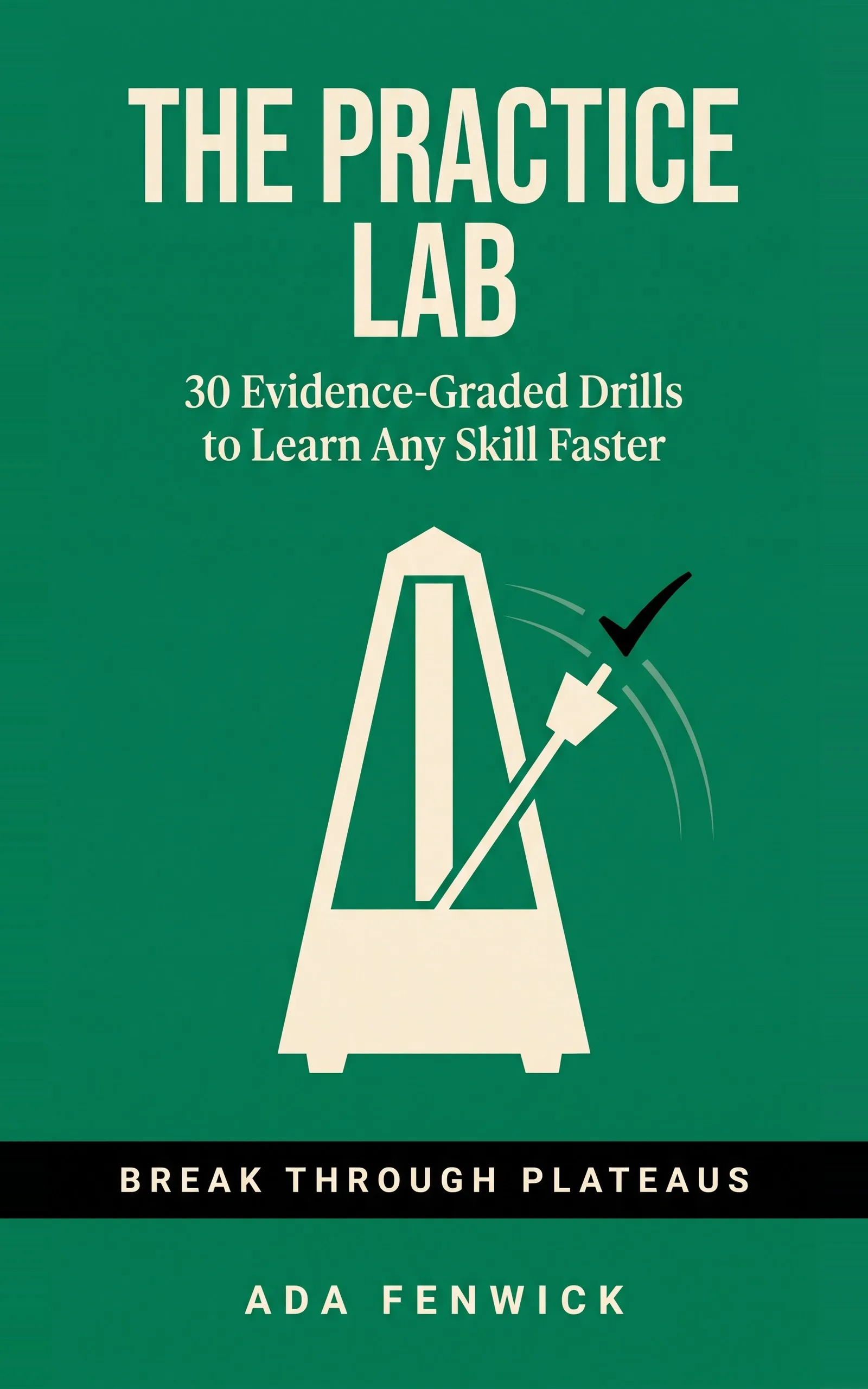
The Practice Lab
30 Evidence-Graded Drills to Learn Any Skill Faster, Break Through Plateaus, and Make It Stick. By Ada Fenwick, 225 pages.
Where this problem is in the book:
- Practice Is Not Performance
- Where Your Attention Goes
- Sleep and Skill
- Keep It: Overlearning and Coming Back
Links go to Amazon. ToolGenX publishes this book under a pen name and earns from every sale. Amazon sets the price and handles delivery and returns.
Tonight, in five steps
- Do one full run-through. Start to finish, for one listener or your phone's camera. No restarts. If you stumble, keep going.
- Write one line, then stop. Note what held up and what did not. Do not drill the shaky part for an hour to end on a good note.
- Guard your sleep. Set a stopping time that leaves you more than six hours in bed.
- Plan the warm-up. Write down the few easy passages or practice swings you will do before you play.
- Pick one cue. For the parts you already own, choose one word or one target to hold. "Smooth." "Back of the court."
That is the whole evening. The rest of this page explains why each step is there.

Why the smooth run tonight cannot be trusted
Picture a piano bench at nine the night before a spring recital. One passage on page two still wobbles. You play it ten times, then fifteen. By the end it is clean, and you go to bed happy.
The trouble is that a clean run late at night measures what your hands can do while the passage is warm. Researchers call that performance, and it is a poor guide to what you keep. A 2015 review by Soderstrom and Bjork called it "often an unreliable index" of learning.
People misread this in a set direction. In a 2001 keypad study by Simon and Bjork, the practice that felt best in the session did worse on a test a day later. People still predicted it would win.
There is a second reason to stop early. Long, unbroken practice of one hard spot is where fatigue piles up. A 2008 study by Rickard and colleagues named exactly this: fatigue builds "over the course of massed (i.e., concentrated) training." Your last tries tonight are tired tries, so they tell you little in either direction.
Sleep will not add a bonus overnight, either. The famous claim that you wake up better mostly vanished in better studies. What sleep does seem to do is help you keep what you practiced. That is reason enough to protect it.
Protect the night, then warm up for real
The chapter Sleep and Skill gives a drill called Protect the Night Before (PROMISING, indirect). Its core is simple: do not let your hardest session or a show day follow a short night.
The evidence is about performance, not learning. In 2022, Craven and colleagues pooled 69 publications on short sleep and physical performance. They defined sleep loss as six hours or less in a 24-hour period. Performance dropped by about 7.6 percent on average. Tasks done in the morning were "largely unaffected." The book notes the limits: about 89 percent of the people studied were male, and results varied a lot.
Tomorrow, expect a dip when you first start. Researchers call it warm-up decrement, the short slump after any rest. In a 1993 study by Wrisberg and Anshel, 65 skilled tennis players rested for 5 or 15 minutes. Practice swings and "air dribbling" wiped out the dip. Running in place helped a bit less. Simply imagining the strokes was not among the things that cleared it.
So warm up with real movement, the way you will perform. Do not grade yourself on the first cold note or swing.

When it counts, let the parts you know run quietly
The last piece is where your attention goes. In a 2002 study by Beilock and colleagues, experienced golfers putted better when their attention was pulled away than when they focused on their stroke. Novices did better focusing on the movement. The authors wrote that for well-learned skills, "high-level skill execution is harmed" by step-by-step attention.
That fits choking. A 2001 study by Beilock and Carr found people choked under pressure on a putting task, and what the authors called self-consciousness training removed it.
The chapter Where Your Attention Goes turns this into the Quiet Mind Check (PROMISING). Sort the piece or the game into parts you own and parts you are still learning. On owned parts, hold one cue. On new parts, think through the steps as much as you need.
Tomorrow is a show day. The book's rule for show days, from Practice Is Not Performance, is to warm up the way you will perform, then trust what you have. In the book's worked example, the best man says his toast once in the car on the wedding day and leaves it alone.
For the next event, start earlier. A 2021 analysis found that practice under mild pressure helped later performance under pressure, which is why The Practice Lab schedules dress rehearsals days ahead. If the shaky passage keeps falling apart, our page on practicing it perfectly and then messing it up explains the Next-Day Test that catches it early.
One rule sits above all of this. Pain is not part of the method. Stop and ask a professional.

Is The Practice Lab the right book for you?
Yes, if
- You have a recital, match, audition or toast tomorrow and one part still feels shaky
- You are tempted to drill it until midnight
- You want a short plan for tonight and tomorrow morning
Skip it if
- Your nerves are so strong they stop you from performing at all (a professional can help more than a drill)
- Something hurts when you play or swing (stop and see a teacher, doctor or physical therapist)
Fair doubts before you buy
Should I not fix the shaky part while I still can?
A short look is fine. Hours of it tonight will mostly make the passage feel fixed while it is still warm. In a 2001 study, the practice that felt best in the session did worse a day later, and people still bet on it. Tomorrow you need a rested body more than one more tired rep.
Is this plan tested?
Not as a whole. The book has no study of the night before a recital. What it has are pieces with their own badges: the split between practice days and show days (PROMISING), protecting the night before (PROMISING, indirect) and research on sleep, warm-up and pressure.
Get The Practice Lab
Thirty practice drills for adults learning a skill, each traced to its research and badged SOLID, PROMISING or STORY ONLY, from the Next-Day Test to shaking off the rust.
Links go to Amazon. ToolGenX publishes this book under a pen name and earns from every sale. Amazon sets the price and handles delivery and returns.
This book is for general education about practice methods. It is not medical, physical therapy or coaching advice. If practice hurts, stop and see a qualified professional.
Questions people ask about this
- Should I practice the night before a recital?
- Lightly. One full run-through without restarts, for a listener or a camera, is the most useful thing you can do. Then stop. Long drilling tonight builds fatigue and a false sense of how ready you are, and it can cut into your sleep.
- How much sleep do I need before a game or performance?
- Aim to stay above six hours. A 2022 analysis of 69 publications defined sleep loss as six hours or less in a day and found physical performance dropped by about 7.6 percent on average after it. Morning tasks were largely unaffected.
- How should I warm up on the day?
- With real movement before you judge anything. In a 1993 study of skilled tennis players, practice swings cleared the short dip that follows a rest, and imagining the strokes was not among the things that cleared it. Play a few easy passages or hit a few balls first.
- How do I stop overthinking during a performance?
- For parts you already know well, pick one cue, a word or a target, instead of talking yourself through the steps. In a 2002 study, step-by-step attention hurt experienced golfers and soccer players on moves they owned. For parts still new, thinking through the steps is fine.
Related problems
- You had it perfect last night. Why did it fall apart when it counted?
You played it clean ten times last night and lost it today. The research on practice versus learning explains why, and a three-minute check fixes it.
- Does practicing in your head work? What three reviews of mental practice found
Mental practice helps a skill, but less than real practice. Three reviews over 27 years agree on a small to medium effect, best added to real reps.
- Blocked vs random practice: which one helps an adult learner more?
Random practice beats blocked practice in the lab. On real courts and in practice rooms the edge is small. Here is how to use both, in the right order.
- Everything inside The Practice Lab
Every chapter, who the book is for, and every problem it helps with.
// Also on this topic
- guideA gift for an adult going back to school or studying for a big exam
Shopping for an adult student or someone facing a licensing exam? Give study tools with real evidence behind them, plus a few cheap extras and one offer.
- guideYour exam is in a week. How to spend the seven days so it sticks
One week left and a pile of material? Test yourself instead of rereading, come back to each topic twice and keep your sleep. Here is the plan.
- bookStop Rereading
30 Evidence-Graded Ways to Learn Faster, Remember Longer, and Use What You Study, for Adults Learning Something New