Last updated
Your exam is in a week. How to spend the seven days so it sticks

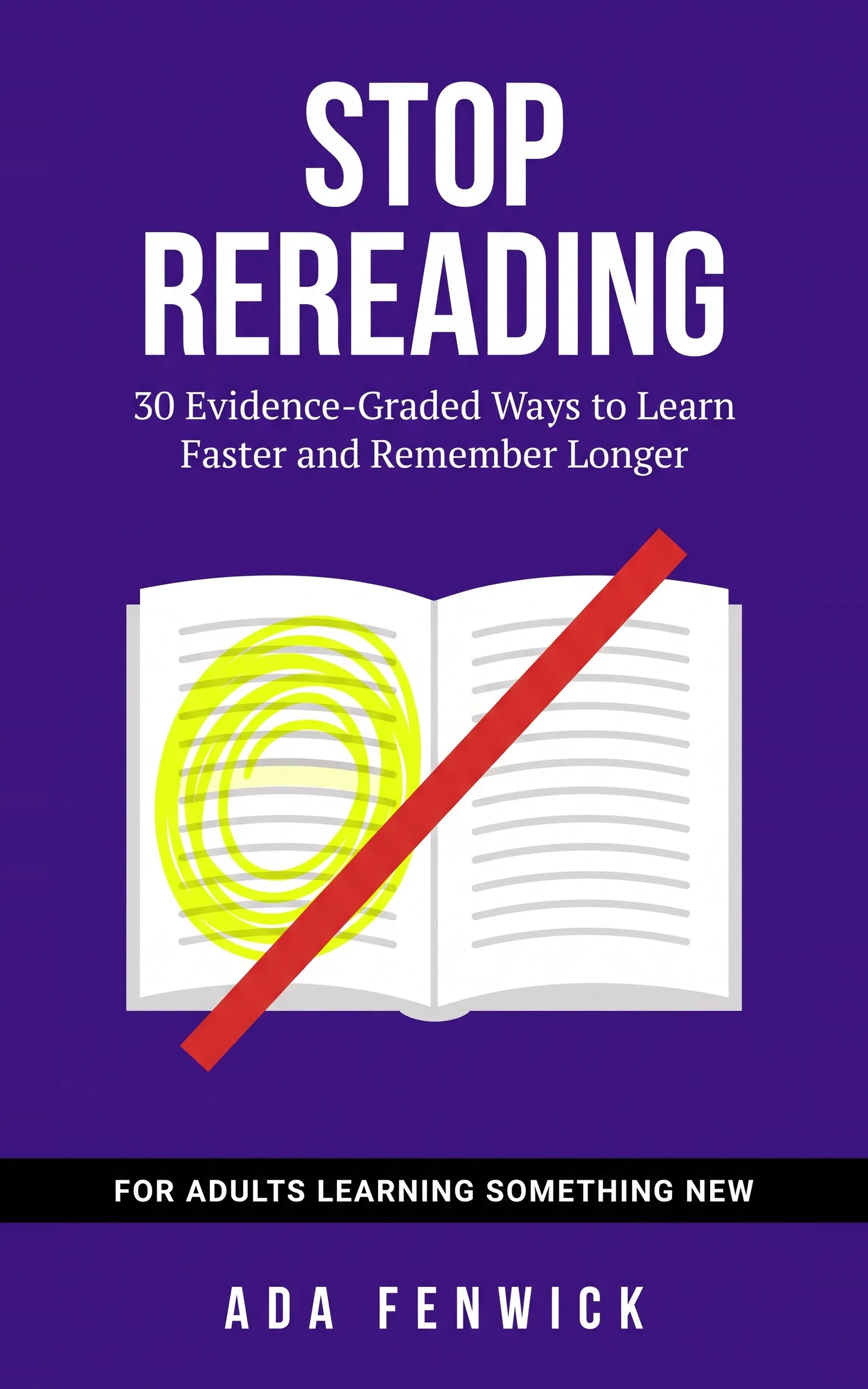
The book for this problem
Stop Rereading
30 Evidence-Graded Ways to Learn Faster, Remember Longer, and Use What You Study, for Adults Learning Something New. By Ada Fenwick, 224 pages.
Where this problem is in the book:
- Retrieval Practice: Pull It Out, Don't Pour It In
- Spacing: Less Cramming, More Coming Back
- Sleep Is Part of Studying
Links go to Amazon. ToolGenX publishes this book under a pen name and earns from every sale. Amazon sets the price and handles delivery and returns.
The seven days, in short
- Tonight, list the topics. Put the ones most likely to be tested at the top. If there are too many, cut from the bottom.
- Learn each topic once, then test it. End every session by closing the book and writing what you can recall. Then check and fix the gaps.
- Come back after 1 to 3 days. Each topic gets at least two more closed-book reviews before the exam.
- Use the evening for the hardest topic. Recall it for ten minutes the next morning, before anything else.
- Keep your normal bedtime every night. That is your study cutoff, all week.
- In the last two days, review everything once or twice. Keep these sessions short, a day apart.
This is our sketch built from the tools in the book, not a tested schedule. The pieces each have research behind them, and the next sections show it.

Why the cram night feels better than it works
Picture a parent at ten on a Thursday night, quizzing a teenager on a history test that is tomorrow. By eleven-thirty he knows every date. He gets a decent grade. Three weeks later the same material shows up on a cumulative quiz, and he can barely start an answer.
That is cramming doing exactly what it is built to do. It works for one day.
Spacing the same hours out works for longer. In a 2008 study by Cepeda and colleagues, more than 1,350 people learned facts, reviewed them after a gap, then took a final test. For a test one week away, the best gap was about 20 to 40 percent of that week. That is roughly 1 to 3 days. Being a little off the best gap cost little. Having no gap at all is what costs you.
Cramming also fools the person doing it. In a 2009 flashcard study by Kornell, spreading the practice out beat massing it. Yet 72 percent of learners believed after the first session that massing had worked better. So expect your spaced week to feel less sure than a cram night. That feeling is not a verdict.
What you do in each session matters as much as when. Make every review a test, not a reread. On tests 2 days and a week later, students who practiced recall beat students who restudied, in a 2006 study by Roediger and Karpicke. With a week left, that is the trade to make.
Sleep is part of this week's plan
When time is short, sleep looks like the one thing you can cut. The research says it is doing part of the studying.
In a 2016 study by Mazza and colleagues, 40 people learned foreign words in two sessions, 12 hours apart. One group studied in the morning and again that evening. The other studied in the evening, slept, and studied again the next morning. The sleep group needed about half as much practice to relearn the words in the second session. They also remembered more at one week and six months.
That is why the plan puts the hardest topic in the evening and a short recall the next morning.
Now the other side. Meta-analyses by Newbury and colleagues in 2021 found that losing sleep after learning hurt memory by a small amount. Losing it before learning hurt more. The authors also found signs of publication bias, so the exact sizes are loose. The direction is the same in both.
One more study is useful in exam week. Okano and colleagues gave activity trackers to 100 chemistry students, and 88 finished. Sleep on the night before a test showed no link to the score. Sleep across the week and month before did. We read that as a plain message: the whole week counts, not only the last night.
This describes research only. If you have ongoing trouble sleeping, talk to a health care provider.

Where the book picks up
Stop Rereading was written for adults studying for an exam on top of a full life. Each of its 30 tools carries a badge for its evidence. With a week left, three chapters matter most.
Retrieval Practice: Pull It Out, Don't Pour It In has the Blank Page and Flashcards Done Right, both SOLID. The Blank Page is ten minutes with a closed book, then a second pen for the gaps.
Spacing: Less Cramming, More Coming Back has the Spacing Calendar (SOLID). Its last step fits this week: in the final days, add one or two short reviews of everything, a day or two apart.
Sleep Is Part of Studying has Study, Then Sleep and the No All-Nighter Rule, both SOLID. If you fall behind, move work earlier or cut scope. Do not move it later.
If the exam is further off than a week, our page on how far apart to space study sessions has the gaps for longer waits.
Is Stop Rereading the right book for you?
Yes, if
- Your exam is about a week away and you feel behind
- Your plan so far is to read everything one more time
- You are thinking about a late night or two to catch up
Skip it if
- You want a way to learn a whole course from zero in seven days
- You have ongoing trouble sleeping (talk to a health care provider)
Fair doubts before you buy
Cramming got me through school. Why stop now?
Cramming does work for the next morning, partly. On a test 5 minutes after study, restudy beat testing in a 2006 study by Roediger and Karpicke. But after 2 days and a week, testing won. Dunlosky wrote that cramming can help students "squeak by," but it is "not that effective" for keeping what they learned.
I am too far behind to sleep. Is one late night really so bad?
In a 2021 set of meta-analyses by Newbury and colleagues, sleep loss before learning hurt new memory by a moderate amount (g = 0.621). Teens in a diary study who gave up sleep to study more had more trouble in class the next day. If you are behind, the book says to move work earlier and cut scope, not stay up.
Get Stop Rereading
Thirty study tools for adults learning something new, each traced to its research and badged SOLID, PROMISING or STORY ONLY, from the Closed-Book Check to a weekly learning system.
Links go to Amazon. ToolGenX publishes this book under a pen name and earns from every sale. Amazon sets the price and handles delivery and returns.
This book is for general education about learning methods. It is not medical or psychological advice. If you have ongoing trouble with sleep, attention or memory, talk to a health care provider.

Questions people ask about this
- How many times should I review each topic in a week?
- At least twice after you first study it, with a gap of 1 to 3 days between reviews. That gap comes from a 2008 study by Cepeda and colleagues of more than 1,350 people. For a test a week away, the best gap was about 20 to 40 percent of the wait.
- Is it better to reread my notes or do practice questions?
- Practice questions, or any closed-book recall with a check afterward. In the 2013 review of ten study methods by Dunlosky and colleagues, practice testing and spacing were the only two rated high. Rereading, highlighting and summarizing were rated low.
- Should I study the night before the exam?
- A short closed-book review is fine. Stop at your usual bedtime. In a study of 100 chemistry students by Okano and colleagues, sleep on the single night before a test showed no link to the score. Sleep across the week and month before did. One good night is not a rescue, so protect all seven.
- What if I cannot cover everything?
- Cut scope on purpose. The No All-Nighter Rule in the book says to choose the topics most likely to be tested and drop the rest for now. Then give the topics you keep real closed-book reviews, spaced a day or more apart.
Related problems
- How far apart to space your study sessions, based on when the test is
The best gap between reviews grows with the time until your test: about 1 to 3 days for next week, 3 to 5 weeks for next year. Here is the rule.
- You studied it last night and it is gone today. Why that happens, and what fixes it
Read your notes three times and still blank on the first question? Familiar is not the same as remembered. Here is why, and a five-minute fix.
- Does having your phone nearby hurt studying? The brain drain study, checked again
A 2017 study said a silent phone on your desk drains your thinking. A careful 2022 repeat did not find it. Here is what does cost you when you study.
- Everything inside Stop Rereading
Every chapter, who the book is for, and every problem it helps with.
// Also on this topic
- guideRecital, match or big game tomorrow? How to spend tonight before the day
The night before a recital or match is too late to learn much new. Do one full run, protect your sleep and plan a real warm-up for the morning.
- guideBlocked vs random practice: which one helps an adult learner more?
Random practice beats blocked practice in the lab. On real courts and in practice rooms the edge is small. Here is how to use both, in the right order.
- bookThe Practice Lab
30 Evidence-Graded Drills to Learn Any Skill Faster, Break Through Plateaus, and Make It Stick