Last updated
Does practicing in your head work? What three reviews of mental practice found

The pool is closed until Thursday
Say you signed up for adult swim lessons the month you turned 55. Class meets twice a week. In between, the pool is crowded or too far away.
You can get from one end to the other. What you cannot do yet is breathe to the side without lifting your whole head, which sinks your legs.
On the off days you watch a video of the stroke and nod along. By Thursday most of it is gone. The instructor says "roll, don't lift," you know exactly what she means, and your body does the old thing anyway.
You may have more practice time than you think. Some of it can happen on the couch or in bed. It will not replace the pool, and the research is plain about that. But those minutes are worth something.

Rehearsing the move, not picturing the trophy
There is a lot of fuzzy talk about visualization: see yourself winning, hear the crowd. That is not what this research tested.
In the studies, mental practice has a narrow meaning. Driskell, Copper and Moran, in a 1994 review, defined it as "the cognitive rehearsal of a task in the absence of overt physical movement." In plain words, you run the movement in your head without doing it.
For a swimmer, that means the arm reaching forward, the body rolling and one goggle staying in the water while the mouth clears. It does not mean a picture of yourself as a confident swimmer at the beach.
That review pooled the earlier studies. It found that "mental practice has a positive and significant effect on performance." The size depended on the kind of task, the gap before testing and how long the mental practice lasted.

How big the effect is once the bias is checked
The 1994 review is three decades old, and much of psychology has been rechecked since. So in 2020, Toth and colleagues ran a follow-up of 37 studies published between 1995 and 2018.
The effect held up, but it shrank. After checking for publication bias, they wrote that mental practice "has a small but significant positive effect on performance." The number was r = 0.131. Task type and the kind of imagery changed the result.
A 2021 meta-analysis by Simonsmeier and colleagues looked at imagery training in sports. It found an overall effect "medium in magnitude," with d = 0.431. Imagery helped performance, and also motivation and how people felt. More intensive training tended to work better.
Three reviews across 27 years point the same way. Mental practice helps, and its honest size sits between small and medium.
Then comes the part most visualization advice skips. A 2022 meta-analysis by Jiménez Díaz and colleagues pooled 24 studies and compared three kinds of practice. During learning, physical practice alone had an effect of 1.75. Mental practice alone came in at 0.80, and the two combined at 1.78. In their words, mental practice "does not replace" physical practice, but it can add to it "under some conditions."
The book adds one fair caveat. In some studies the combined group may simply have practiced longer in total. The safe reading is that adding a few imagined reps to real practice helped more than real practice alone, in the studies we have.
One more finding matters. A 2021 review by Ladda and colleagues listed past experience with the movement among the factors that shape results. Imagery seems to work better once you have done the move for real.

Add imagined reps around the real ones
The Practice Lab gives this research two drills in Practice in Your Head, and both are SOLID.
The Mental Run-Through takes five to ten minutes:
- Pick one short piece of the skill, a few seconds long, that you have done for real a few times.
- Sit or lie still, close your eyes and run it at its real speed.
- Include how it feels: where your weight goes, the sound, the water.
- If the imagined version goes wrong, stop, rewind and run the correct one.
- Do five to ten runs. Stop early if your mind drifts.
- Write one detail you had not noticed before.
Mix Real and Imagined Reps adds three to five minutes to a normal session. Do three imagined reps before your first real rep of a hard piece, and two between sets. On days you cannot practice for real, do a Mental Run-Through instead. Never trade a session you could do for an imagined one. If you are resting an injury, ask your doctor or physical therapist before adding any reps. The book says the counts are a starting point, since no study settles the best ratio.
The chapter Watch, Copy, Get Coached adds one link. A 2022 pair of analyses by Chye and colleagues found that watching a model while imagining yourself doing the move beat watching alone. It did not beat imagery alone.
We find the honesty here useful. The drills earn their SOLID badge, and the effect is still modest. That is the right size of promise for a skill you are building on a couch.
If your bigger problem is when you practice, see how long a practice session should be.
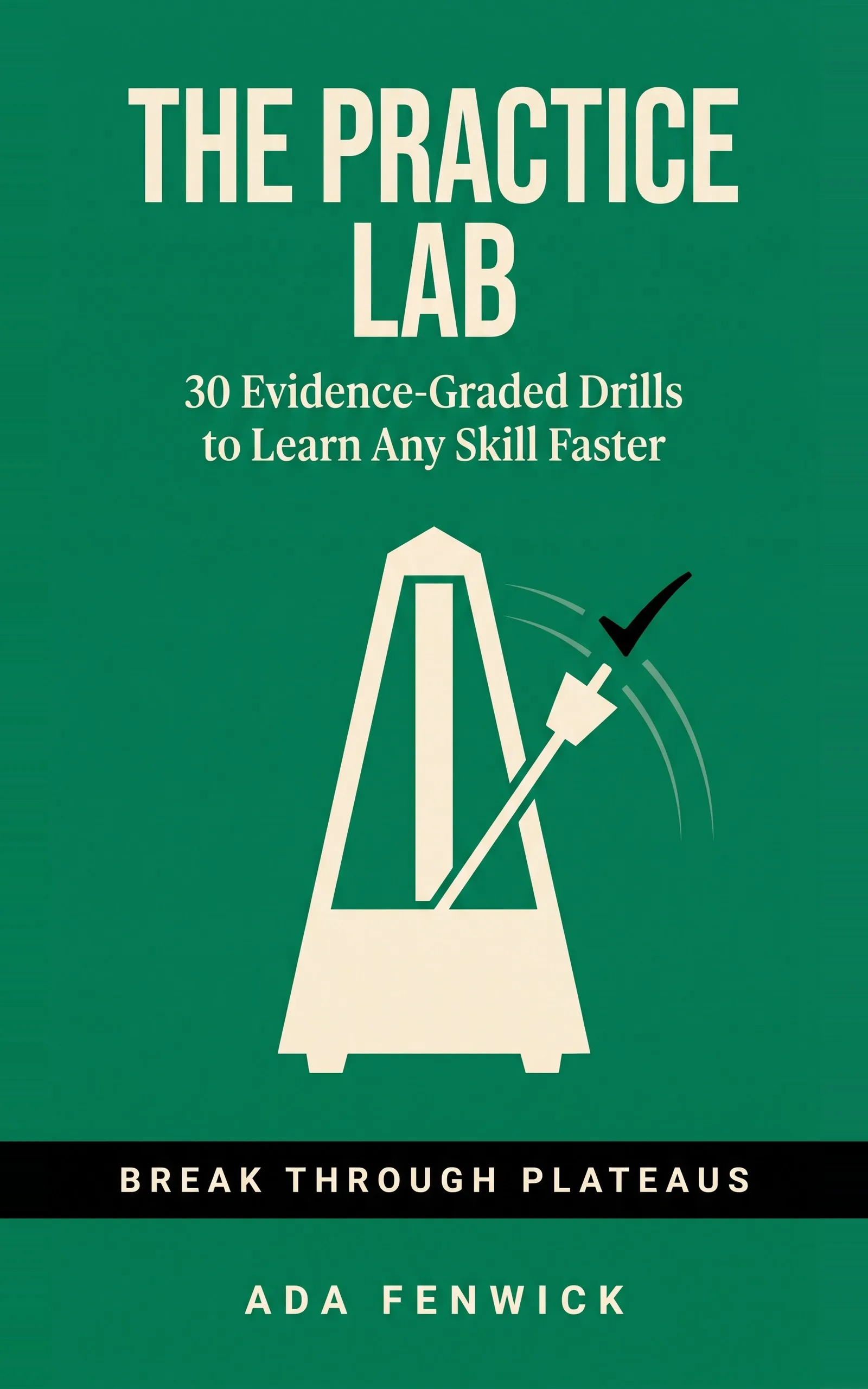
The book for this problem
The Practice Lab
30 Evidence-Graded Drills to Learn Any Skill Faster, Break Through Plateaus, and Make It Stick. By Ada Fenwick, 225 pages.
Where this problem is in the book:
- Practice in Your Head
- Watch, Copy, Get Coached
Links go to Amazon. ToolGenX publishes this book under a pen name and earns from every sale. Amazon sets the price and handles delivery and returns.

Is The Practice Lab the right book for you?
Yes, if
- You can only practice for real a couple of times a week
- You want extra reps on days your body, schedule or neighbors say no
- You have heard visualization works and want to know how much
Skip it if
- You hope picturing success will replace practice (it will not)
- You are resting an injury and have not asked a doctor or physical therapist what is safe
Fair doubts before you buy
Is this not just positive thinking?
No. In the research, mental practice means running the movement itself in your head, without moving. A 1994 review defined it as "the cognitive rehearsal of a task in the absence of overt physical movement." Picturing a trophy or a crowd is a different thing, and it is not what these studies tested.
If the effect is small, why bother?
Because the real choice on a closed-pool day is imagined reps or nothing. A few minutes in your head costs almost nothing and adds modest, real reps. On days you can practice for real, a few imagined reps around the real ones did about as well or a little better than real practice alone.
Get The Practice Lab
Thirty practice drills for adults learning a skill, each traced to its research and badged SOLID, PROMISING or STORY ONLY, from the Next-Day Test to shaking off the rust.
Links go to Amazon. ToolGenX publishes this book under a pen name and earns from every sale. Amazon sets the price and handles delivery and returns.
This book is for general education about practice methods. It is not medical, physical therapy or coaching advice. If practice hurts, stop and see a qualified professional.

Questions people ask about this
- Does visualization really work for sports?
- Yes, with a modest effect. A 2021 meta-analysis of imagery training in sports found an effect "medium in magnitude," and imagery helped motivation too. A 2020 review that checked for publication bias put the effect at small but significant.
- Can mental practice replace physical practice?
- No. A 2022 meta-analysis of 24 studies found mental practice alone helped much less than physical practice, and concluded that it "does not replace" physical practice. Its best use is alongside real reps, or on days when real reps are not possible.
- How much mental practice should I do?
- A 2025 analysis of 86 studies and 3,593 athletes suggested about ten minutes, three times a week, over roughly a hundred days produced the strongest gains. That is a pattern pulled from many studies, not a tested plan, so treat it as a starting point.
- Should I imagine from inside my body or watch myself from outside?
- Nobody has settled this for everyday learners. One narrow 2023 analysis found the inside view worked better for skill passing from one limb to the other. The book suggests running it as if you are doing it, with how it feels, and switching views if that helps you spot a mistake.
- Does mental practice work for a skill I have never done?
- It seems to work better once you have done the movement for real. A 2021 review listed past experience with the movement among the factors that shape results. You need a felt version of the move to replay.
Related problems
- How long should a practice session be, and how often should you practice?
No study backs 20 or 45 minutes. The evidence points to about an hour or less per sitting, most days, rather than one long weekend session.
- Recital, match or big game tomorrow? How to spend tonight before the day
The night before a recital or match is too late to learn much new. Do one full run, protect your sleep and plan a real warm-up for the morning.
- Too old to learn an instrument or a sport at 50, 60 or 70? What the studies say
A 2008 review found older adults keep the ability to learn new movement skills. Here is what does change with age, and how to adjust your practice.
- Everything inside The Practice Lab
Every chapter, who the book is for, and every problem it helps with.
// Also on this topic
- guideTaking notes by hand or on a laptop: what the repeat studies found
The famous laptop note-taking study did not hold up when it was repeated. Here is what the newer studies found, and what matters more than the pen.
- guideHow to use ChatGPT to study without letting it do the learning for you
In a trial with nearly 1,000 students, a plain chatbot raised practice scores and lowered exam scores. Here is how to use AI for hints, not answers.
- bookStop Rereading
30 Evidence-Graded Ways to Learn Faster, Remember Longer, and Use What You Study, for Adults Learning Something New