Last updated
You had it perfect last night. Why did it fall apart when it counted?

Clean at the kitchen table, gone at the jam
Picture a fiddle tune and a Thursday night jam at the library. You have been learning the tune for two weeks. One phrase, a quick climb up the strings, keeps tripping you.
Wednesday night you sit at the kitchen table with a metronome. You play the phrase slowly, then faster. By the fifteenth try it is clean, and it stays clean five times in a row. You put the bow down feeling ready.
Thursday at the jam, the tune comes around. The phrase arrives and your fingers land late. You fake your way back in two bars later.
You did have it. You had it at the end of a practice session, with the phrase fresh and nothing else to think about. That is a different thing from having it a day later, in a room full of people, starting cold.
Most of us read that as a failure of talent, or age, or nerve. The research points somewhere else.

Practice performance and learning are two different things
Researchers who study skill split one everyday word into two. Performance is what you can do right now, during or right after practice. Learning is what is still there later.
In 2015, Soderstrom and Bjork reviewed the research on that split. What we can see while we practice, they wrote, is performance, "which is often an unreliable index" of whether learning happened.
The gap runs both ways. Learning can happen with no visible change in practice. And practice can look better without much learning behind it. In their words, "certain manipulations can have opposite effects on learning and performance."
A 2012 review of motor skills by Kantak and Winstein reached the same place. Hard practice conditions "may impair practice performance, but enhance long-term retention of motor skills." The authors concluded that a test given later is a better sign of learning than how you do at the end of practice.
That gives the book its main line: a good practice session often feels worse than a bad one. The reverse matters too. A session that ends in frustration has not failed by default.

Why the smooth run fools almost everyone
If the gap were easy to feel, it would not catch so many people. It catches them in a predictable direction.
In 2001, Simon and Bjork had people learn timing patterns on a keypad. Some practiced each pattern in a block. Others practiced them mixed. Then everyone predicted how they would do on a test 24 hours later.
The result: "blocked practice enhanced acquisition but harmed retention. Participants, though, predicted better performance given blocked practice." The easy practice felt more like learning, and people bet on it. They bet wrong. The authors warned that people who treat the current ease of a skill as a sign of learning do so "at their peril."
Later work found the same mismatch. A 2007 study by Simon found that learners' predictions "did not match the group differences actually observed." A 2010 study by Kornell and colleagues found it in a different task, learning visual categories. People rated massed study as better, even though spacing won.
So the five clean runs on Wednesday night were not a lie. They measured what your hands could do while the phrase was still warm. That is just not the question you cared about.
The three-minute check that shows what stuck
When researchers want to know what was learned, they wait and test cold. A 2022 analysis by McKay and colleagues called delayed tests "the gold standard in motor learning research." You can borrow the idea with no lab at all.
This is the heart of The Practice Lab. Its chapter Practice Is Not Performance gives the Next-Day Test, one of the book's five SOLID drills:
- At the end of today's session, write the task and how the last few attempts went.
- Tomorrow, before any warm-up, do the task cold. Three to five attempts is plenty.
- Score the first attempt on its own. It is the most honest one.
- Write the next-day score beside yesterday's ending.
- If it dropped a lot, do not panic. Yesterday showed you a peak, not a floor.
- Use the next-day score to pick what to practice next.
The book is clear about the badge. The gap between practice and learning is one of the best-replicated findings in motor learning, so the principle is SOLID. The exact number of attempts on the card is the author's choice.
The same chapter adds a second drill, Separate Practice Days from Show Days (PROMISING). Most days before an event are practice days, where messy work is allowed and judged by the next-day test. One or two days are dress rehearsals: the whole thing once, for a listener or a camera, no restarts.
There is evidence behind the rehearsal part. A 2021 analysis by Low and colleagues pooled 14 studies of pressure training, 10 in sport and 4 in law enforcement, with 394 people. Practicing under simulated pressure helped later performance under pressure, with a medium-sized effect once one outlier was removed. The split itself has never been tested as a method, which is why it says PROMISING.
What we like here is how little it asks. Three minutes the next morning, and your scoreboard changes from how practice felt to what it left behind.
If your event is tomorrow and there is no time for a week of checks, our page on a recital or match tomorrow covers tonight. And if the slip comes from a routine of thirty reps in a row, blocked vs random practice is the next read.
How to Use This Lab has one more rule worth repeating. Some drills ask for more reps or a faster tempo. Pain is not part of the method. Stop and ask a professional.
The book for this problem
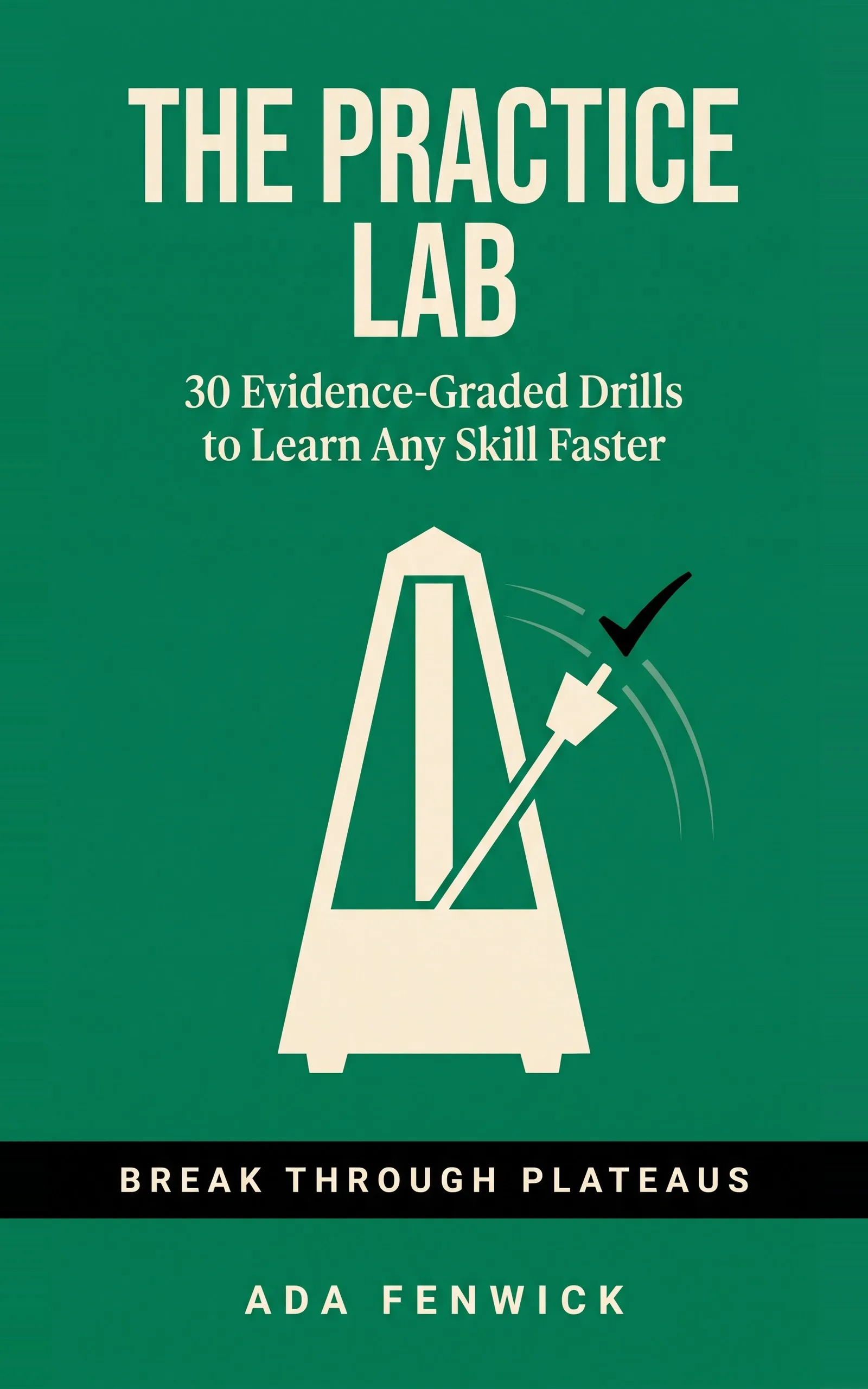
The Practice Lab
30 Evidence-Graded Drills to Learn Any Skill Faster, Break Through Plateaus, and Make It Stick. By Ada Fenwick, 225 pages.
Where this problem is in the book:
- Practice Is Not Performance
- How to Use This Lab
Links go to Amazon. ToolGenX publishes this book under a pen name and earns from every sale. Amazon sets the price and handles delivery and returns.
Is The Practice Lab the right book for you?
Yes, if
- You get a passage, a serve or a speech right at home, and it falls apart the next day
- You end each session on a clean run and still feel unready
- You want a simple test that shows what actually stuck
Skip it if
- Your hands, wrists or voice hurt when you practice (stop and see a teacher, doctor or physical therapist)
- You freeze from stage fright that stops you from playing at all (a professional can help more than a drill)
Fair doubts before you buy
Is this not just nerves?
Nerves can play a part, and the book covers pressure too. But the slip shows up even with no one watching, like a toast that falls apart in the car the next morning. The bigger cause is judging practice by how its last few minutes felt. A cold check the next day separates the two.
Should I just practice more until it holds?
More of the same can make the session look better without making the skill stick. In the keypad study, repeating one pattern in a block looked best in practice and did worse on the test a day later. Changing what you measure helps more than adding minutes.
Get The Practice Lab
Thirty practice drills for adults learning a skill, each traced to its research and badged SOLID, PROMISING or STORY ONLY, from the Next-Day Test to shaking off the rust.
Links go to Amazon. ToolGenX publishes this book under a pen name and earns from every sale. Amazon sets the price and handles delivery and returns.
This book is for general education about practice methods. It is not medical, physical therapy or coaching advice. If practice hurts, stop and see a qualified professional.
Questions people ask about this
- Why can I play something perfectly in practice but not later?
- Because the last few runs of a session measure what your hands can do while the piece is fresh. That is real, but it is not the same as what you will keep. A 2015 review by Soderstrom and Bjork called practice performance "often an unreliable index" of learning.
- What is the difference between performance and learning?
- Performance is what you can do right now, during or just after practice. Learning is what is still there later. Researchers measure learning with a delayed test: practice, wait, then test cold. A 2022 analysis called these tests "the gold standard in motor learning research."
- How do I know if my practice is working?
- Test it cold the next day. Before any warm-up, do the task three to five times and score the first attempt on its own. Write it next to how yesterday ended. Use the next-day score, not the end of the session, to decide what to practice next.
- Why does a good practice session sometimes feel bad?
- Harder practice can make a session look worse and still help you keep more. A 2012 review by Kantak and Winstein found that hard practice conditions may hurt how you do in practice but help long-term retention. So a frustrating hour is not a failed hour by default.
- How do I practice for performing under pressure?
- Add a little pressure on purpose before the day. A 2021 analysis by Low and colleagues pooled 14 studies of pressure training with 394 people. Practicing under simulated pressure helped later performance under pressure. A run-through for one listener, or filming with no do-overs, is a small dose of that.
Related problems
- Recital, match or big game tomorrow? How to spend tonight before the day
The night before a recital or match is too late to learn much new. Do one full run, protect your sleep and plan a real warm-up for the morning.
- Blocked vs random practice: which one helps an adult learner more?
Random practice beats blocked practice in the lab. On real courts and in practice rooms the edge is small. Here is how to use both, in the right order.
- Is the 10,000-hour rule true? What the violin study really found
The 10,000-hour rule came from one violin study and a best-known retelling. Here is what the hours really showed, and what predicts progress better.
- Everything inside The Practice Lab
Every chapter, who the book is for, and every problem it helps with.
// Also on this topic
- guideYou studied it last night and it is gone today. Why that happens, and what fixes it
Read your notes three times and still blank on the first question? Familiar is not the same as remembered. Here is why, and a five-minute fix.
- guideHow far apart to space your study sessions, based on when the test is
The best gap between reviews grows with the time until your test: about 1 to 3 days for next week, 3 to 5 weeks for next year. Here is the rule.
- bookStop Rereading
30 Evidence-Graded Ways to Learn Faster, Remember Longer, and Use What You Study, for Adults Learning Something New