Last updated
Blocked vs random practice: which one helps an adult learner more?

| Question | Blocked practice | Random (mixed) practice |
|---|---|---|
| What it looks like | All reps of one skill, then the next: AAA, BBB, CCC | Skills mixed in an unpredictable order: A, C, B, B, A, C |
| How the session feels | Smooth; the shots start landing one after another | Messier; often feels worse while you do it |
| Lab results | Looks better during practice, worse on later tests | Better retention and transfer in many lab studies since 1979 |
| Real-world results | Still the base for a skill that does not work yet | Small and not statistically significant in recent analyses |
| Children | Works about as well as mixing | Benefit close to zero in reviews of young learners |
| Adults over 65 | One data set favored it | One analysis favored it; the question is open |
| Best use | Getting a new skill to work at all | Skills you can already do at least some of the time |
The bucket of balls and the real game
Say you play tennis on Sunday mornings at the park. Before your doubles game, you take a bucket of balls to an empty court. Twenty forehands, then twenty backhands, then twenty serves.
By the end of each set, the ball goes where you aim. It is a good feeling.
Then the game starts. A ball comes to your backhand, then a short one, then a lob, then one at your feet. Shots that landed twenty times in a row an hour ago now sail long or hit the net.
You did hit them, with the same ball from the same place and nothing else to think about. The game never once asks for that. That is the gap between blocked and random practice, and it is one of the most studied questions in learning a movement.

Mixing wins big in the lab
The classic study is from 1979, by Shea and Morgan. People learned three movement tasks in either a blocked or a random order. Retention was tested after 10 minutes or 10 days. Random practice led to better retention when the test order differed from the order practiced. It also led to better transfer to new tasks, most of all for the hardest one.
A 1994 study took the idea to a baseball field. Hall, Domingues and Cavazos gave 30 college players 12 extra batting sessions over six weeks. The pitches were fastballs, curveballs and change-ups. The random group improved 56.7 percent. The blocked group improved 24.8 percent. The group with no extra practice improved 6.2 percent. The book is careful: that is ten players per group, and it is more than thirty years old.
There is also the catch you feel in your own sessions. In a 2001 keypad study by Simon and Bjork, blocked practice looked better while people did it and worse on a test a day later. People still predicted blocked would win.

Out on real courts, the edge shrinks
If the story stopped there, everyone should shuffle everything. It does not stop there.
In 2004, Brady pooled 61 studies and found an overall effect of mixing of .38. It split sharply by setting: .57 in basic lab research and .19 in applied research, the kind closer to real teaching. A 2007 review by Barreiros and colleagues looked only at applied settings. Of those studies, 60 percent failed to find a benefit from mixing.
The most recent analyses, by Czyż and colleagues in 2024, pooled 54 studies of retention. Lab studies showed a large benefit from random practice. In applied studies the effect was small and not significant. In their words, the benefit in applied settings "was almost negligible."
Age changes the picture too. Brady found an effect of .50 for adults and .10 for younger learners. A 2019 review of 25 papers on children found "mainly no or conflicting evidence." For older adults, the two newest lines of work point in opposite directions, and nobody has settled it.
So the fair summary is plain. The lab effect is large and well replicated. On courts, in gyms and in practice rooms, every recent analysis finds it small and uncertain.

Block it until it works, then shuffle it
There is a way to use both. In 2010, Porter and Magill tested a schedule that started blocked, moved to a fixed rotation (A, B, C, A, B, C) and ended in random order. For golf putting, novices on this rising schedule kept more. For basketball passes, they did better on retention and transfer than people who stayed blocked or stayed random.
A 2024 sprint hurdles study by Makaruk and colleagues found a mixed result: the same retention, but better transfer for the rising schedule. Two more studies hint at when to switch. In a 2008 study of 48 people by Simon, Lee and Cullen, moving to a new task after one success gave results like random practice. And a 2022 darts study of 120 people found mixing helped when practice kept errors low.
The Practice Lab turns this into two drills in its chapter Blocked or Mixed?, both badged PROMISING:
- Block First, Then Mix. Repeat a new skill in a block until you can do it three times in a row. Then add it to a fixed rotation. When that feels steady, go random. After a good attempt, switch skills. After a miss, stay and try again.
- The Shuffle Session. Pick two or three related skills you can already do sometimes. Mix them so the same one rarely comes twice in a row. Expect it to feel worse. Compare a week of mixed sessions with a week of blocked ones, using cold scores the next day.
Both drills lean on the Next-Day Test from the chapter Practice Is Not Performance, because the session itself will mislead you. The book also flags music: a 2024 study of advanced violinists found blocked practice worked best at a delayed test. If mixing wrecks a passage, send it back to blocks.
What we like is that the chapter refuses to oversell. Mixing is a reasonable, cheap experiment. Your own next-day scores decide whether it stays. For why a smooth session can fool you in the first place, see practicing it perfectly and then messing it up.
Some drills ask for more reps or a faster tempo, so the book's one safety rule applies here too. Pain is not part of the method. Stop and ask a professional.
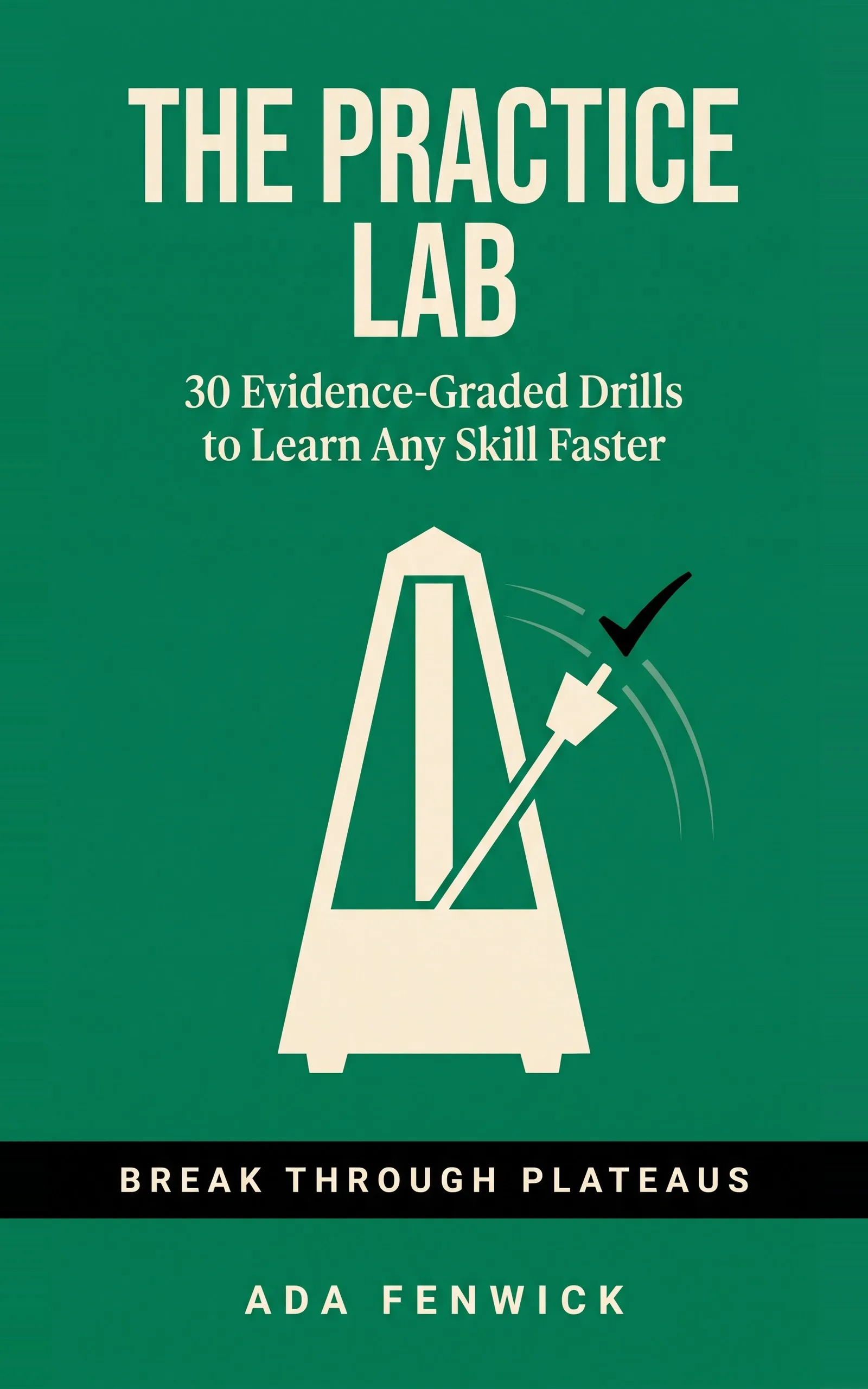
The book for this problem
The Practice Lab
30 Evidence-Graded Drills to Learn Any Skill Faster, Break Through Plateaus, and Make It Stick. By Ada Fenwick, 225 pages.
Where this problem is in the book:
- Blocked or Mixed?
- Practice Is Not Performance
Links go to Amazon. ToolGenX publishes this book under a pen name and earns from every sale. Amazon sets the price and handles delivery and returns.

Is The Practice Lab the right book for you?
Yes, if
- Your shots or passages work in drills and fall apart in a game or a run-through
- A coach or video told you random practice is proven to be better
- You want to know when to repeat and when to mix
Skip it if
- You coach young children and want proof that mixed drills speed up their learning (the research does not show that)
- You want one schedule that works for every skill
Fair doubts before you buy
Is random practice not proven to be better?
Only in the lab. There the effect is large and has been repeated many times. In applied settings, closer to real coaching, recent analyses find it small and not statistically significant. That does not make mixing useless. It makes it an experiment you check with your own next-day scores.
Will mixing make my practice feel worse?
Yes, usually. That is expected. In a 2001 keypad study, blocked practice looked better during the session and did worse on a test a day later, yet people still predicted blocked would win. A messier session is not a failed one, which is why the next-day check matters.
Get The Practice Lab
Thirty practice drills for adults learning a skill, each traced to its research and badged SOLID, PROMISING or STORY ONLY, from the Next-Day Test to shaking off the rust.
Links go to Amazon. ToolGenX publishes this book under a pen name and earns from every sale. Amazon sets the price and handles delivery and returns.
This book is for general education about practice methods. It is not medical, physical therapy or coaching advice. If practice hurts, stop and see a qualified professional.
Questions people ask about this
- What is blocked practice?
- Blocked practice means you finish all your attempts at one skill before moving to the next: AAA, then BBB, then CCC. Thirty serves, then thirty dinks, then thirty drops is blocked practice. It makes a session look smooth because the same move comes again and again.
- What is random practice?
- Random practice mixes skills in an unpredictable order, such as A, C, B, B, A, C. Each attempt asks which skill this moment needs, as a real game does. Researchers call the extra difficulty contextual interference.
- How many skills should I mix at once?
- Two or three related ones. The classic 1979 study by Shea and Morgan used three tasks, and a 2007 study by Simon found the effect with only two patterns. The book suggests two or three skills you can already do at least some of the time.
- Is random practice better for older adults?
- Nobody knows yet. One 2024 analysis found a large benefit for older adults, while data reported by another group found adults over 65 doing better with blocked practice. Until that is settled, the book suggests starting blocked and then mixing, which is safe either way.
- Does random practice work for music?
- It is less clear. The book notes a 2024 study of advanced violinists where blocked practice worked best at a delayed test. If mixing wrecks a passage you could almost play, take that passage back to blocks for a while.
Related problems
- You had it perfect last night. Why did it fall apart when it counted?
You played it clean ten times last night and lost it today. The research on practice versus learning explains why, and a three-minute check fixes it.
- How long should a practice session be, and how often should you practice?
No study backs 20 or 45 minutes. The evidence points to about an hour or less per sitting, most days, rather than one long weekend session.
- Too old to learn an instrument or a sport at 50, 60 or 70? What the studies say
A 2008 review found older adults keep the ability to learn new movement skills. Here is what does change with age, and how to adjust your practice.
- Everything inside The Practice Lab
Every chapter, who the book is for, and every problem it helps with.
// Also on this topic
- guideA gift for an adult going back to school or studying for a big exam
Shopping for an adult student or someone facing a licensing exam? Give study tools with real evidence behind them, plus a few cheap extras and one offer.
- guideTaking notes by hand or on a laptop: what the repeat studies found
The famous laptop note-taking study did not hold up when it was repeated. Here is what the newer studies found, and what matters more than the pen.
- bookStop Rereading
30 Evidence-Graded Ways to Learn Faster, Remember Longer, and Use What You Study, for Adults Learning Something New