Last updated
How far apart to space your study sessions, based on when the test is

| When the test is | Best gap found | In days or weeks | Where it comes from |
|---|---|---|---|
| About 1 week away | 20 to 40 percent of the wait | Roughly 1 to 3 days | Cepeda and colleagues, 2008 |
| 2 to 3 months away | Not reported in the study | About 1 to 2 weeks | The book's estimate between the two results |
| About 1 year away | 5 to 10 percent of the wait | Roughly 3 to 5 weeks | Cepeda and colleagues, 2008 |
| The last week before any test | One or two short reviews of everything | A day or two apart | The Spacing Calendar, last step |
The rule in one line: the further off the test, the longer the gap
The table above is the whole rule. Look up your test date, pick the gap next to it, and put review days on a calendar one gap apart.
There are two things the table does not show. First, the gap is a share of the wait, and that share shrinks as the test moves further away. Second, being a little off costs little. A review every week or two for a test in two months is in the right zone. A review every hour on the last night is not.

Where the numbers come from
Spacing means splitting study into sessions with gaps between them. Its opposite is cramming: the same hours in one block. It is one of the most tested ideas in learning research.
In 2006, Cepeda and colleagues pulled together 839 assessments of spaced study, from 317 experiments in 184 articles. All used verbal tasks, like word lists and word pairs. Only 12 of 271 direct comparisons found no benefit from spacing, or a negative one. The review also found that the best gap grew as the time until the test grew.
Two years later the same group ran a large study of more than 1,350 people. People learned a set of facts, then reviewed them after a gap of up to 3.5 months. They took a final test up to a year after the review. For any test date, a longer gap helped at first. Past the best point, results fell off slowly.
That study gives the first and third rows of the table. It did not report a test two or three months away. The book reads between the two results and suggests about 1 to 2 weeks. It says plainly that this is its own estimate, not a published number, and we repeat that here.
The authors drew a sharp conclusion from the pattern: "many educational practices are highly inefficient." Most of us learned to study the week before, in one long push. The data point the other way.

What to do in each review session
The gap tells you when to come back. It does not tell you what to do once you are there.
The answer from the book is to make every review a test. Close your notes and write what you can recall, or run your flashcards cold. Then check. Rereading after a gap can help a little, as Dunlosky noted in 2013. Testing yourself after a gap does more.
How many reviews is enough? Rawson and Dunlosky (2011) ran three experiments with 533 students learning concepts, tested one to four months later. Their advice: practice each idea until you recall it correctly 3 times. Then relearn it 3 more times, in widely spaced sessions.
A big flashcard deck makes this hard to track by hand. The book's Three-Box Card System does the math for you. Cards you get right move to a box you see less often. Cards you miss go back to the front. The idea goes back to a card box from 1972 credited to Sebastian Leitner. No controlled trial of the box itself turned up, so the book badges it PROMISING, not SOLID. Its parts are each well supported.

Setting up your own Spacing Calendar
The Spacing Calendar is a SOLID tool from Stop Rereading. It takes about ten minutes to plan.
- Write your test date and today's date. Count the days between.
- Pick your gap from the table.
- For each topic, mark the day you first learn it. Then mark review days, one gap apart, up to the test.
- Make every review a recall session. Do not reread.
- If you miss a review, do it as soon as you can. Then pick the gap up again from that day.
- In the last week, add one or two short reviews of everything, a day or two apart.
Spacing: Less Cramming, More Coming Back has the full calendar, the Three-Box Card System and a worked example of a family planning for a final nine weeks out.
The 30-Day Plan at the back lays out a month of learning in chunks. Each chunk is reviewed the next day, then about 3 days later, a week later and two weeks later. The book is clear that the rhythm is its own reading of the research, not a tested schedule.
If your test is only days away, our page on an exam in a week fits these gaps into seven days.
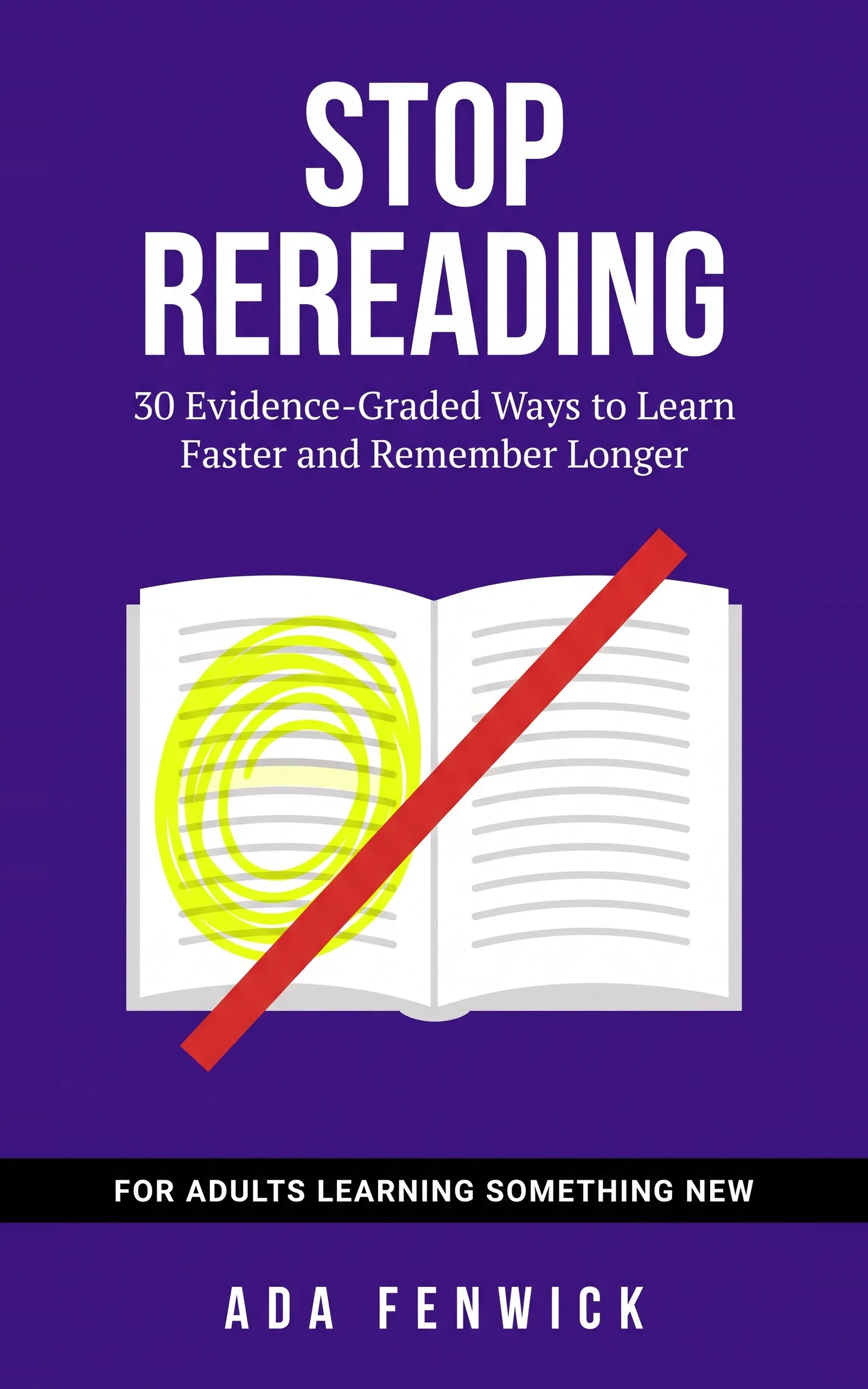
The book for this problem
Stop Rereading
30 Evidence-Graded Ways to Learn Faster, Remember Longer, and Use What You Study, for Adults Learning Something New. By Ada Fenwick, 224 pages.
Where this problem is in the book:
- Spacing: Less Cramming, More Coming Back
- The 30-Day Plan
Links go to Amazon. ToolGenX publishes this book under a pen name and earns from every sale. Amazon sets the price and handles delivery and returns.

Is Stop Rereading the right book for you?
Yes, if
- You have a test date and a pile of material
- You have heard spacing works but do not know how many days to leave
- You keep planning reviews and then doing them all the night before
Skip it if
- You are practicing a physical skill like golf or piano (the companion book covers that)
- You want one fixed percentage that works for every test date
Fair doubts before you buy
I have seen "always space by 10 to 20 percent." Is that wrong?
No single percentage holds. In Cepeda and colleagues (2008), the best gap was about 20 to 40 percent of a one-week wait and about 5 to 10 percent of a one-year wait. The longer the wait, the smaller the share. A fixed rule would be too long for a close test and too short for a far one.
What if I get the gap wrong?
It costs little. In the same study, results rose as the gap lengthened, then tapered off slowly past the best point. Being a few days off barely matters. The real loss is no gap at all: every review crammed into the last night.
Get Stop Rereading
Thirty study tools for adults learning something new, each traced to its research and badged SOLID, PROMISING or STORY ONLY, from the Closed-Book Check to a weekly learning system.
Links go to Amazon. ToolGenX publishes this book under a pen name and earns from every sale. Amazon sets the price and handles delivery and returns.
This book is for general education about learning methods. It is not medical or psychological advice. If you have ongoing trouble with sleep, attention or memory, talk to a health care provider.

Questions people ask about this
- How many days between study sessions is best?
- It depends on the test date. For a test about a week away, about 1 to 3 days. For a test a year away, about 3 to 5 weeks. Those come from Cepeda and colleagues (2008). For two or three months out, about 1 to 2 weeks is the book's estimate between those results, not a tested number.
- Does spacing work for math?
- Yes, with a smaller effect. A 2025 review by Murray and colleagues found a small to medium benefit of spacing in math (g = 0.28, from 27 studies). It was smaller inside real courses (0.24) than in stand-alone studies (0.43). It is still a reliable gain.
- What should I do if I miss a review day?
- Do the review as soon as you can, then pick the gap up again from that day. A review a day or two late still counts. Skipping reviews to keep up with new material is the trade that costs the most.
- How many times should I review each thing?
- Rawson and Dunlosky (2011) suggest practicing each idea until you recall it correctly 3 times, then relearning it 3 more times in widely spaced sessions. Their three experiments with 533 students found large gains in long-term memory for little extra practice.
Related problems
- Your exam is in a week. How to spend the seven days so it sticks
One week left and a pile of material? Test yourself instead of rereading, come back to each topic twice and keep your sleep. Here is the plan.
- You studied it last night and it is gone today. Why that happens, and what fixes it
Read your notes three times and still blank on the first question? Familiar is not the same as remembered. Here is why, and a five-minute fix.
- Taking notes by hand or on a laptop: what the repeat studies found
The famous laptop note-taking study did not hold up when it was repeated. Here is what the newer studies found, and what matters more than the pen.
- Everything inside Stop Rereading
Every chapter, who the book is for, and every problem it helps with.
// Also on this topic
- guideIs the 10,000-hour rule true? What the violin study really found
The 10,000-hour rule came from one violin study and a best-known retelling. Here is what the hours really showed, and what predicts progress better.
- guideYou had it perfect last night. Why did it fall apart when it counted?
You played it clean ten times last night and lost it today. The research on practice versus learning explains why, and a three-minute check fixes it.
- bookThe Practice Lab
30 Evidence-Graded Drills to Learn Any Skill Faster, Break Through Plateaus, and Make It Stick