Last updated
How long should a practice session be, and how often should you practice?

| Question | What the research found | How firm |
|---|---|---|
| One long session or several short ones? | Spread-out practice beat massed practice in two meta-analyses and in trials of surgical skills | Strong |
| How long per sitting? | One hour a day was most efficient for learning to type; no study backs 20 or 45 minutes | Moderate; one hour was the shortest tested |
| How many hours a day? | Two 2-hour sessions a day gave the least learning per hour and the worst recall later | Moderate |
| How far apart? | Short gaps, such as back-to-back days, looked best in surgical reviews; the ideal gap is unknown | Leaning |
| Rest between single reps? | Not needed for quick one-shot moves; the strong case is for spreading whole sessions | Mixed |
| A 20-minute starting block? | A practical guess for busy adults, not a research finding | Untested |
Three hours every Sunday, and by Wednesday it is gone
Picture a cello in the corner of a small living room. Its owner is 52 and took lessons as a girl. Last fall she started again.
Her weekdays are full, so Sunday is cello day. She practices for three hours straight. By late afternoon the new scale runs clean and her bow arm feels loose.
By Wednesday, when she picks it up for five minutes before bed, the scale is a mess again. Her fingers hover over the strings, unsure.
Nothing is wrong with her hands or her memory. The problem is the shape of her week. Three hours on one day and nothing on the other six is one of the weakest ways to spend the same time.

The typists who trained one hour a day
Popular advice is very precise about session length. You will see "practice for 20 minutes" or "45 minutes" as if a study proved it. The book looked, and could not find a study that supports any exact number of minutes for adult skill practice.
What the research has is a ceiling. In 1978, Baddeley and Longman trained four groups of postal workers to type code on a typewriter keyboard. The groups trained in sessions of one or two hours, once or twice a day.
Learning per hour of training was best in the group that did one one-hour session a day. It was worst in the group that did two two-hour sessions a day. Months later, typing speed had dropped by about 30 percent, and the heaviest group again did worst.
There was a cost. The one-hour group took 12 weeks to learn what the heaviest group learned in 3, and they resented it. Spreading out costs calendar time. It buys more learning per hour.
Other sources land in a similar range. Ericsson's 1993 violin study found practice sessions averaged 80 minutes, and cited work suggesting effective practice "may be closer to 1 hr per day." A 2025 surgical review recommended one session a day, at most 2 hours long.
So the best-supported unit is about an hour or less, about once a day. Anything shorter is a reasonable guess.
Spread the sessions, not the reps
How often matters even more than how long, and here the evidence is strong. Two meta-analyses found that spreading practice beats massing it. In 1999, Donovan and Radosevich pooled 63 studies and found an average effect of 0.46 in favor of spacing, a moderate size. The book notes it came out larger in less careful studies.
Trials with real skills agree. In 2006, Moulton and colleagues randomly assigned 38 junior surgical residents to learn to join tiny blood vessels in one day or across weekly sessions. Both groups got the same total time. One month later, the spread-out group did significantly better on most measures.
A 2025 review by Jørgensen and colleagues covered 28 studies of surgical training. Of the 19 that directly compared spread-out and massed training, 15 favored spreading. None favored massing.
Two limits keep this honest. First, it is about spreading sessions, not resting between every rep. In a 1989 study, longer rests helped a continuous task but not a quick one-shot move. Second, nobody knows the perfect gap. The surgical reviews lean toward short ones, and a 2023 review found back-to-back days seemed best. For a busy adult, that means most days rather than once a week.
A week plan you can start Monday
The Practice Lab turns this into two drills in Short Sessions, Spread Out.
The Practice Week Map is one of the book's five SOLID drills. It takes ten minutes once a week:
- Write the total practice time you have in a normal week. Be honest.
- Split it into short sessions on separate days. Four to six is the book's planning default, not a research number.
- Put each one on a day and time, attached to something you already do, like after coffee.
- Keep the gaps short. Back-to-back days beat one session a week.
- At week's end, mark which sessions happened. Move a missed one to a spare day. Do not stack it.
The Short Block (PROMISING, with a STORY ONLY starting length) sets each sitting. Start with about 20 minutes and one target. Stop when the timer goes, even if it is going well. Keep the day to about an hour, and adjust the length after a week.
For our cellist, three Sunday hours might become five weekday blocks of 20 minutes and one shorter Sunday split into pieces. That is a little less time. It is spread so no gap is longer than a day.
The Practice Plans section at the back builds four month-long plans this way, for an instrument, a sport, a spoken language and drawing. Each uses 20 to 30 minute blocks, four to six times a week. The book says plainly that nobody has tested those exact plans. It also repeats its one safety rule: pain is not part of the method. Stop and ask a professional.
If your weekday gaps come from being unable to play at all, mental practice can fill some of them.
The book for this problem
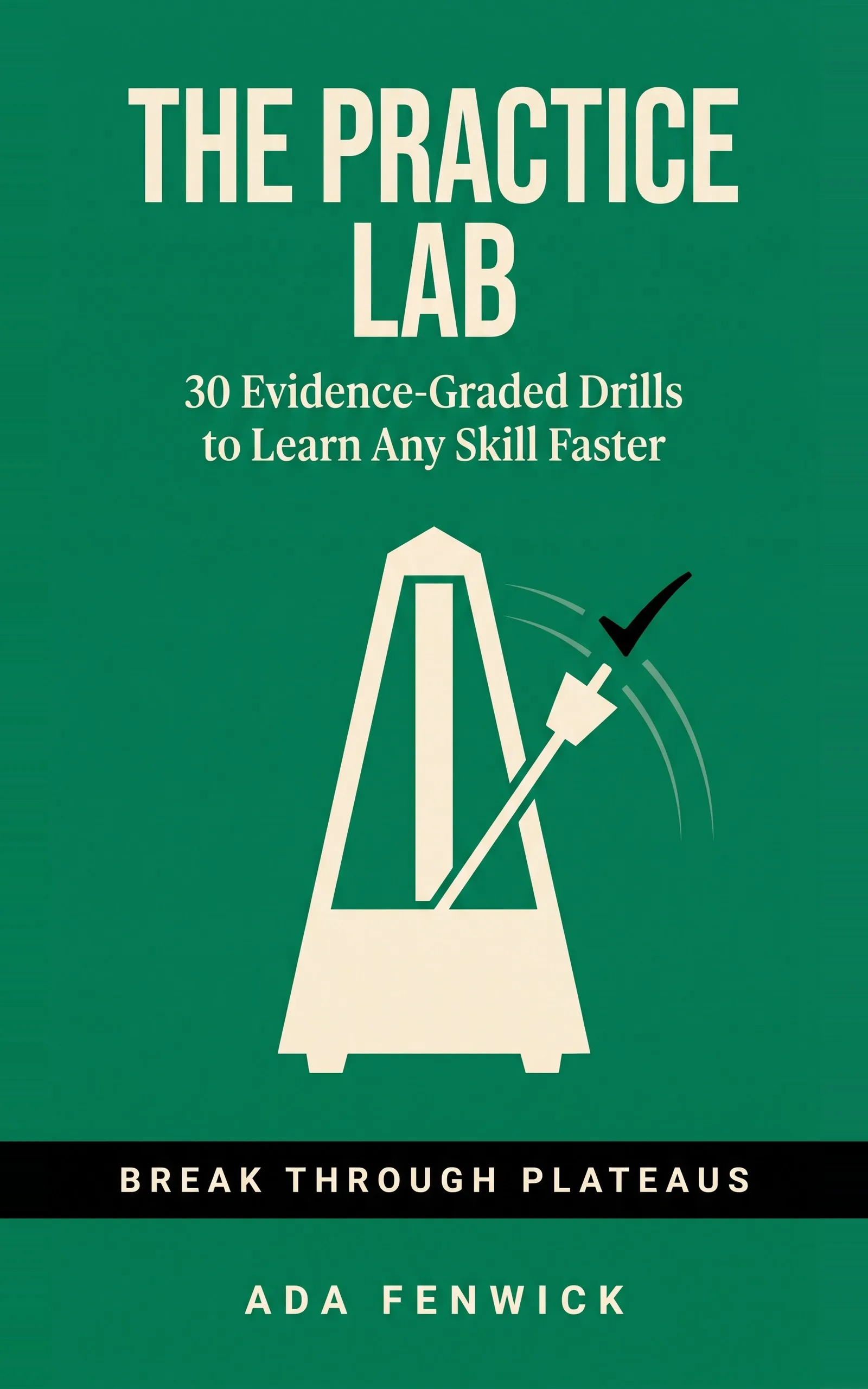
The Practice Lab
30 Evidence-Graded Drills to Learn Any Skill Faster, Break Through Plateaus, and Make It Stick. By Ada Fenwick, 225 pages.
Where this problem is in the book:
- Short Sessions, Spread Out
- Practice Plans
Links go to Amazon. ToolGenX publishes this book under a pen name and earns from every sale. Amazon sets the price and handles delivery and returns.

Is The Practice Lab the right book for you?
Yes, if
- You save all your practice for one long session on the weekend
- Long sessions leave you foggy and you wonder if shorter ones would be better
- You want a weekly plan that fits a job and a family
Skip it if
- You want a proven minute count for your exact skill (no study gives one)
- Practice causes pain or strain (stop and see a teacher, doctor or physical therapist)
Fair doubts before you buy
Will short sessions not slow me down?
On the calendar, maybe. In the typing study, the one-hour-a-day group resented taking 12 weeks to learn what the heaviest group learned in 3. But they learned more per hour of training and kept more months later. Spreading out costs calendar time and buys more learning for each hour.
Is 20 minutes not too short to get anything done?
Nobody has tested 20 minutes for adult skill practice. The book uses it as a starting block for busy people and says so on the drill card. If you are still sharp at the end, go longer. If you fade halfway, go shorter. Keep the day to about an hour of focused practice.
Get The Practice Lab
Thirty practice drills for adults learning a skill, each traced to its research and badged SOLID, PROMISING or STORY ONLY, from the Next-Day Test to shaking off the rust.
Links go to Amazon. ToolGenX publishes this book under a pen name and earns from every sale. Amazon sets the price and handles delivery and returns.
This book is for general education about practice methods. It is not medical, physical therapy or coaching advice. If practice hurts, stop and see a qualified professional.
Questions people ask about this
- Is it better to practice every day or a few long sessions a week?
- Every day, or most days, is the better bet. Two meta-analyses found spread-out practice beats massed practice. Reviews of surgical training lean toward short gaps, and one 2023 review of simulator training found back-to-back days seemed to work better than longer or shorter gaps.
- How many hours a day should an adult practice?
- About an hour of focused practice is the best-supported figure. In the 1978 typing study, one hour a day gave the most learning per hour. A 2025 surgical review recommended one session a day of at most 2 hours. More hours can mean more total skill sooner, but each extra hour is worth less.
- Do I need long rests between each rep?
- No. The strong evidence is for spreading whole sessions across days, not waiting between every chord or putt. A 1989 study by Lee and Genovese found longer rests helped a continuous task but not a quick one-shot task, where massed reps did better.
- What if I miss a practice session?
- Move it to a spare day instead of doubling up on the next one. Stacking two sessions into one day rebuilds the long block you were trying to avoid. The book puts it in the Practice Week Map: mark what happened, move what did not.
Related problems
- Blocked vs random practice: which one helps an adult learner more?
Random practice beats blocked practice in the lab. On real courts and in practice rooms the edge is small. Here is how to use both, in the right order.
- Does practicing in your head work? What three reviews of mental practice found
Mental practice helps a skill, but less than real practice. Three reviews over 27 years agree on a small to medium effect, best added to real reps.
- Is the 10,000-hour rule true? What the violin study really found
The 10,000-hour rule came from one violin study and a best-known retelling. Here is what the hours really showed, and what predicts progress better.
- Everything inside The Practice Lab
Every chapter, who the book is for, and every problem it helps with.
// Also on this topic
- guideTaking notes by hand or on a laptop: what the repeat studies found
The famous laptop note-taking study did not hold up when it was repeated. Here is what the newer studies found, and what matters more than the pen.
- guideDoes having your phone nearby hurt studying? The brain drain study, checked again
A 2017 study said a silent phone on your desk drains your thinking. A careful 2022 repeat did not find it. Here is what does cost you when you study.
- bookStop Rereading
30 Evidence-Graded Ways to Learn Faster, Remember Longer, and Use What You Study, for Adults Learning Something New