Last updated
You read it three times and still can't explain it. The Feynman technique, done properly.

You knew it on Sunday. On Monday you could not say it.
You read the chapter three times. You highlighted it in yellow. It felt clear.
Then someone asked a simple question and your mouth went dry. You knew the words. You could not put them in order.
Now the quiet worry starts. Maybe you are just not smart enough for this.
You are not the problem. That gap between "it feels clear" and "you can say it" happens to almost everyone. It even has a name.

Why rereading feels like learning and isn't
When you reread, the page gets familiar. Familiar feels a lot like understood. Your brain is not lying to you on purpose. It just confuses the two.
In 2002, two Yale researchers asked people how well they understood everyday things, like a zipper or a flush toilet. Then they asked them to write out how each one works, step by step. After writing, people rated their own understanding lower. The researchers called this the illusion of explanatory depth. In plain words, you think you know more than you do, until you try to explain it.
Rereading never puts you to that test. Highlighting does not either. A 2013 review led by John Dunlosky looked at common study habits and rated self-explanation as moderately useful, above both of them.
So the fix is not more reading, and we have all done plenty of that. It is explaining.

The note on Feynman's blackboard
The physicist Richard Feynman died in February 1988. Around that time, someone photographed the blackboard in his office. The Caltech Archives still hold the photo. In one corner, in chalk:
"What I cannot create, I do not understand."
You will see this called his last words. It was not. It was a working note. The same board had a list headed "TO LEARN." Near the end of his life, a Nobel winner still kept a list of things he did not know yet.
That is the real lesson. Feynman checked his understanding by rebuilding or explaining things himself. He also kept a written list of his gaps, going back to a notebook he started in graduate school around 1940.
You can't always build the thing. But you can explain it from scratch, and that turns out to be very revealing.

The Zipper Test, step by step
This is Drill 6 in the book, and it carries a SOLID badge. It takes about 15 minutes.
- Pick something you feel you understand. How a zipper works, how a mortgage works, how your company makes money.
- Rate your understanding from 1 to 7. Write the number down.
- Write a step-by-step explanation for a smart twelve-year-old. No jargon. If you use a technical word, you have to explain it.
- Every time you hit a step where you are not sure, write GAP and keep going.
- When you finish, rate yourself again from 1 to 7.
- Copy every GAP into a separate list of things you don't know.
Here is the odd part. If your second number is lower than your first, the drill is working. If you found no gaps at all, explain it again to a skeptical expert. They ask different questions than a twelve-year-old.
The book walks through an example. A woman who explains loans at a bank every day rates herself 6 out of 7 on how mortgage rates get set. By the end of one page she has four GAPs and rates herself a 4. She is a little annoyed. She is also curious about her own job for the first time in years.

The usual four steps, and how the Zipper Test lines up
Most guides you find online give the Feynman technique as four steps. The University of York study guide is a typical one:
| Usual step | What it asks | Where it sits in the Zipper Test |
|---|---|---|
| 1. Teach it to a child | Explain the topic to someone with no background | Step 3, the explanation for a smart twelve-year-old |
| 2. Find the gaps | Notice where you cannot answer a "why" | Step 4, writing GAP and moving on |
| 3. Simplify and clarify | Go back to the material, then rewrite the hard parts in plain words | Step 6, the GAP list, worked through one a week |
| 4. Review and repeat | Go again until it is simple and right | Run it again, or explain it to a skeptical expert |
So the two versions agree on the core. The book adds one thing the usual list skips: the rating from 1 to 7 before and after. That number is how you catch the illusion of explanatory depth in yourself, instead of just reading about it.
One more note on the name. Feynman never called this the Feynman technique. The name came later. The habits it rests on, explaining from scratch and keeping a list of what you do not know, are his.

Where the gaps go next
This is the problem The Genius Lab was written for: the gap between feeling sure and being able to say it.
Feynman: Play Is a Research Method has the full Zipper Test and a worked example. It also has Drill 7, a notebook of the things you don't know, where your GAPs go so you can work through one a week. And it checks the famous Feynman stories, including the wobbling plate he said led to his Nobel Prize. He got the plate's physics backwards, which is part of the fun.
Building Rooms in Your Head covers the memory palace. That is the right tool when you need to hold a list, not understand an idea. Our memory palace page has the basics.
Sleep, Movement, and the Supplement Aisle shows why studying in the evening and then sleeping tends to help you keep facts, and gives you a small test to see if it works for you.
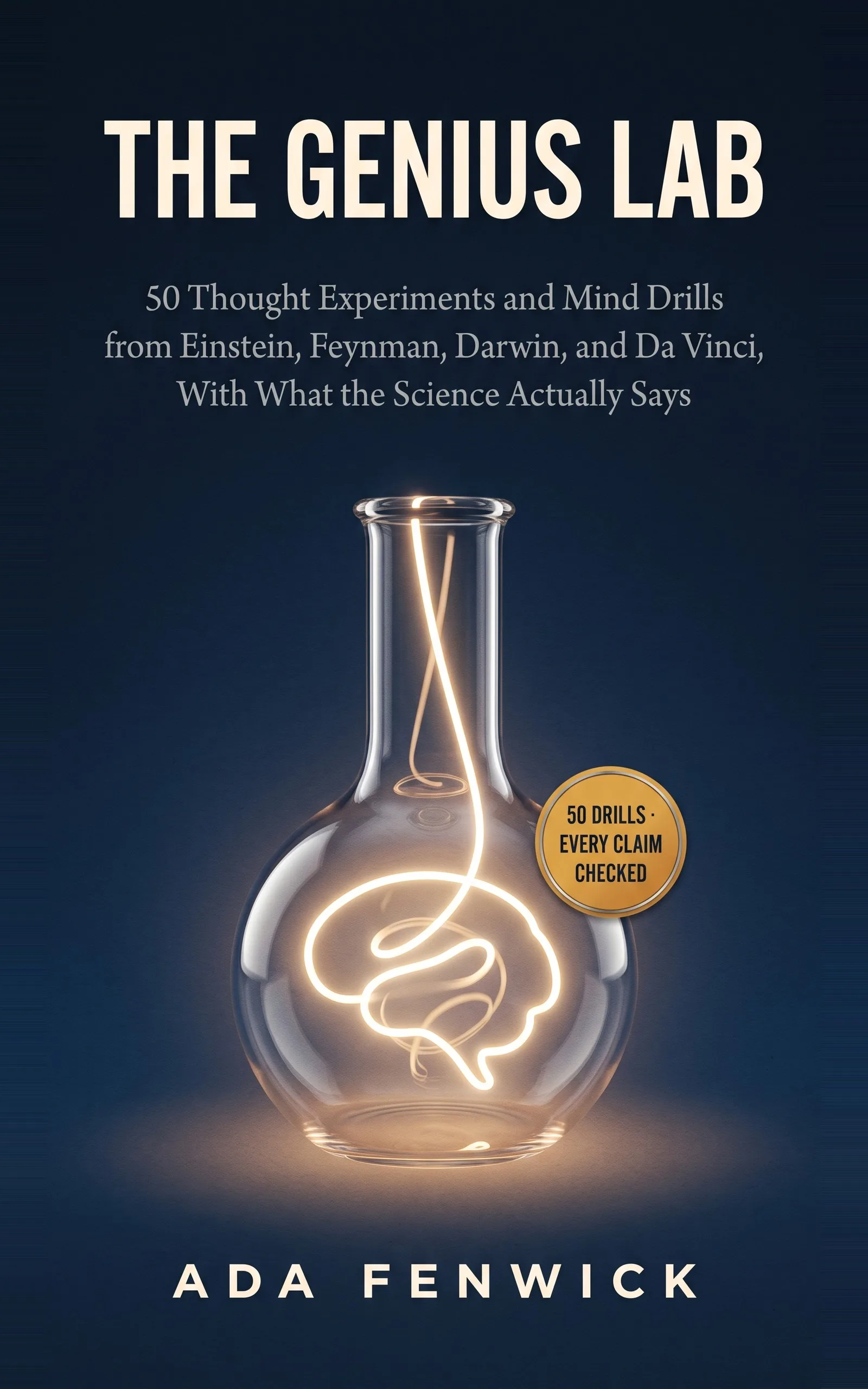
The book for this problem
The Genius Lab
50 Thought Experiments and Mind Drills from Einstein, Feynman, Darwin, and Da Vinci, With What the Science Actually Says. By Ada Fenwick, 233 pages.
Where this problem is in the book:
- Feynman: Play Is a Research Method
- Building Rooms in Your Head
- Sleep, Movement, and the Supplement Aisle
Links go to Amazon. ToolGenX publishes this book under a pen name and earns from every sale. Amazon sets the price and handles delivery and returns.

Is The Genius Lab the right book for you?
Yes, if
- You reread notes and highlight, and it feels like learning but does not stick
- You freeze when someone asks you to explain your own job
- You want to know if the Feynman technique is real or just a nice story
Skip it if
- You need to memorize a list, where a memory palace fits better
- You want a way to feel smart quickly, since this drill often does the opposite
Fair doubts before you buy
I already know the Feynman technique from YouTube. What would a book add?
Most videos give the steps and stop. The book adds the before and after rating, which turns a vague feeling into a number, and a second notebook where every gap goes to be worked on one a week. It also tells you which parts of the Feynman story are true, which surprises most people.
Does it matter that Feynman never named it the Feynman technique?
Not for whether it works. The name came later. What holds up is the research on explaining, which is strong. The book's version, the Zipper Test, is built on that research and on a line Feynman really wrote on his blackboard.
Get The Genius Lab
Fifty short drills taken from what famous thinkers actually did, each labeled by whether it works for ordinary people, with sixty myths corrected.
Links go to Amazon. ToolGenX publishes this book under a pen name and earns from every sale. Amazon sets the price and handles delivery and returns.

Questions people ask about this
- Does the Feynman technique actually work?
- The core of it does. Explaining a topic in your own words shows you where your understanding is thin, and a 2013 review rated self-explanation as moderately useful for learning, ahead of rereading and highlighting. Research on producing answers yourself, and on expecting to teach, points the same way.
- What is the illusion of explanatory depth?
- It is the feeling that you understand something much better than you do. Researchers at Yale named it in 2002. People rated their grasp of everyday things like zippers and flush toilets, then wrote out how they work, and their ratings fell once they saw the gaps.
- How do you explain something like you are teaching a child?
- Write it step by step for a smart twelve-year-old. No jargon is allowed, and if you use a technical word you must explain it. Every time you reach a step you are unsure of, write GAP and keep going. The gaps are the point.
- Why can't I explain something I understand?
- Often because you know it by sight, not by steps. Things you see every day feel familiar, and familiar feels like understood. Trying to explain it from scratch is what shows the difference.
- Did Feynman say 'What I cannot create, I do not understand' as his last words?
- No. It was written in chalk on the blackboard in his Caltech office, which was photographed around the time of his death in 1988. It was a working note, not a deathbed line. The same board had a list headed TO LEARN.
- What are the 4 steps of the Feynman technique?
- Study guides usually give four: explain the topic simply as if to a child, find the gaps where you get stuck, go back to the material and simplify those parts, then review and repeat. The book's Zipper Test covers the same ground and adds a 1 to 7 rating before and after, so you can see the gap shrink or grow.
Related problems
- How to build a memory palace when you have never tried one before
A memory palace uses a place you know to hold a list. Here is how to build your first one in 20 minutes, why it works, and what the studies found.
- How to think like Einstein: what he really did, and the parts the internet made up
Einstein did not ride a light beam or picture an elevator. Here is the method he described in his own words, and a 15-minute drill to try it.
- Stuck on a problem and your brain has stopped working? Do this in the next hour.
Creative block with a deadline? Work hard for 25 minutes, take a real break with no phone, then check. Here is the order, and the study behind it.
- Everything inside The Genius Lab
Every chapter, who the book is for, and every problem it helps with.