Last updated
Bad decision or bad luck? How to judge a choice that went wrong

| Question | Decision quality (left column) | Luck (right column) |
|---|---|---|
| What goes in it | What you knew, what you did to learn more and how you chose | Everything that shaped the result that you could not have known or controlled |
| The electrician's entry | Asked about workload and hours, talked to two people on the crew, set a deadline and a good-enough bar | The firm lost its biggest contract, which nobody outside management knew was at risk |
| The question you answer | Given what you knew, was this a sound way to decide? | Was the luck good, bad or mixed? |
| Words you can write | Yes, partly or no | Good, bad or mixed |
| The bias that blurs it | Hindsight bias: the outcome now looks like it was obvious | Outcome bias: a bad break gets scored as a bad choice |
| What you take forward | One process lesson, like asking a small employer how many contracts it depends on | Nothing to fix. A bad break is allowed to sting. |
How to read the two columns
The table above is the book's Two-Column Review. It carries a PROMISING badge. Outcome bias is well studied, but nobody has tested this kind of review as a fix for it.
The left column is everything you did. The right column is everything that happened to you. The rows show what each side holds, the question you answer for each and what you get to keep.
Look hardest at the last row. Only the left column produces a lesson. "Ask about the firm's biggest clients" is a process lesson. "Never leave a big company" is the result talking, and it teaches you the wrong thing.
Here is how to fill it in:
- Draw a line down a blank page. Label the left side Decision quality and the right side Luck.
- On the left, write what you knew, what you did to learn more and how you chose. Use any note you made at the time, not your memory.
- On the right, write everything that shaped the result that you could not have known or controlled on the day you chose.
- Under the left side, write yes, partly or no: given what you knew, was this a sound way to decide?
- Under the right side, write whether the luck was good, bad or mixed.
- Write one line about your process for next time. Only process counts.

Eight months later, the firm cut her hours
Picture an electrician who spent most of last spring deciding whether to leave a big contractor for a small local firm.
She did it properly. She asked the owner about the workload and hours. She talked to two people on the crew. She set a deadline, picked a good-enough bar and chose the small firm.
Eight months later, the firm lost a big contract and cut her hours. Now she replays it every night. Her old job is still posted. Everyone who said "are you sure?" seems to have been right.
So ask two plain questions. On the day she chose, what did she know? Could she have found out about a contract that nobody outside the firm knew was at risk?
If the answer is no, she did not make a bad decision. She got a bad result. Those are different things, and the mind is very bad at keeping them apart.

Why your memory sides with the result
Two traps blur the columns.
The first is about memory. In Fischhoff's 1975 experiments, people who were told how an event ended rated that ending as more likely. They did not notice the shift. They overestimated what they would have known without being told. That is the electrician at midnight. She knows about the contract now, so she believes the old her should have known too.
The second is about judgment. In 1988, Baron and Hershey gave people the same decision with only the outcome changed. People rated the decision as better, and the person as more able, when the outcome was good. A 2023 preregistered replication by Aiyer and colleagues with 692 people found the bias again, and larger than before. It held even for people who said results should not count.
Your life has more hands of cards in it than you think. If you score yourself on the luck, you learn the wrong lessons. Worse, every bad break starts to feel like proof that you cannot be trusted to decide.
Write it down before the result comes in
The best defense starts before the result. The book's Decision Log (PROMISING) has you write, on the day you choose, what you knew, why you chose and what you expect, with how sure you are as a percent. Then you set a review date.
One rule matters most: write the percent before the result comes in, never after. In a forecasting tournament, keeping track of forecasts helped, but as part of a package with training and teamwork, which is why the book stops at PROMISING.
What we like about the pair of tools is that it cuts both ways. Run the review on a lucky win too, especially when you hear yourself say you just knew it would work. That is harder, and it matters more.
The chapters that split skill from luck
This is the problem Done Deciding was written for.
Judge the Decision, Not the Result: How to Stop Grading Yourself on Luck holds the Decision Log and the Two-Column Review, the electrician's full page and the myth checks on hindsight, outcome bias and who really coined "resulting."
Close the Door: Why a Final Choice Feels Better Than an Open One helps with the step before this one: treating a careful choice as finished, so you stop hunting for proof against it.
If the result has turned into a nightly replay, our page on how to stop replaying a decision gives the one tool in the book with a SOLID badge.
The book for this problem
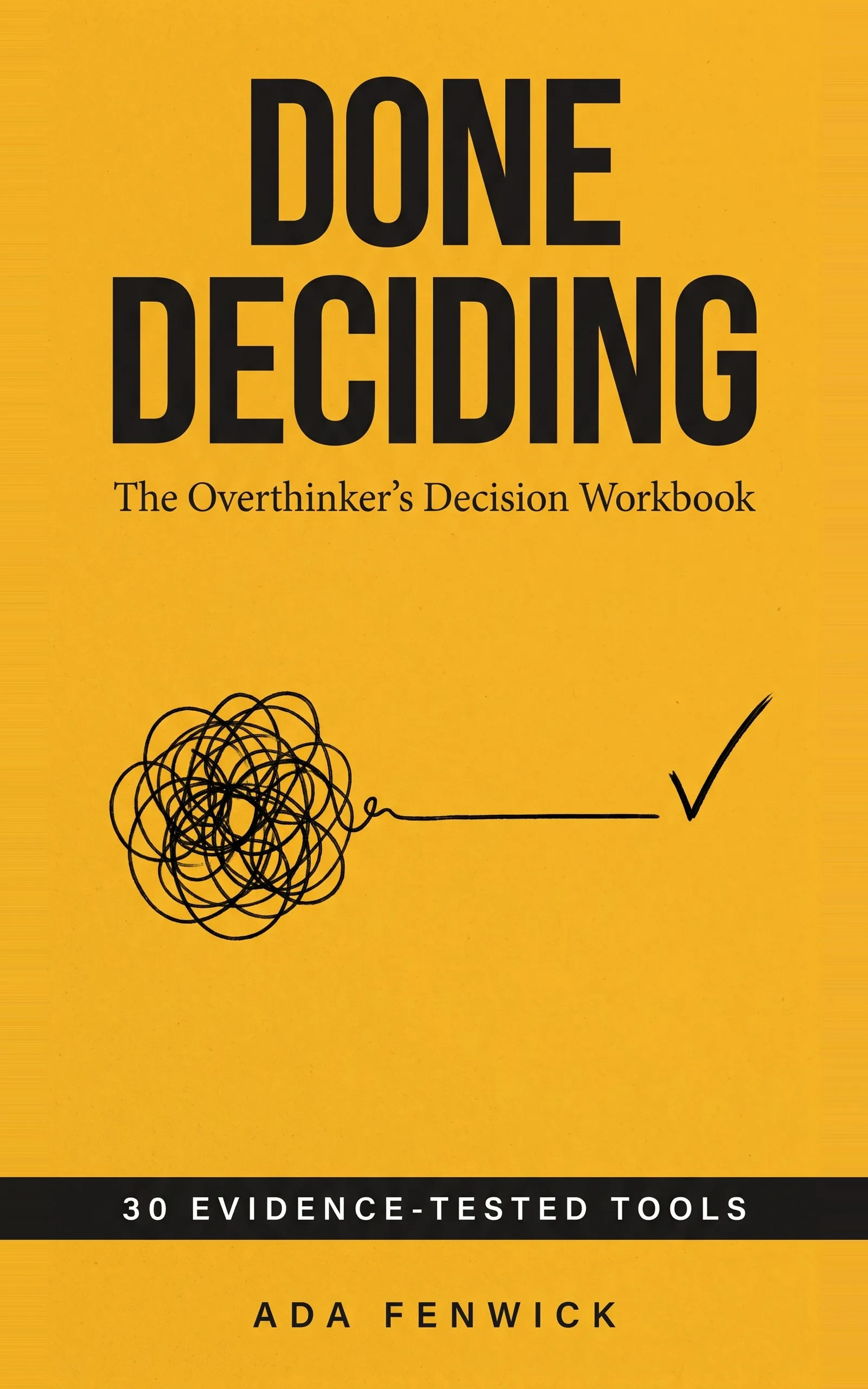
Done Deciding
The Overthinker's Decision Workbook. 30 Evidence-Tested Tools to Make Hard Choices Faster, Quiet the What-Ifs, and Stop Second-Guessing. By Ada Fenwick, 207 pages.
Where this problem is in the book:
- Judge the Decision, Not the Result: How to Stop Grading Yourself on Luck
- Close the Door: Why a Final Choice Feels Better Than an Open One
Links go to Amazon. ToolGenX publishes this book under a pen name and earns from every sale. Amazon sets the price and handles delivery and returns.

Is Done Deciding the right book for you?
Yes, if
- A choice you made with care turned out badly and you replay it every night
- People who said "are you sure?" now seem to have been right
- A lucky win is making you trust a sloppy way of choosing
Skip it if
- You want to be told the result was fine when it was not
- You need help with the money, legal or health fallout of the result itself
Fair doubts before you buy
Isn't this just a way to let myself off the hook?
No. The review can come back "partly" or "no." It only refuses to let the result do the grading. It also works the other way: when a careless choice works out, the same page shows you that it was luck, before you take a bigger risk the same way.
I already know about hindsight bias. Why would I need a tool?
Knowing is not enough. In a 2023 replication, outcome bias held even among people who said results should not count. The book says a written record made before the result comes in is a much better defense than knowing the name of the bias.
Get Done Deciding
Thirty small decision tools for overthinkers, each traced to its research and badged SOLID, PROMISING or STORY ONLY, from the first loop test to closing the door after you choose.
Links go to Amazon. ToolGenX publishes this book under a pen name and earns from every sale. Amazon sets the price and handles delivery and returns.
Questions people ask about this
- How do you know if you made a bad decision or just had bad luck?
- Ask what you knew on the day you chose and whether you could have found out more in the time you had. If you gathered what you reasonably could, looked at more than one option and chose on purpose, it was a sound decision, even if luck went against it. One result is a weak test of a decision.
- What is outcome bias?
- It is judging a decision by how it turned out instead of by what the person knew. In 1988, Baron and Hershey showed people the same decision with good or bad outcomes, and people rated it, and the person, better when the outcome was good. A 2023 preregistered replication with 692 people found the bias again, and larger.
- What is hindsight bias?
- Once you know how something ended, the ending starts to look obvious. In Fischhoff's 1975 experiments, people told an outcome rated it as more likely and did not notice the shift. A 2021 repeat with 890 people found it again. A 2025 preregistered attempt, still a preprint, did not, so any single classic study deserves some humility.
- Why do I keep blaming myself for a decision that turned out badly?
- Because the result now feels like it was always coming, so you believe the old you should have seen it. That is hindsight talking. Write down what you actually knew then. If you have a note from the day you chose, use it instead of your memory.
- What does resulting mean?
- It is a poker word for judging a decision by its result. Annie Duke writes about it in Thinking in Bets (2018). A player can make the right call and lose the hand. If she changes her play because of that one loss, she gets worse. Duke presents it as a word poker players already used, not one she made up.
Related problems
- Can't stop thinking about a decision you already made? Give it a time slot
The choice is made but the replay runs all day. Close the door first, then move the what-ifs into one short daily worry window. Here are the rules.
- You have to make a decision by tomorrow and you still can't choose
A decision is due tomorrow and you are stuck. Size it in two minutes, set a default, make one call, and break a true tie with a coin.
- Afraid of making the wrong decision? Find out what you are scared of losing
When the facts point one way and you still cannot move, a fear is usually holding the door. Name it in five minutes, then size the regret.
- Everything inside Done Deciding
Every chapter, who the book is for, and every problem it helps with.
// Also on this topic
- guideYou keep overthinking a big decision. Is something wrong with you?
Stuck overthinking a big decision? Sort it by whether you can undo it, then set a bar and a stop date so more research stops buying comfort.
- guideHow to keep a decision journal: what to write, and when to look back
How to keep a decision journal: the six fields to write before you decide, when to review, and how to judge the choice apart from how it turned out.
- bookMental Models That Actually Work
40 Thinking Tools from Munger, Bezos, Feynman, and Kahneman, Tested Against the Evidence, for Clearer Thinking and Better Decisions