Last updated
How to keep a decision journal: what to write, and when to look back

| Field | What to write | When |
|---|---|---|
| Date and decision | The date, the choice in one line and the options you seriously considered | Before you decide |
| Forecast | What you expect, with a number: '70 percent chance the new hire is still here and doing well in a year' | Before you decide |
| Reasons | Your two or three main reasons | Before you decide |
| Mind-changer | The one fact that, if false, would most change your mind | Before you decide |
| Mood | A few words: tired, rushed, excited, anxious | Before you decide |
| Review date | A date in your calendar when the outcome should be clear | Before you decide |
| What happened | The result, written before you reread the entry | On the review date |
| Lesson | Where your forecast, reasons and confidence were right or wrong | On the review date, after rereading |
What each field is for, and why the order matters
The table follows the book's tool card for the decision journal. The first six fields happen before you choose. The last two happen on the review date. Keep that order. It is the whole point.
One rule matters more than the rest. On the review date, write what happened first. Only then reread the old entry. If you reread first, the old words start to bend toward the result.
The number in the forecast field matters most. "This hire will work out" cannot be checked. "Seventy percent chance she is still here and doing well in a year" can. Write enough of those and you can see if your 70 percent calls come true about 70 percent of the time.
This is not a diary. You do not write about your day. You write before choices that matter and repeat, the kind where you find out later how it went.

Why your memory cannot be the record
In 1975, a study on remembered guesses asked people to guess the odds of events around President Nixon's 1972 trips. Later they were asked to recall their guesses. They remembered giving higher odds to the things that had happened.
This is called hindsight bias. It is not lying. It is how memory works once you know the end. A 2004 review pooled 95 studies and found a moderate effect again and again.
And it hurts learning. To get better, you compare what you expected with what happened. Hindsight bias quietly edits the first half.

A year later, you open the notebook
Picture a hiring choice. You wrote that you were 80 percent sure. You listed her references and her sample project as the main reasons. In small letters at the bottom you also wrote: rushed, need someone by Monday.
She left after four months. Without the entry, you would remember having doubts all along. With it, you see the real lesson. The deadline made the call, not the candidate.
That small mood line is easy to skip. It can turn out to be the most useful line on the page.

Which choices to log, and which to skip
Most guides say to log only decisions that matter. The book is more specific. The journal pays off when you make the same kind of choice again and again and find out later how it went: hiring, projects, purchases, investments, bets on what a customer wants.
It does much less for one-off choices you will never repeat. And a quick call you can undo by tomorrow does not need ten minutes of writing. Keep the notebook for the decisions where a pattern could show up.

Reading many entries at once
One entry tells you about one choice. The real lesson shows up across many. The book's sister card for this is Keep Score, and it carries a SOLID badge.
Every 20 forecasts, group your entries by how sure you were. Then check. Of the things you called 80 percent likely, how many happened? If it was closer to half, you run too sure on that kind of call. Write one sentence about what you will change, such as "Too sure about clients you like," and keep going.
That is why the number in the forecast field matters. Words like "probably" cannot be scored. Numbers can.

Grade the choice apart from the result
The journal gives you an honest record. The book pairs it with a second card on how to read it.
Write the outcome in one line, then cover it. List what you knew back then. Grade the process from 1 to 5. Then uncover the outcome and grade it apart. Place the choice in one of four boxes: good choice and good result, good choice and bad result, bad choice and good result, or bad choice and bad result.
Of the four, we find the bad choice, good result box the most useful. It is where you got away with something. A 2023 study with 692 people found that people judge the same choice as better when it ends well, even when they say outcomes should not count.

The chapters behind the journal
This is the problem Mental Models That Actually Work was written for.
Decision Journals has both cards: The Decision Journal and Judge the Decision, Not the Outcome. It also sorts out the Kahneman story, which comes from a retelling, not his own writing.
Calibration: How Sure Should You Be? shows what to do with the numbers in your forecast field once you have a few dozen. It has a way to keep score on your own calls.
The Decision Selector and the 30-Day Plan has a blank Decision Log page and a calibration tracker you can copy, plus a month of short drills that build the habit.
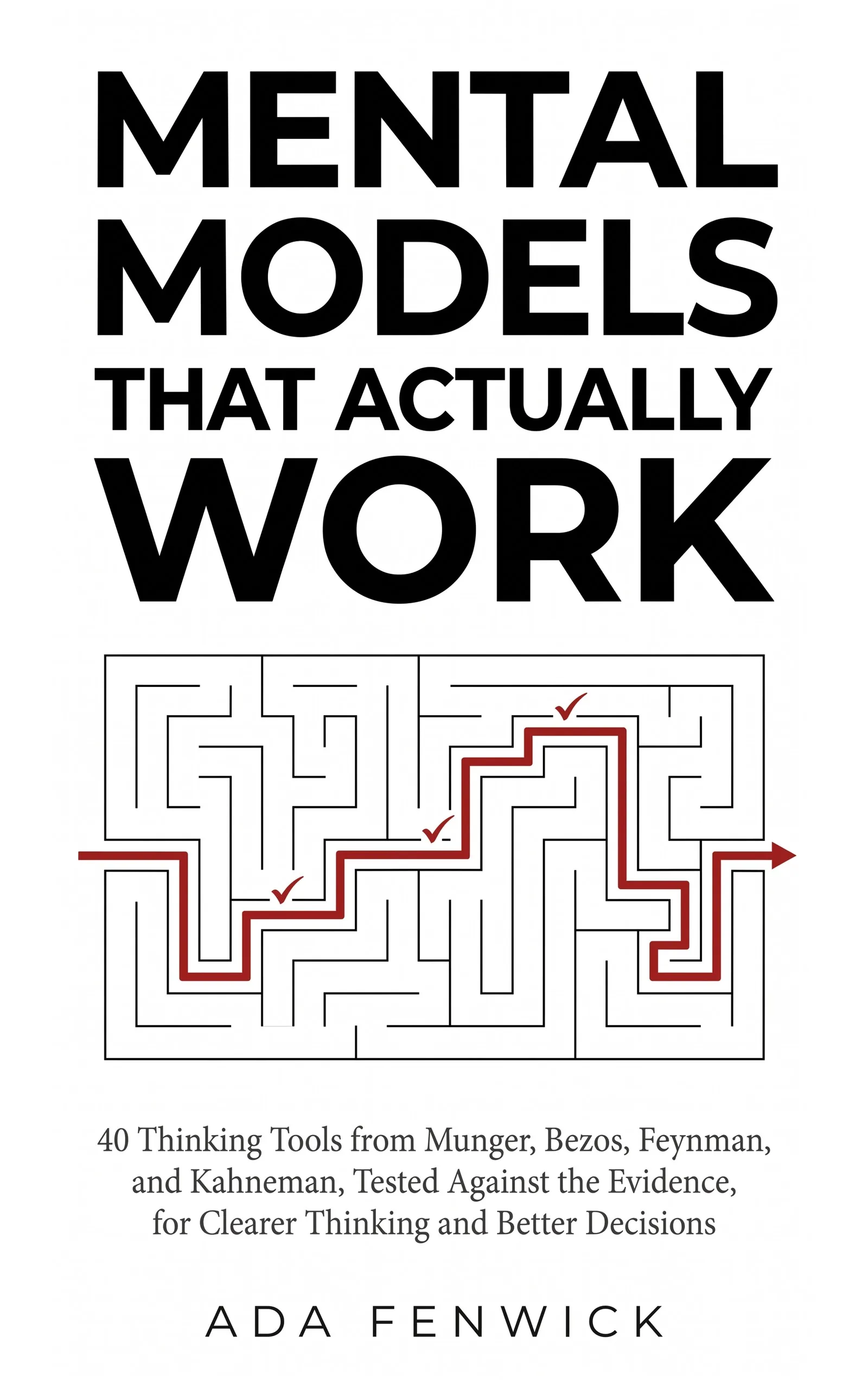
The book for this problem
Mental Models That Actually Work
40 Thinking Tools from Munger, Bezos, Feynman, and Kahneman, Tested Against the Evidence, for Clearer Thinking and Better Decisions. By Ada Fenwick, 288 pages.
Where this problem is in the book:
- Decision Journals
- Calibration: How Sure Should You Be?
- The Decision Selector and the 30-Day Plan
Links go to Amazon. ToolGenX publishes this book under a pen name and earns from every sale. Amazon sets the price and handles delivery and returns.

Is Mental Models That Actually Work the right book for you?
Yes, if
- You make the same kind of choice again and again, like hiring or buying
- You suspect you remember being more right than you were
- You want a clear list of what to write and when
Skip it if
- You want a daily diary or a mood journal
- Your choices are one-offs you will never repeat
Fair doubts before you buy
Can't I just remember my decisions?
Memory is on the outcome's side. After you learn how things went, you tend to remember guessing closer to the result than you did. That effect has been found across 95 studies. A dated note is the only record that does not shift.
Is a notes app as good as a notebook?
The book asks for one notebook kept only for decisions, and the paperback has log pages you can fill in. What matters most is that each entry is dated and written before the outcome. Any place that keeps that honest will work.
Get Mental Models That Actually Work
Forty thinking tools, each traced to its source and labeled by how well it holds up, so you know which to use and when.
Links go to Amazon. ToolGenX publishes this book under a pen name and earns from every sale. Amazon sets the price and handles delivery and returns.

Questions people ask about this
- What should a decision journal include?
- The date, the decision and options, what you expect with a number, your main reasons, the fact that would change your mind, your mood and a review date. Later you add what happened and what you learned.
- How often should you review a decision journal?
- Each entry gets its own review date, set for when the outcome should be clear. In the book's 30-day plan, every seventh day is also a review day where you learn nothing new and only read your log for patterns.
- Did Daniel Kahneman recommend keeping a decision journal?
- The story comes from Michael Mauboussin, who said in a 2012 interview that Kahneman told him to buy a cheap notebook and track decisions. No place in Kahneman's own writing recommending a decision journal has been found. Say 'as Mauboussin tells it.'
- Does keeping a decision journal really help?
- The problem it fixes is real. Hindsight bias, misremembering past guesses in the direction of what happened, is well proven. But no controlled study has yet tested whether journals improve later decisions, so the book rates the tool PROMISING.
- Why write how you feel in a decision journal?
- Because mood is easy to forget later and can turn out to be the real cause. In the book's example, a hiring entry had a small note: rushed, need someone by Monday. A year later, that note explained the bad hire better than the candidate did.
- Which decisions should go in a decision journal?
- Choices you make again and again and later get feedback on. The book names hiring, projects, purchases, investments and bets on what a customer wants. It is less useful for one-off choices you will never repeat, and you do not need it for small calls you can undo in a day.
Related problems
- How to make better decisions when you keep making the same kind of bad call
Want to make better decisions? Start with two tested questions, then keep a short written log so you can see your own patterns.
- Should you quit after investing so much? The sunk cost question, asked plainly
Hard to quit after so much time or money? Learn why the sunk cost pull is so strong, and the fresh-start question that helps you decide from today.
- Which mental models actually work, and which are just famous quotes?
Which mental models actually work? See which tools have real studies behind them, and which famous quotes, like Munger's incentive line, have no source.
- Everything inside Mental Models That Actually Work
Every chapter, who the book is for, and every problem it helps with.