Last updated
Can't stop thinking about a decision you already made? Give it a time slot

| When | What you do | Why it is set up this way |
|---|---|---|
| Before you start | Pick 15 to 30 minutes a day, same time and same place, at a time you can protect | The method moves worry to a fixed daily period instead of banning it |
| Day one | Write an if-then plan: if the decision pops up, jot two words and save it for the window | A 2025 trial found adding an if-then plan cut worry time by about 15 minutes compared with postponing alone |
| During the day | Write a word or two, then turn back to what you were doing | You are rescheduling the thought, not fighting it |
| When the window opens | Set a timer, read your notes and worry on purpose. If a new fact turned up, write the one step it calls for | Real new facts still get handled |
| When the timer ends | Stop. Close the notebook, stand up and leave that spot | The time and place are part of the method |
| How long to keep it up | At least a week | The trials ran from about one week to a month |
| If it feels hard | Keep going; you are not alone | People in an online trial also said postponing was hard |
What the table asks of you each day
The table is the book's Worry Window card, step by step. The left column is the moment. The middle is what you do. The right is the reason, taken from the trials the book cites.
The heart of it is simple. You do not ban the thought. You move it. When the decision pops up at 10 a.m., you write two words and go back to work. At 6:30 p.m., you give it fifteen minutes on purpose. Then you stop.
The size of the effect matters, so here it is plainly. A 2023 meta-analysis by Dippel, Brosschot and Verkuil pooled seven randomized trials with 999 people. Compared with just writing worries down, postponing them had small effects on how long and how often people worried. The trials were short, and long-term follow-up is still missing. One online version over six days found no effect at all.
So the badge is SOLID, with a plain label next to it: small but real. That is exactly why we think it is worth trying. It is the only card in the book with pooled trial evidence behind it, and the book does not oversell it.

Two months after she said no to day shifts
Picture a pharmacy tech named Rosa. Two months ago, she turned down a transfer to day shifts at another store. She stayed because she trusts her team and the commute is short. She made the call carefully. She still thinks it was right.
That does not stop the replay. It starts in the car. It comes back while she counts pills, and again while she brushes her teeth. The same few scenes every time: the interview, the offer email, the minute she clicked decline.
None of it is new. She is not reconsidering. She is just rewatching.
Replaying is not a personal failing. In a 2010 study by Killingsworth and Gilbert, people's minds were wandering in 46.9 percent of random check-ins during the day. If you replay your decision while folding laundry, you are in large company.

Close the door before you start the window
The window works best on a decision that is actually closed. Many people leave a door propped open without noticing.
You signed the lease, but the rental app is still on your phone. You bought the car, but the price alerts still ping. In a 2002 study by Gilbert and Ebert, students who could swap their chosen photo print later liked it less than students whose choice was final. Yet most people said they would rather keep the option.
A 2013 paper by Bullens and colleagues suggests why. When a decision stays reversible, your attention drifts to the flaws in what you picked. Their title says it well: the grass isn't merely greener on the other side, it's also very brown over here.
So first, close it. Remove the saved searches and alerts. Write the one real event that would make you reopen the choice, like "the landlord fails to fix the heat by December." Then start the window.
Two weeks of Rosa's window
Say Rosa tries it. Her window is 6:30 p.m. at the kitchen table, fifteen minutes with a timer. She also sets three phone alarms during the day, at 10:40, 2:15 and 5:50, each one asking her to notice where she is and what she is doing. That second habit is a separate card with a STORY ONLY badge.
The first few days, the alarms catch her replaying almost every time. She writes "day shift" in the notebook and turns back to the customer at the counter. At 6:30 she reads the list, worries on purpose and finds nothing new. The timer ends. She closes the notebook.
That is the honest picture. The replay does not vanish. It gets smaller, and it starts to keep office hours.
When it is more than a replay
The book is a set of decision tools. It is not therapy, and it cannot tell you whether something more is going on.
It draws the line where the National Institute of Mental Health does: to be diagnosed with GAD, a person must find it hard to control worry on most days for at least six months. If worry has been hard to control for months, or it is wearing down your sleep, focus or work, talk to a health care provider. That is a reason to get support, not a reason to try harder with a workbook.

The chapters for after you decide
This is the problem Done Deciding was written for. Most decision books stop at the moment you choose. This one has a whole part for what comes after.
Close the Door: Why a Final Choice Feels Better Than an Open One has two cards. The Done Ritual (STORY ONLY) puts your choice on paper in the past tense, with the one event that would reopen it. Stop Shopping After You Buy (PROMISING) removes the alerts and searches that keep a finished choice open.
Quiet the Replay: Give the What-Ifs a Time Slot and Get Your Day Back has the Worry Window, the Autopilot Interrupts alarms (STORY ONLY) and a Worry Window log in the workbook pages.
If the replay is really about a result that went badly, read bad decision or bad luck next.
The book for this problem
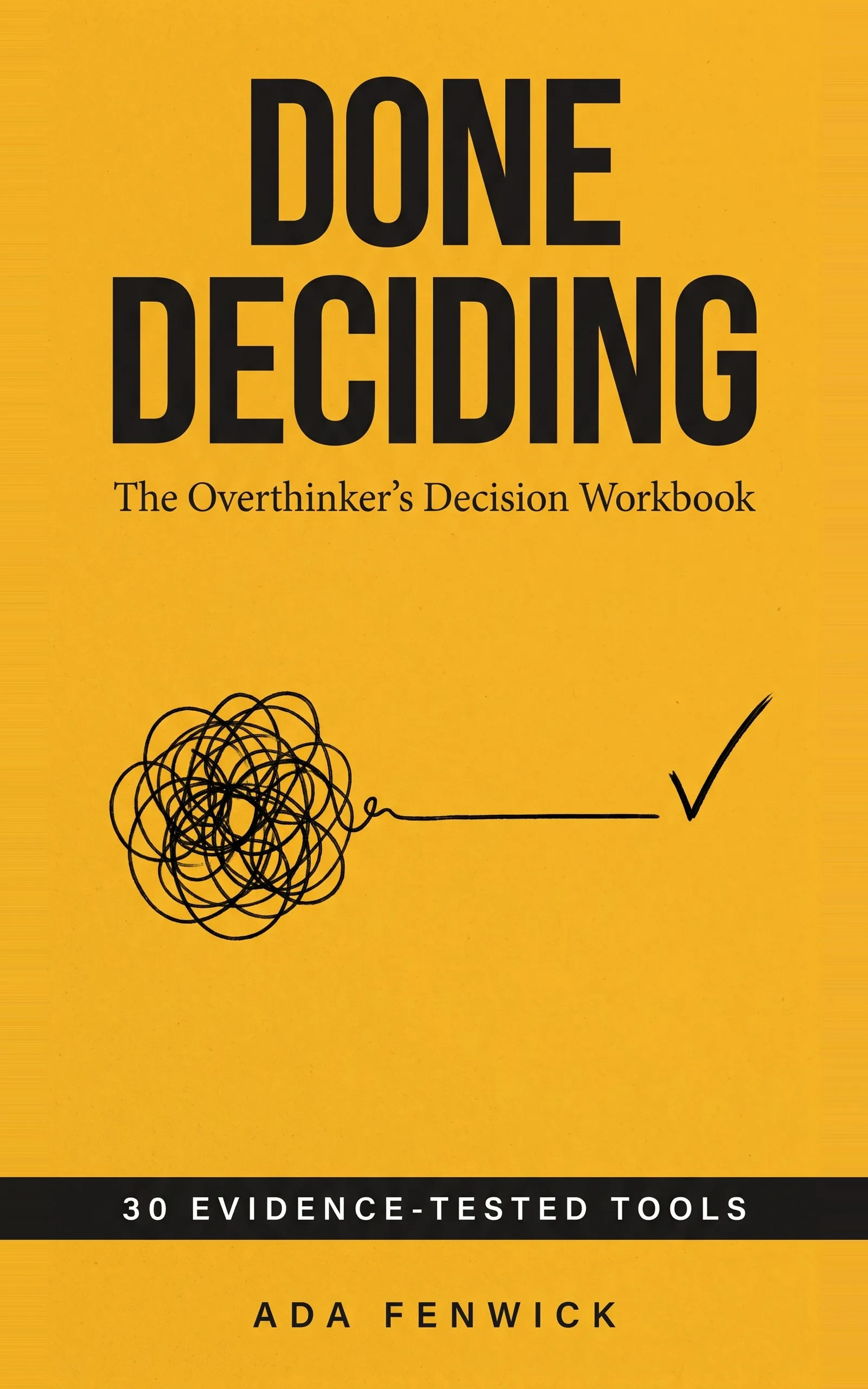
Done Deciding
The Overthinker's Decision Workbook. 30 Evidence-Tested Tools to Make Hard Choices Faster, Quiet the What-Ifs, and Stop Second-Guessing. By Ada Fenwick, 207 pages.
Where this problem is in the book:
- Quiet the Replay: Give the What-Ifs a Time Slot and Get Your Day Back
- Close the Door: Why a Final Choice Feels Better Than an Open One
Links go to Amazon. ToolGenX publishes this book under a pen name and earns from every sale. Amazon sets the price and handles delivery and returns.

Is Done Deciding the right book for you?
Yes, if
- You chose carefully and still rewatch the same scenes all day
- You are not reconsidering, just replaying
- You still have the old listings, alerts or saved searches on your phone
Skip it if
- Worry has been hard to control on most days for months (talk to a health care provider)
- You want your mind to go silent (no tool here promises that)
Fair doubts before you buy
Scheduling worry sounds like it would make it worse.
It sounds that way, and it is fair to doubt it. But this is the one tool in the book with a SOLID badge. A 2023 review pooled seven randomized trials with 999 people, and postponing worry reduced daily worry. The effect was small, and one online version found nothing. The book says so plainly.
Is this not just therapy in disguise?
The method comes from worry research, but the book is not therapy and does not treat anything. It is a habit for one narrow job: moving the replay of a choice out of your whole day. If worry feels out of control, the book points you to a health care provider.
Get Done Deciding
Thirty small decision tools for overthinkers, each traced to its research and badged SOLID, PROMISING or STORY ONLY, from the first loop test to closing the door after you choose.
Links go to Amazon. ToolGenX publishes this book under a pen name and earns from every sale. Amazon sets the price and handles delivery and returns.

Questions people ask about this
- How do I stop thinking about a decision I already made?
- First, close it: delete saved searches, turn off alerts and write down the one real event that would make you reopen it. Then give the leftover replay a daily window of 15 to 30 minutes. When it comes up outside the window, jot two words and go back to what you were doing.
- What is a worry window?
- It is a set time each day, at the same time and place, when you let yourself worry on purpose. Outside it, you note the worry and save it for later. Researchers call this worry postponement. Its first tests date to 1983, and a 2023 meta-analysis of seven trials found a small but real effect.
- How long should a worry period be?
- The book suggests 15 to 30 minutes a day, with a timer, at the same time and in the same place. The trials ran from about a week to a month, so give it at least a week before you judge it.
- Why do I keep replaying a decision when I know it was right?
- Minds wander a lot, and often backward. In a 2010 study, people were thinking about something other than what they were doing in 46.9 percent of random check-ins. Keeping the decision open also feeds it: when a choice stays reversible, attention drifts to the flaws in what you picked.
- When is overthinking a decision a sign of anxiety?
- The book does not diagnose, but it quotes the US National Institute of Mental Health: to be diagnosed with GAD, a person must find it hard to control worry on most days for at least 6 months. If that fits, or it is wearing down your sleep, focus or work, talk to a health care provider.
Related problems
- Bad decision or bad luck? How to judge a choice that went wrong
A choice went wrong and you blame yourself. Split it into what you knew and what you could not control, then keep only the lesson about how you chose.
- Afraid of making the wrong decision? Find out what you are scared of losing
When the facts point one way and you still cannot move, a fear is usually holding the door. Name it in five minutes, then size the regret.
- Stuck in analysis paralysis? Check whether you are thinking or just spinning
Stuck in analysis paralysis? A five-minute test shows whether you are still learning or just looping, and what to do next in each case.
- Everything inside Done Deciding
Every chapter, who the book is for, and every problem it helps with.
// Also on this topic
- guideThe Edison nap: how to catch ideas at the edge of sleep, and when to stop
The steel-ball story has no source, but a 2021 study tested the nap. Here are the steps, the stop rules, and what the evidence really shows.
- guideFirst principles thinking explained simply, with a way to try it today
First principles thinking means splitting a problem into what is true and what is habit, then rebuilding. Plain steps and an honest evidence note.
- bookMental Models That Actually Work
40 Thinking Tools from Munger, Bezos, Feynman, and Kahneman, Tested Against the Evidence, for Clearer Thinking and Better Decisions