Last updated
You keep asking everyone for advice before you decide, and it never settles it

Four yeses, one maybe and a question about money
It is Thursday night, phone in hand. You have been with your partner for two years. Last week he asked if you would like to move in together when your lease ends in March.
Since then you have asked your best friend, your sister, your mom and two people at work. You screenshotted his text and sent it to a group chat.
Four people said go for it. One said "only if you're sure." Your mom asked who would pay for what. Now you are writing to a college roommate you have not talked to in a year.
Part of you already knows the next reply will not settle it. Stopping still feels risky, as if the answer that ends all doubt is waiting in the next message.

Advice works, so that is not the problem
We want to be clear about this, because "stop asking people" is lazy advice. Asking is one of the best decision tools there is.
In a 2004 set of studies by Ilan Yaniv, people made a judgment, heard an adviser and made a final call. They gave their own view more weight than the adviser's. Even so, using advice made them more accurate. In plain words, people listen to advice less than they should, and still do better for having heard it.
So the book gives you permission to ask. The question is what you are asking for.

Why a bigger poll gives you less certainty
Notice what those studies are about. Someone asks to get information, takes it in and decides. That is not what happens at 11 p.m. with a screenshot.
The second kind of asking wants someone to say "it will be fine" with enough force that the worry stops. Then it comes back, and you ask again.
Research by David Budescu and colleagues found that confidence in a set of opinions drops as the opinions spread out. A 2007 study by Budescu and Yu found that one of the best predictors of a decision maker's confidence was how much the advisers agreed.
Now look at the group chat again. Four yeses, one "only if you're sure," one money question. That spread is normal. If what you want from the poll is certainty, a spread like that will never deliver it.
There is a quiet cost too. A 2008 review by Starr and Davila pooled 38 studies and found that excessive reassurance seeking went with low mood, and more weakly with being rejected by others. Those are links, mostly measured at one point in time. They do not show that asking causes low mood, and the book makes no clinical claim. The practical point is smaller: asking the same question again can wear on the people who love you.

Information or permission?
Look at the questions you have been sending. Information questions sound like this:
- "What did you wish you had known before you moved in with someone?"
- "How did you two split rent and bills?"
- "What do you see in us that might be missing from the picture?"
Permission questions sound like this:
- "Do you think it's a good idea?"
- "Would you do it?"
People who have been there can answer the first kind, and their answers give you something new to weigh. Only you can answer the second kind. Each person who tries is guessing at your life from the outside.
Audit the advice in ten minutes
The book's Advice Audit carries a STORY ONLY badge. It has never been tested. It is a sorting job you can do with your recent messages.
- List everyone you asked about this decision, with a few words on what each said.
- Mark each name NEW if they gave you new information, like a fact, an experience or a question you had not thought of. Mark it R if they mostly gave reassurance or a vote.
- Count the R's. If the last two people added nothing new, the polling is over.
- Write the one or two pieces of information that actually changed how you see the choice.
- Write the question you were really hoping someone would answer. It is often "Tell me this won't go wrong." Nobody can answer that for you.
- Decide who, if anyone, still has a fact you need. Ask that person one specific question, then stop.
Be the friend you would have asked
Here is the odd part. You probably give clear advice to other people all the time. In the book, a reader is stuck for six weeks on whether a widowed dad should move into the spare room. Then a coworker says her mother-in-law might move in, and the reader has advice for her in ten seconds. Talk to your husband. Try a month before anyone sells anything. Set ground rules while everyone is calm.
That gap has been studied. In three experiments with 693 people, Igor Grossmann and Ethan Kross found people reasoned more wisely about a friend's relationship conflict than their own. When people pictured their own problem from an outside observer's seat, the gap closed. Older adults were no wiser about their own lives than younger ones. Stepping back helped both.
The book turns this into Advise a Friend (PROMISING). Picture a real friend with your exact problem. Write their situation using their name, then write what you would tell them. Check four things: did you admit what they cannot know yet, suggest a middle path, say that things might change and think about the other people involved? Then read it back as if it were written to you.
Ask once, ask well, then decide
If the audit shows you have been polling, the fix is not to ask nobody. It is to ask one person well. The book's One Trusted Voice card (STORY ONLY) has you pick someone who knows the area, knows you and has told you hard things before. Ask what you might be missing, not whether you should do it. Listen without arguing, write down the one point that surprised you, and tell them your decision date before you hang up.
You can still tell everyone else what you decide. Sharing news is not the same as asking for a vote.
Where Done Deciding takes it from here
This is the problem Done Deciding was written for.
Stop Polling Everyone: Ask Well, Ask Once, Then Decide has the Advice Audit, One Trusted Voice and the full research on advice and agreement.
Get Out of Your Own Head: Give Yourself the Advice You'd Give a Friend has Advise a Friend and a three-minute card for talking to yourself by name when the loop gets loud.
If the asking is really about fear, start with our page on being afraid of making the wrong decision.
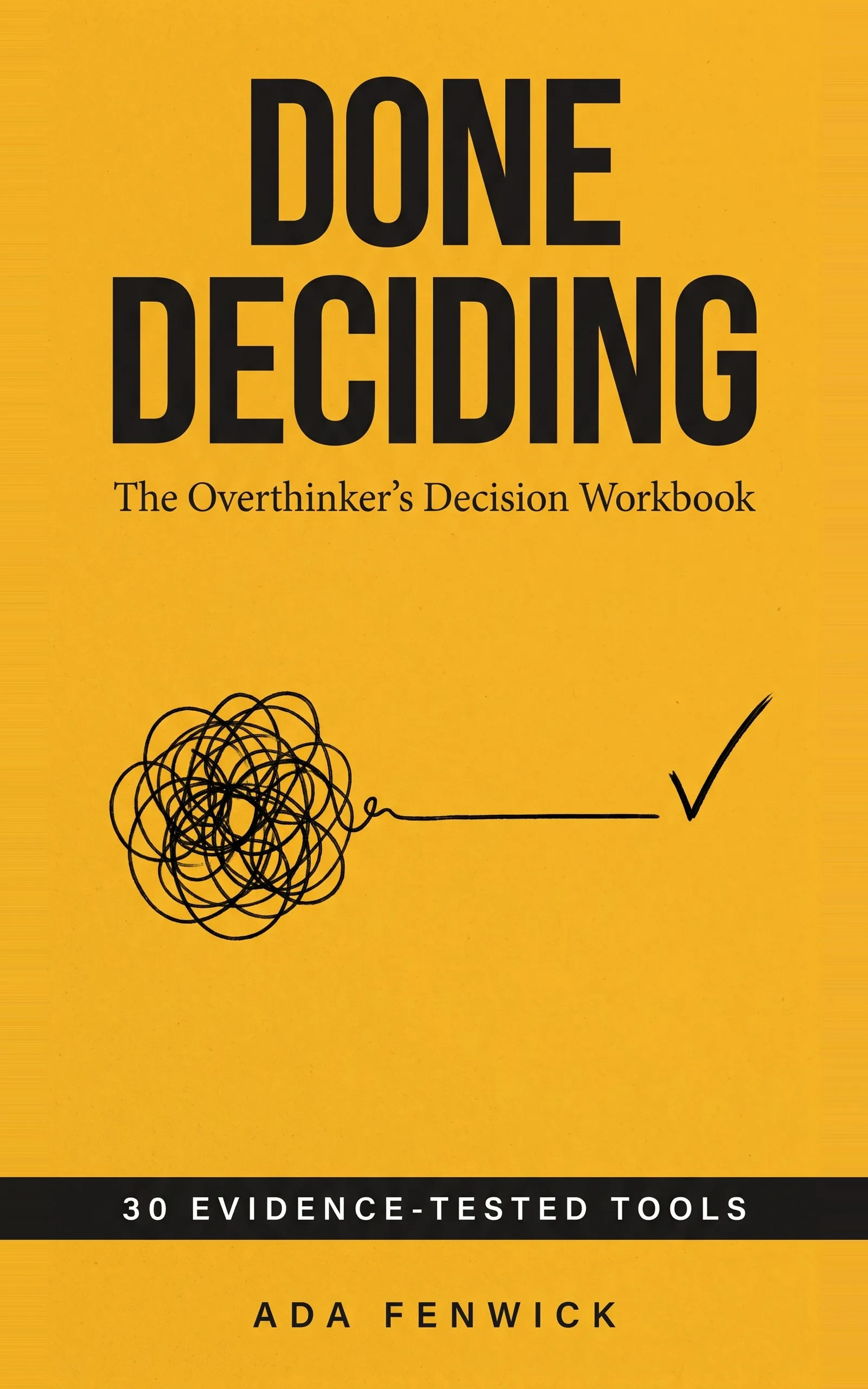
The book for this problem
Done Deciding
The Overthinker's Decision Workbook. 30 Evidence-Tested Tools to Make Hard Choices Faster, Quiet the What-Ifs, and Stop Second-Guessing. By Ada Fenwick, 207 pages.
Where this problem is in the book:
- Stop Polling Everyone: Ask Well, Ask Once, Then Decide
- Get Out of Your Own Head: Give Yourself the Advice You'd Give a Friend
Links go to Amazon. ToolGenX publishes this book under a pen name and earns from every sale. Amazon sets the price and handles delivery and returns.

Is Done Deciding the right book for you?
Yes, if
- You have screenshotted a text and sent it to a group chat for a verdict
- You are halfway through a message to someone you have not spoken to in a year
- You give friends clear advice in seconds and cannot do it for yourself
Skip it if
- The urge to check and ask feels constant and painful (a licensed professional is the right person to talk to)
- You want the book to tell you who to listen to on a money, legal or medical question
Fair doubts before you buy
But two heads are better than one. Why stop asking?
The book agrees, and does not tell you to stop. Advice tends to make judgments better. What it targets is the other kind of asking, the kind that hunts for "it will be fine." That kind cannot be answered by anyone else, and each new reply has a fresh chance to disagree.
What if the one person I pick is wrong?
They might be. The goal is not certainty, which no adviser can give you. The goal is one careful view you can actually weigh, instead of a tally you can never finish. You still make the call, and you still use your own three criteria.
Get Done Deciding
Thirty small decision tools for overthinkers, each traced to its research and badged SOLID, PROMISING or STORY ONLY, from the first loop test to closing the door after you choose.
Links go to Amazon. ToolGenX publishes this book under a pen name and earns from every sale. Amazon sets the price and handles delivery and returns.
Questions people ask about this
- Is it bad to ask a lot of people for advice?
- Not in itself. In a 2004 study by Ilan Yaniv, using advice made judgments more accurate, though people gave advice less weight than they should. It turns into a problem when you keep asking the same question for reassurance. If the last two people added nothing new, the next one probably will not either.
- Why do I need other people to tell me my decision is right?
- Often because what you want is certainty, not information. Research on advice shows confidence rises when advisers agree and falls when they do not. Different people see the same choice differently, so a wide poll almost never agrees enough to give you the calm you are looking for.
- How do I stop seeking reassurance from others?
- Check what kind of questions you are sending. "How did you two split rent?" asks for information. "Do you think it is a good idea?" asks for permission, and only you can answer it. Keep the first kind, aimed at the right person, and stop sending the second kind to everyone.
- Why is it easier to give advice to others than to yourself?
- In three experiments with 693 people, Grossmann and Kross found people reasoned more wisely about a friend in a relationship conflict than about their own. When people looked at their own problem as an outside observer would, the gap closed. Age did not help. Stepping back did.
- Who should I ask for advice on a big decision?
- One person who knows the area, knows you well enough to be frank and has told you things you did not want to hear before. Sometimes those are two people. Pick the one whose input your choice depends on most, and ask a real question, not a vote.
Related problems
- Afraid of making the wrong decision? Find out what you are scared of losing
When the facts point one way and you still cannot move, a fear is usually holding the door. Name it in five minutes, then size the regret.
- Stuck in analysis paralysis? Check whether you are thinking or just spinning
Stuck in analysis paralysis? A five-minute test shows whether you are still learning or just looping, and what to do next in each case.
- A gift for an overthinker that helps, without telling them to just relax
Shopping for someone who overthinks every choice? Give small tools they can use at 11 p.m., plus one offer from you that beats any pep talk.
- Everything inside Done Deciding
Every chapter, who the book is for, and every problem it helps with.
// Also on this topic
- guideHow to build a memory palace when you have never tried one before
A memory palace uses a place you know to hold a list. Here is how to build your first one in 20 minutes, why it works, and what the studies found.
- guideHow to keep a decision journal: what to write, and when to look back
How to keep a decision journal: the six fields to write before you decide, when to review, and how to judge the choice apart from how it turned out.
- bookMental Models That Actually Work
40 Thinking Tools from Munger, Bezos, Feynman, and Kahneman, Tested Against the Evidence, for Clearer Thinking and Better Decisions