// book · by Nancy Whitaker (pen name)
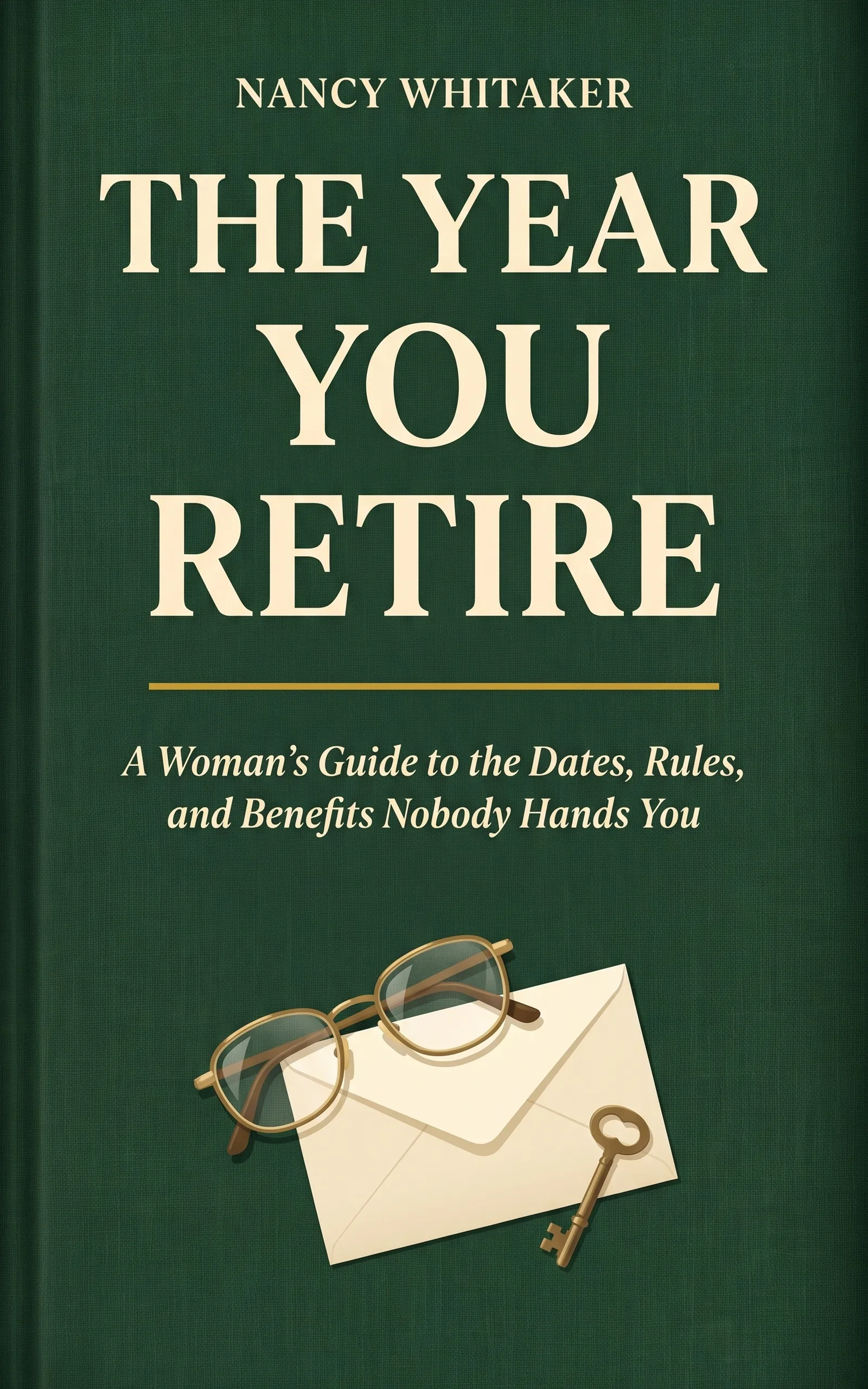
The Year You Retire
A Woman's Guide to the Retirement Dates, Rules, and Benefits Nobody Hands You
The day the job ends, quiet deadlines start. This book gathers them from six federal agencies and fifty states, with a source and a year on every number.
Links go to Amazon. ToolGenX publishes this book under a pen name and earns from every sale. Amazon sets the price and handles delivery and returns.
This book lays out published rules and dates. It is not legal, tax, medical or financial advice. For your own record, call your State Health Insurance Assistance Program (SHIP) or Social Security.
- author
- Nancy Whitaker
- length
- 169 pages (paperback)
- formats
- Kindle, paperback
- sold by
- Amazon
This book is for you if
- You retire this year and your job coverage ends with it
- You are a widow and were told a full retirement age from the wrong table
- You heard about free state college classes after 60 and want the real rules
- You are buying a retirement gift for your mother
- Your Medicare premium is based on a salary you no longer earn
Skip it if
- You want investment or tax advice
- You live outside the US
// problems this book helps with
Start from your problem
Each page below answers one real question in plain words, then shows where The Year You Retire goes further.
- Your first year of retirement feels empty, and every day looks the same. Is that normal?
Retirement feels flat by the third Monday? What went missing is the structure your job gave you. Here is how to replace it one piece at a time.
- Free college classes for seniors by state: what the lists leave out
Free college classes for seniors start at 60 in many states, but tuition is not the whole bill. The four rules the lists skip, and the one call to make.
- Your job just ended and you are past 65. Here is your Medicare deadline.
Your job ended after 65? You have eight months to sign up for Part B. Here is when the clock starts, why COBRA does not stop it, and what late costs.
- Looking for a retirement gift for a woman that she will actually use?
A retirement gift for a woman that does more than sit on a shelf: a guide to the dates and benefits nobody hands her, plus a note on how to give it well.
- Taking Social Security while still working? They do not take it right back.
The 2026 Social Security earnings limits, what counts as earnings, and why withheld benefits are not lost. The rule, its year, and who can check yours.
- Spousal or ex-spouse Social Security benefits: which rules apply to you?
Spousal and ex-spouse Social Security benefits side by side: marriage length, age, whether he must have filed, and the most you can get. With sources.
- Your widow's benefit stopped growing even though you waited. Here is the cap nobody explained.
If your husband took Social Security early, your widow's benefit can be capped. Here is the rule, the two numbers in it, and the question to ask.
- What is a widow's full retirement age for survivor benefits? It is not the one you read.
A widow's full retirement age for survivor benefits uses a shifted table. Find your row, the percent at each age, and who can confirm your own date.
What happens the day the job ends
Maybe there was a cake in the break room. Maybe the job ended without asking. Either way, there was a last day, and then you went home.
Nobody put the clock in the card. On that day, several deadlines start running. The Medicare window is one. Some of these clocks charge a penalty every month for the rest of your life if they are missed.
The Year You Retire starts there, on purpose. Its first part is the calendar: Medicare enrollment, Social Security claiming ages, the earnings test, the records you can claim on, and the yearly windows that open each autumn and winter. That is the part with deadlines in it, so it goes first.
Every number has a source and a year
Most books in this category have no source list. This one is built around its list.
Every age, percent and deadline was traced to the body that runs the rule: the statute, the agency's program manual, or the agency's own public page. Each chapter ends with where its facts came from and the date they were checked, mostly September 2026.
Where a rule could not be confirmed, the book says so in the place you would have trusted it. Two state tuition programs that appear on almost every online list were left out for that reason. A short section at the back names six popular claims that did not hold up when checked against the official source.
We find that last part the most useful. A source list proves someone looked. A list of what could not be verified proves they were willing to say so.
Written for women, and for widows in particular
Social Security was built in 1935 around one earner and one homemaker. The rules have been patched ever since, and the patches are where a woman's money often is.
The book maps the four records a woman may claim on. It explains the ten-year rule for ex-spouses, which counts by calendar year rather than by month. It gives the shifted full retirement age table for widows, which sits in a footnote most readers never see. And it explains the cap on a widow's benefit when her husband claimed early, a rule that lives in the staff manual rather than on the pages written for widows.
It does not tell you which record to claim on, or when. It tells you the rule, the year, and who can run the numbers on your own file for free.
What becomes yours, and the shape of the year
The second part is about what opens up. A lifetime parks pass at 62. Tuition waivers that start at 60 in ten of the eighteen states the book confirmed, along with the fees, seat rules and income tests the lists leave out. Tax lines that change at 65. Programs that want your working experience. The local network funded under the Older Americans Act.
The third part is about the first year itself. The Monday Problem names the six things a job quietly supplied, and why replacing them is a scheduling task as much as an emotional one. The Long Half starts from one number: a woman who reaches 65 can expect, on average, 20.7 more years. It ends with a short list of what one person should know about where the papers are.
At the back are ten working pages to write on. If the book was a gift, the most useful afternoon the two of you can spend starts with one sentence: show me where things are.
We publish this book under the Nancy Whitaker pen name, and we kept the same rule the book keeps: if a number could not be traced to its source, it stayed out.
What is inside
- The seven-month Medicare window, the eight-month window after a job ends, and why COBRA does not hold it open
- The full retirement age table read as a real month, plus the shifted table that applies to widows
- The earnings test with 2026 limits, and Social Security's own statement that withheld benefits are not lost
- Four records a woman may claim on: her own, her husband's, her late husband's and an ex-husband's
- The survivor benefit cap that applies when a husband claimed early, and the question to ask about it
- Senior tuition rules in eighteen confirmed states, many of which start at 60, not 65
- The Monday problem: what goes missing when work ends, and why one fixed commitment beats a bucket list
- Ten working pages at the back for your dates, your records and where the important papers are
Chapters
- 01If someone gave you this book
- 02What this book is not
- 03The Window That Closes
- 04The Age Ladder
- 05If You Keep Working
- 06Her Own Record, and the Other Ones
- 07The Yearly Doors
- 08What Changes Every January
- 09The Lifetime Card
- 10Sitting in a Classroom Again
- 11The Discounts That Are Real
- 12Tax Lines You May Not Have Looked At
- 13Somebody Needs What You Know
- 14The Network You Did Not Know You Had
- 15The Monday Problem
- 16Two People, One Kitchen
- 17The Long Half
- 18A Year From Now
- 19Your First Year Pages
The paperback, up close









Questions about The Year You Retire
- Who is The Year You Retire for?
- Women in the US who are retiring this year or just did, and anyone buying a thoughtful gift for one. It suits a reader who wants the exact rule and its year, with a source to check, rather than a list of hobbies.
- Does the book tell me when to claim Social Security?
- No. It states the rules, such as the claiming ages, the earnings test and the survivor cap, and leaves the choice to you. Each chapter ends by naming who can look at your own file, with free options like Social Security and your State Health Insurance Assistance Program listed first.
- Is this legal, tax or financial advice?
- No. The book says so on its first pages. It is a map of the rules and a set of questions worth asking the people who can see your actual situation.
- Who is Nancy Whitaker?
- Nancy Whitaker is a pen name. The book says plainly that its work is research rather than lived experience. Every rule was traced to the agency that runs it, and the book offers traceability rather than authority.
- Will the numbers go out of date?
- Yes, and the book plans for it. Dollar figures are stated with their year, mostly 2026. One chapter explains where each figure is published every January, so you can check the current year yourself.
Get The Year You Retire
Retirement starts deadlines nobody mails you; the book gathers them from six federal agencies and fifty states with a source on every number.
Links go to Amazon. ToolGenX publishes this book under a pen name and earns from every sale. Amazon sets the price and handles delivery and returns.