Last updated
Your widow's benefit stopped growing even though you waited. Here is the cap nobody explained.

You waited, and the number did not move
You did what everyone told you. You held off. You read that a widow can get up to 100 percent, and you planned around that.
Then the letter came. The amount was lower than you worked out. Or it went up a little, then stopped.
So you sit at the kitchen table and wonder what you did wrong. You read the rule. You did the math.
You did not do anything wrong. You were given half a rule.
This page is not legal, tax, medical or financial advice. It lays out the rule as Social Security writes it, checked in 2026, so you can ask about your own case.

Why the 100 percent you were told is only half true
Social Security's survivor amount page says a widow can get up to 100 percent at her survivor full retirement age. That is true.
What the page does not spell out is the assumption under it. The 100 percent assumes a husband who did not claim early.
Most articles copy that page and stop there. So the one fact that changes your number never reaches you. It is not a secret. It is just written in a place nobody reads, the manual Social Security staff use.

The cap, in plain words
Here is the rule from the program manual, RS 00615.320.
If your husband started his own benefit early, at a reduced rate, your widow's benefit is capped. It is limited to the larger of two numbers:
- 82.5 percent of his primary insurance amount at death. That phrase means the benefit he would have got at his own full retirement age.
- The reduced amount he would have been getting if he had lived.
Waiting still helps until you reach that cap. After that, it does nothing. No amount of waiting lifts it.
Social Security calls this the RIB-LIM. You will not hear the word at a counter. A widow who does not know it exists can wait years for a raise that is not coming.
The question to ask is short. Does the RIB-LIM apply to the benefit on your file, and where is the ceiling?

The cap with round numbers
Rules like this are easier to see with numbers. These are made-up round figures, only to show how the two parts of the cap work. Your own figures come from Social Security.
Say his full benefit at full retirement age, his primary insurance amount, was $2,000 a month. He was born in 1960 and claimed at 62. The book's age table shows a 30 percent cut for that, so he was paid $1,400.
Now work out the cap. It is the larger of two numbers:
| Part of the cap | Sum | Result |
|---|---|---|
| 82.5 percent of his full benefit | $2,000 x 0.825 | $1,650 |
| What he was being paid | Reduced at 62 | $1,400 |
| Your cap is the larger one | $1,650 |
So in this example, the most the widow can get is $1,650, not $2,000. That is true even if she waits to her survivor full retirement age.
Waiting still matters below the cap. If she claims at 60, she starts at 71.5 percent of his full benefit. Here that is $1,430, under the cap, so she gets $1,430. Waiting pushes her number up toward $1,650. Past that point, waiting adds nothing.

The switch that is still open to widows
There is a second rule that matters here, and it runs in your favor.
For most people, filing for one Social Security benefit files for all of them. You cannot pick one and save the other. That rule closed for spouses born January 2, 1954 or later.
Widows are exempt. The manual, at GN 00204.020, allows a widow to take reduced benefits on one record for a time and later file on another record for a higher benefit.
So a widow might take a survivor benefit first and let her own grow, then move to her own at 70. Or the other way round. Which way works depends on two numbers: what your record pays, and what his pays. That is arithmetic on your own file, and Social Security can run it with you for free.
There is one more thing to bring. If he had waited past his full retirement age, his delay credits carry into a widow's benefit. If he claimed early, the cap above is the rule instead. Bring the date he claimed and his date of birth.

Where The Year You Retire covers the rest
This is the problem The Year You Retire was written for. Nancy Whitaker calls the cap the most important rule in its chapter, and puts it where a widow will find it.
Her Own Record, and the Other Ones covers all four records a woman may claim on: her own, her husband's, her late husband's and an ex-husband's. It has the cap, the switch for widows and the remarriage rule. It also flags a case it could not fully verify, the surviving divorced spouse, and tells you to ask about it by that name.
The Age Ladder explains why his claiming age sets a floor under the survivor's benefit for the rest of her life, and why that belongs on the table before either of you claims.
The book also gives the shifted age table for widows. If you have not checked your own survivor age yet, start with the widow full retirement age table.
What we found most useful is the list of documents to bring: the death certificate, the marriage certificate, and the date he claimed. The rules are decided on paper, not on memory.
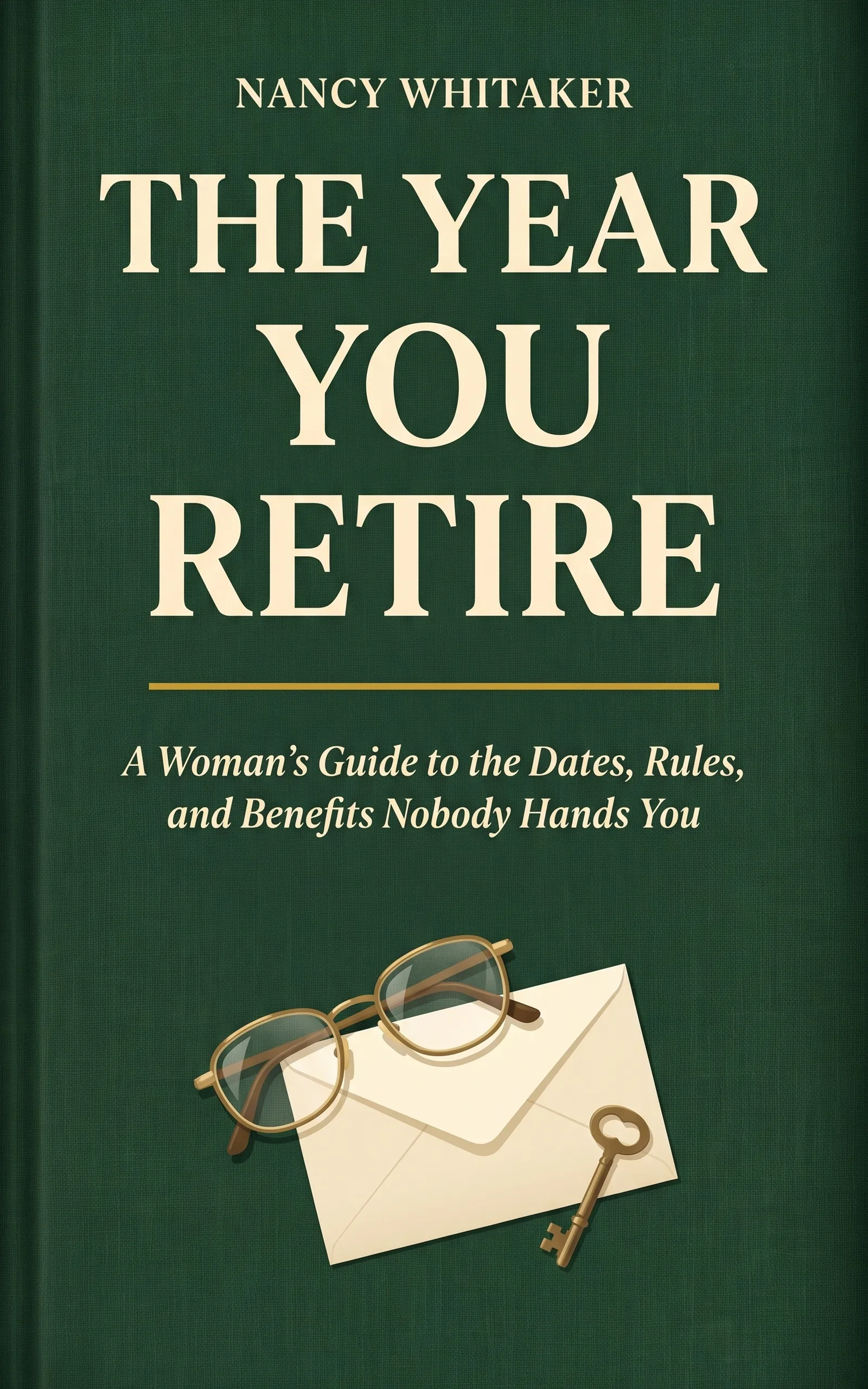
The book for this problem
The Year You Retire
A Woman's Guide to the Retirement Dates, Rules, and Benefits Nobody Hands You. By Nancy Whitaker, 169 pages.
Where this problem is in the book:
- Her Own Record, and the Other Ones
- The Age Ladder
Links go to Amazon. ToolGenX publishes this book under a pen name and earns from every sale. Amazon sets the price and handles delivery and returns.

Is The Year You Retire the right book for you?
Yes, if
- You are a widow and your husband claimed his benefit before his full retirement age
- You were planning to wait for 100 percent and want to know if that is real
- You want the rule's name so you can ask about it at the counter
Skip it if
- You want someone to tell you which record to claim on and when
- Your husband waited until his full retirement age or later to claim
Fair doubts before you buy
Social Security would have told me about a cap, wouldn't they?
They may, if you ask. The rule lives in the program manual staff use, not on the pages written for widows, and the term RIB-LIM is not one you will hear at a counter. Knowing the name means you can ask about it directly.
Can a book really help with something this specific?
It cannot see your record, and it says so. What it can do is show you the rule, where it is written, and the exact question to ask. The number itself has to come from Social Security.
Get The Year You Retire
Retirement starts deadlines nobody mails you; the book gathers them from six federal agencies and fifty states with a source on every number.
Links go to Amazon. ToolGenX publishes this book under a pen name and earns from every sale. Amazon sets the price and handles delivery and returns.
This book lays out published rules and dates. It is not legal, tax, medical or financial advice. For your own record, call your State Health Insurance Assistance Program (SHIP) or Social Security.

Questions people ask about this
- Why is my survivor benefit less than 100 percent?
- Two common reasons. You may have claimed before your survivor full retirement age, which lowers the percent. Or your husband claimed his own benefit early, which can cap your benefit at the larger of 82.5 percent of his full amount or what he would have been getting.
- What is the RIB-LIM?
- It is Social Security's name for the widow's limit. If the husband claimed early, the widow's benefit is limited to the larger of 82.5 percent of his primary insurance amount at death or the reduced benefit he would have received had he lived.
- Should a widow wait to claim survivor benefits?
- That depends on your own numbers, and this page will not choose for you. The rule is that waiting raises the benefit only until you reach any cap that applies. Social Security can tell you where your cap is.
- Can a widow switch from survivor benefits to her own benefit later?
- Yes. Widows are exempt from the rule that makes you file for everything at once. A widow can take reduced benefits on one record for a time and later file on another record for a higher benefit.
- Does remarrying stop survivor benefits?
- A remarriage at or after 60 is disregarded for survivor benefits. A remarriage before 60 bars the benefit while that marriage lasts, and entitlement can begin again the month the later marriage ends.
Related problems
- What is a widow's full retirement age for survivor benefits? It is not the one you read.
A widow's full retirement age for survivor benefits uses a shifted table. Find your row, the percent at each age, and who can confirm your own date.
- Spousal or ex-spouse Social Security benefits: which rules apply to you?
Spousal and ex-spouse Social Security benefits side by side: marriage length, age, whether he must have filed, and the most you can get. With sources.
- Taking Social Security while still working? They do not take it right back.
The 2026 Social Security earnings limits, what counts as earnings, and why withheld benefits are not lost. The rule, its year, and who can check yours.
- Everything inside The Year You Retire
Every chapter, who the book is for, and every problem it helps with.