Last updated
What is a widow's full retirement age for survivor benefits? It is not the one you read.

| Your birth year | Row you read for survivor | Your own full retirement age | Your survivor full retirement age |
|---|---|---|---|
| 1945 through 1954 | 1943 through 1952 | 66 | 66 |
| 1955 | 1953 | 66 and 2 months | 66 |
| 1956 | 1954 | 66 and 4 months | 66 |
| 1957 | 1955 | 66 and 6 months | 66 and 2 months |
| 1958 | 1956 | 66 and 8 months | 66 and 4 months |
| 1959 | 1957 | 66 and 10 months | 66 and 6 months |
| 1960 | 1958 | 67 | 66 and 8 months |
| 1961 | 1959 | 67 | 66 and 10 months |
| 1962 or later | 1960 or later | 67 | 67 |
How to read the survivor table in two steps
This page is not legal, tax, medical or financial advice. It sets out the rule so you know what to ask.
The table above has two ages for one woman. The first is your full retirement age for your own benefit. The second is your full retirement age as a widow. For many birth years, they are not the same.
Step one: find your birth year in the left column. Step two: read across to the last column. That is the age at which a survivor benefit can reach its top level.
The rule comes from a footnote. On its normal retirement age page, Social Security says widows whose benefit is based on reaching 60 should add 2 years to the year of birth shown in the table. In plain words, the survivor table runs two years behind.
So a widow born in 1960 has two ages in the same year. Her own is 67. Her survivor age is 66 and 8 months.

Two birthdays that move you to another row
If you were born on January 1, Social Security treats you as born the year before. You read the row above yours. That is not rounding. It changes the age.
There is a second rule for any birthday on the first of a month. Social Security figures your age as if your birthday fell in the month before.
If either one is you, ask Social Security to confirm your date in writing. Do not work it out from a table alone, including this one.

What the percent climbs toward
A widow can start survivor benefits at 60. At 60, the payment starts at 71.5 percent of his benefit. Social Security's survivor amount page gives a few points along the way: over 75 percent at 61, over 80 percent at 63, and over 90 percent at 65.
Waiting until your survivor full retirement age can take you up to 100 percent. That top level assumes something, though. It assumes he did not claim his own benefit early.
If he did, a cap can apply, and waiting past it gains nothing. That rule has its own page: why a widow's benefit stops growing.
Social Security used to post a month-by-month chart. It no longer does. If you need the exact figure for one month, that number has to come from them.

How the cut is spread across the months
Social Security's survivors early chart says a survivor benefit that starts at 60 is always cut by 28.5 percent. That is the 71.5 percent above. The cut shrinks a little for each month you wait, until it is gone at your survivor full retirement age.
So the later your survivor age, the more months the cut is spread over, and the smaller each month's step. Here is the sum, 28.5 percent divided by the months from 60 to your survivor age.
| Your birth year | Months from 60 to survivor age | Cut for each month early, about |
|---|---|---|
| 1945 through 1956 | 72 | 0.396 percent |
| 1957 | 74 | 0.385 percent |
| 1958 | 76 | 0.375 percent |
| 1959 | 78 | 0.365 percent |
| 1960 | 80 | 0.356 percent |
| 1961 | 82 | 0.348 percent |
| 1962 or later | 84 | 0.339 percent |
Use it to see the shape, not to plan a date. Your own number, in dollars, comes from Social Security.

The age on the letter in the kitchen drawer
You have read the normal table. Maybe a friend showed it to you, or you found it yourself after the funeral. You were born in 1960, so the row says 67. You do the math and plan to wait.
Nobody told you the table has a second version. It sits in a footnote on an actuary's page. Nobody would think to look there.
Eight months is not small. It is eight months of a benefit at its full level, or eight months of waiting for a level you had already reached.
So write two ages on the same page. Your own, and your survivor age. Then take both to Social Security and ask them to confirm each one against your own record.

Where Nancy Whitaker's book goes from here
This is the problem The Year You Retire was written for. A widow can have a claim on more than one record, and each one has its own rules.
Her Own Record, and the Other Ones has the survivor table shift, the 71.5 percent floor, the nine-month marriage rule and the remarriage rule. Remarrying at or after 60 does not cost you the survivor benefit. It also has the switching rule that is still open to widows, which lets you take one benefit now and move to another record later.
The Age Ladder has the normal table, the January 1 rule and the rule that a husband's delay credits carry into his widow's benefit.
Your First Year Pages gives you a page for the records you might claim on, with a line for the date of death and whether he claimed early.
The best part, we think, is how plain the book is about what it could not confirm. Where Social Security does not state a rule, the book says so and tells you what to ask.
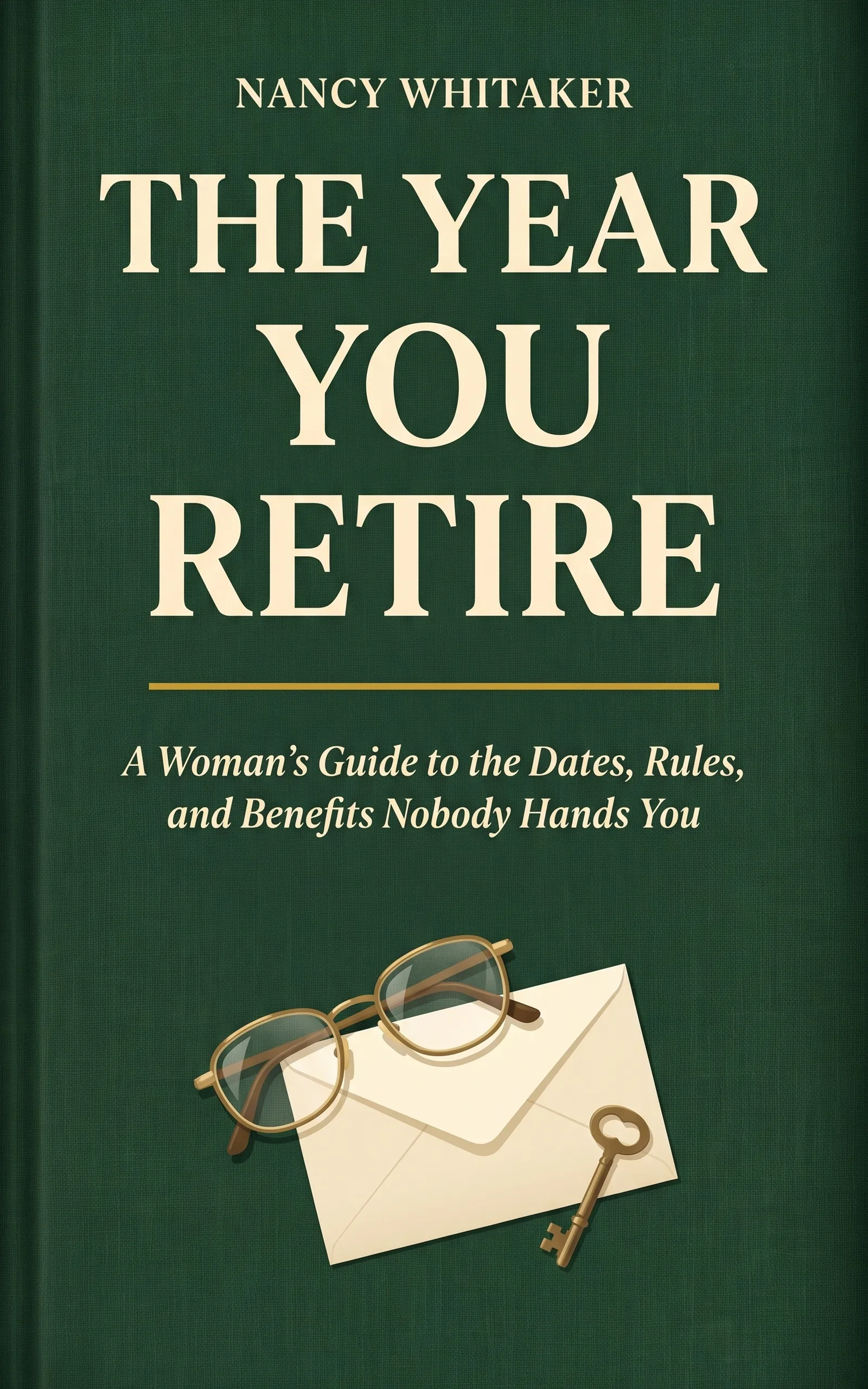
The book for this problem
The Year You Retire
A Woman's Guide to the Retirement Dates, Rules, and Benefits Nobody Hands You. By Nancy Whitaker, 169 pages.
Where this problem is in the book:
- Her Own Record, and the Other Ones
- The Age Ladder
- Your First Year Pages
Links go to Amazon. ToolGenX publishes this book under a pen name and earns from every sale. Amazon sets the price and handles delivery and returns.

Is The Year You Retire the right book for you?
Yes, if
- You are a widow, or expect to be one day, and want the exact date
- You were told 67 and want to see the table yourself
- You were born in or after 1957, where the two tables split
Skip it if
- You want someone to tell you when to claim
- You need a month-by-month survivor percent chart, which Social Security no longer publishes
Fair doubts before you buy
Social Security will tell me my date. Why read about it?
They will, and they are the ones to confirm it. Knowing the shift exists means you can ask the right question at the counter. A widow who has only seen the normal table may never think to ask.
I already read a retirement book. Does this one say anything new?
Most general books print the normal table and stop. This one gives the survivor shift, the cap that applies if he claimed early, and the rule that lets widows switch records later. Those are the parts that change a widow's number.
Get The Year You Retire
Retirement starts deadlines nobody mails you; the book gathers them from six federal agencies and fifty states with a source on every number.
Links go to Amazon. ToolGenX publishes this book under a pen name and earns from every sale. Amazon sets the price and handles delivery and returns.
This book lays out published rules and dates. It is not legal, tax, medical or financial advice. For your own record, call your State Health Insurance Assistance Program (SHIP) or Social Security.

Questions people ask about this
- What is the full retirement age for survivor benefits?
- It depends on your birth year, and it uses a shifted table. Social Security says widows should add two years to the year of birth shown in the normal table. A widow born in 1960 reads the 1958 row, so her survivor full retirement age is 66 and 8 months.
- At what age can a widow collect survivor benefits?
- At 60, or at 50 if she has a disability. The marriage must have lasted at least nine months before his death. Claiming at 60 starts at 71.5 percent of his benefit.
- How much is a survivor benefit at 62 or 65?
- Social Security now publishes only waypoints: over 75 percent at 61, over 80 percent at 63 and over 90 percent at 65, up to 100 percent at survivor full retirement age. For an exact month, the number has to come from Social Security.
- Can a widow get 100 percent of her husband's Social Security?
- Up to 100 percent at her survivor full retirement age, if he did not claim early. If he claimed his own benefit early, a cap may apply that waiting cannot lift.
- Can a widow file late and get back pay?
- A widow filing after her survivor full retirement age can reach back up to six months, but never to a month before that age. A widow filing in the month after the death can reach back one month.
Related problems
- Your widow's benefit stopped growing even though you waited. Here is the cap nobody explained.
If your husband took Social Security early, your widow's benefit can be capped. Here is the rule, the two numbers in it, and the question to ask.
- Spousal or ex-spouse Social Security benefits: which rules apply to you?
Spousal and ex-spouse Social Security benefits side by side: marriage length, age, whether he must have filed, and the most you can get. With sources.
- Your job just ended and you are past 65. Here is your Medicare deadline.
Your job ended after 65? You have eight months to sign up for Part B. Here is when the clock starts, why COBRA does not stop it, and what late costs.
- Everything inside The Year You Retire
Every chapter, who the book is for, and every problem it helps with.