Last updated
Spousal or ex-spouse Social Security benefits: which rules apply to you?

| Rule | Husband, living | Ex-husband |
|---|---|---|
| How long the marriage lasted | At least one continuous year before you apply | In each of the ten years before the final divorce, counted by calendar year |
| Your age | 62 for a whole month, unless you care for his child under 16 or disabled | At least 62 |
| Your status now | Married to him | Not married now |
| Must he have filed? | Yes, for his own benefit | Only if divorced less than two continuous years |
| The most you can get | Half his primary insurance amount | Half his primary insurance amount |
| When your own record wins | Not paid if your own benefit is at least half his amount | Same test |
Six rows that decide which claim you have
This page is not legal, tax, medical or financial advice. It puts the rules side by side so you can see which one is yours.
The table compares two claims a woman may have. One is on a living husband's record. The other is on an ex-husband's. They pay the same top amount. They differ in who qualifies.
Half his primary insurance amount is the most either one pays. That phrase means the benefit he would get at his own full retirement age. It is not half of what he is paid now. If he claimed early, your number is still measured against the full figure.
The last row matters most. If your own benefit is already at least half of his, neither claim pays you anything. Social Security's family benefits page puts it simply: they pay the highest amount you qualify for, and they don't add the payment amounts together.

The ten-year rule is not a stopwatch
Most people count the months. That is where they go wrong.
Social Security's manual on divorced spouses says the marriage must have been in existence in each of the ten years before the final divorce. It counts by year, and a short gap can be bridged.
Their own example: a couple married in May 1980 and divorced in May 1986. They remarried in July 1987 and divorced again in September 1990. That adds up to about nine years and two months of marriage.
She still qualifies. The remarriage came no later than the calendar year right after the divorce, so the years join up.
Had they remarried in 1988, the bridge breaks and the claim is gone. One year, decades ago, decides it.
So if your history has a gap, do not rule yourself out with a calculator. Bring the dates and ask Social Security to check the rule in the manual.

The switching move that closed for most of you
You may hear an older friend describe a move. Claim a spousal benefit at 66, let your own grow, switch to your own at 70.
It is gone for almost everyone reading this. The manual says a woman born January 2, 1954 or later who qualifies for both must apply for both. Filing for one files for both, and you get the higher amount.
January 1, 1954 is left out on purpose. Social Security treats a January 1 birthday as the year before.
Widows are the exception, and that rule is still open. It is on the page about the widow's cap.

What happens if you remarry
This is the follow-up question most people ask next. The answer depends on which claim you have.
On an ex-husband's record. The rule is that you are not married now. So a new marriage stops this claim. Whether it can start again if the later marriage ends is not stated in the manual page on divorced spouses. The book flags this as an open question to put to Social Security, not to a magazine.
On a current husband's record. If you remarry, you are married to someone new. The claim you would look at is on the new husband's record, with its own one-year marriage rule.
Widows are different. A remarriage at or after 60 does not count against a survivor benefit at all. That rule belongs to survivors only, and the book warns that you cannot assume it carries over to divorced-spouse benefits.
If a remarriage is in your plans, ask Social Security before the wedding, not after.

The decree in the bottom drawer
You were married nine years and eleven months. Or you think you were. You have never looked at the decree since the day you signed it.
You did the math in your head years ago and decided it did not count. So you never asked.
The test turns on two dates on paper: the day the marriage began and the day the divorce became final. Memory does not settle it. The decree does.
And claiming takes nothing from anyone. Social Security says payments to ex-spouses do not count toward the family maximum.

What Nancy Whitaker's book adds to the table
This is the problem The Year You Retire was written for. A woman in her sixties may have a claim on up to four records, and the book maps all four.
Her Own Record, and the Other Ones has both sets of rules, the bridging example, the two-year rule for an ex who has not filed, and the 1954 date. It also marks two questions no official page answers, and tells you to ask them rather than guess.
The Age Ladder has the full retirement age table that spousal benefits use and the reduction for claiming at 62.
Your First Year Pages has a page for each record you might claim on, with lines for the exact marriage and divorce dates.
What we like is that the book tells you which papers to bring: marriage certificates and the divorce decree with the final date. The rule is decided on those, not on what anyone remembers.
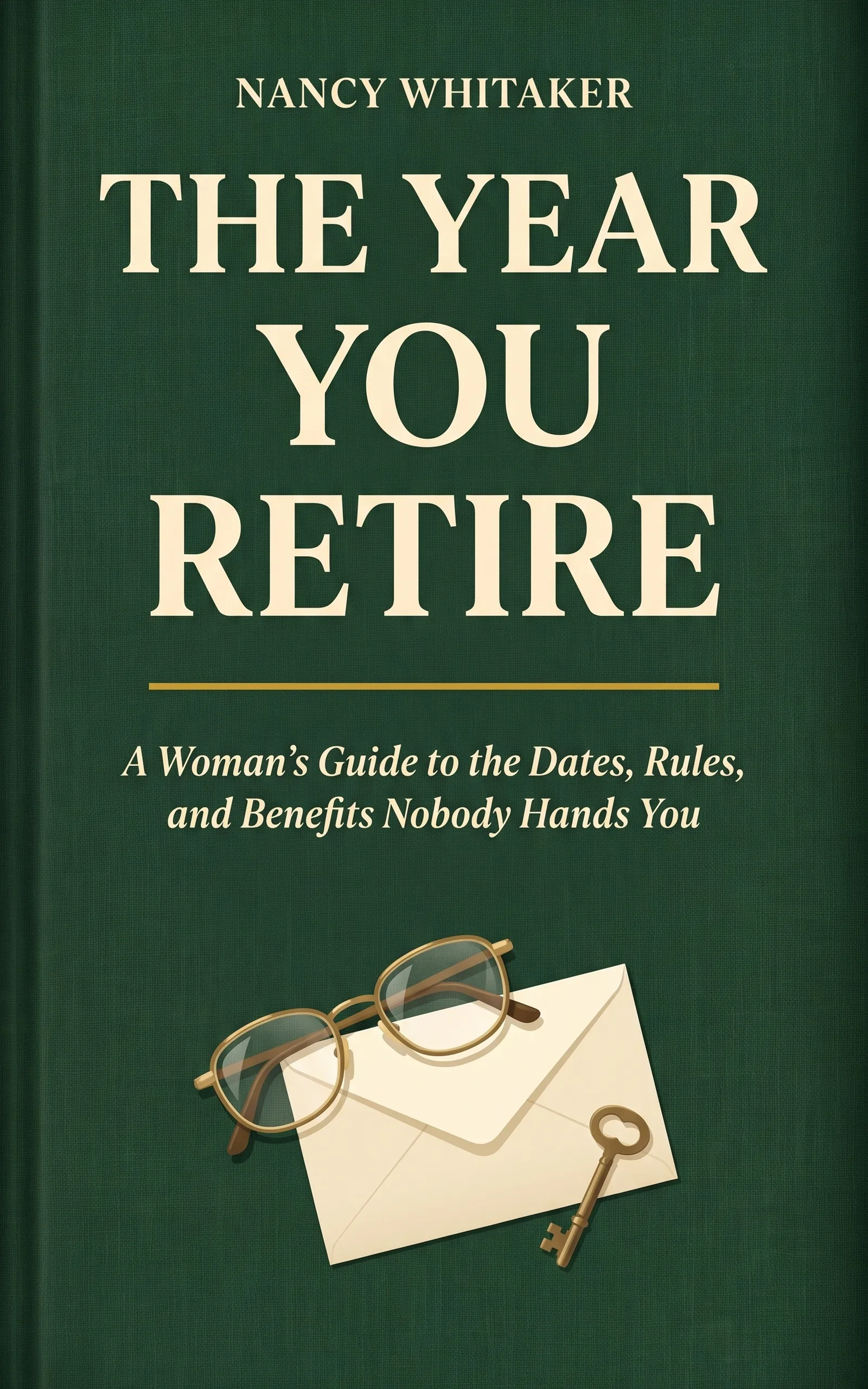
The book for this problem
The Year You Retire
A Woman's Guide to the Retirement Dates, Rules, and Benefits Nobody Hands You. By Nancy Whitaker, 169 pages.
Where this problem is in the book:
- Her Own Record, and the Other Ones
- The Age Ladder
- Your First Year Pages
Links go to Amazon. ToolGenX publishes this book under a pen name and earns from every sale. Amazon sets the price and handles delivery and returns.

Is The Year You Retire the right book for you?
Yes, if
- You are married and your own record is smaller than his
- You were divorced after a long marriage and are not sure it counts
- Your marriage had a gap, a divorce and a remarriage, and you did the math with a calculator
Skip it if
- You want someone to tell you which record to claim on
- You are a widow; survivor benefits have their own rules
Fair doubts before you buy
My ex will find out if I claim. Isn't that a problem?
Social Security does not ask his permission or tell him you applied, once the divorce rules are met. Payments to ex-spouses also do not count toward the family maximum, so his benefit and his current wife's are untouched.
Why not just ask Social Security and skip the reading?
Do ask them. The ten-year bridging rule lives in the program manual, not on public pages, so the person at the counter may not have it at hand. Knowing it exists means you can bring your dates and ask them to check.
Get The Year You Retire
Retirement starts deadlines nobody mails you; the book gathers them from six federal agencies and fifty states with a source on every number.
Links go to Amazon. ToolGenX publishes this book under a pen name and earns from every sale. Amazon sets the price and handles delivery and returns.
This book lays out published rules and dates. It is not legal, tax, medical or financial advice. For your own record, call your State Health Insurance Assistance Program (SHIP) or Social Security.

Questions people ask about this
- How long do you have to be married to get spousal benefits?
- At least one continuous year before you apply, for a current husband. For an ex-husband, the marriage must have been in existence in each of the ten years before the final divorce.
- Does my ex-husband have to be collecting Social Security for me to claim?
- Only if you have been divorced less than two continuous years. After two years, he only has to be 62 and fully insured, meaning he has enough work credits to qualify, whether or not he has filed.
- What is the most a spousal benefit can be?
- Half of his primary insurance amount, which is what he would get at his full retirement age. It is measured against that figure even if he claimed early. You get the full half only if you wait until your own full retirement age.
- How much is a spousal benefit reduced at 62?
- 30 percent for women born 1943 through 1954, rising to 35 percent for women born in 1960 or later. That is a larger cut than the one on your own benefit.
- Can I take a spousal benefit now and switch to my own later?
- Not if you were born January 2, 1954 or later. Filing for one files for both, and you are paid the higher amount. A woman born January 1, 1954 is treated as born in 1953 and falls outside that rule.
Related problems
- What is a widow's full retirement age for survivor benefits? It is not the one you read.
A widow's full retirement age for survivor benefits uses a shifted table. Find your row, the percent at each age, and who can confirm your own date.
- Your widow's benefit stopped growing even though you waited. Here is the cap nobody explained.
If your husband took Social Security early, your widow's benefit can be capped. Here is the rule, the two numbers in it, and the question to ask.
- Taking Social Security while still working? They do not take it right back.
The 2026 Social Security earnings limits, what counts as earnings, and why withheld benefits are not lost. The rule, its year, and who can check yours.
- Everything inside The Year You Retire
Every chapter, who the book is for, and every problem it helps with.