// book · by Nancy Whitaker (pen name)
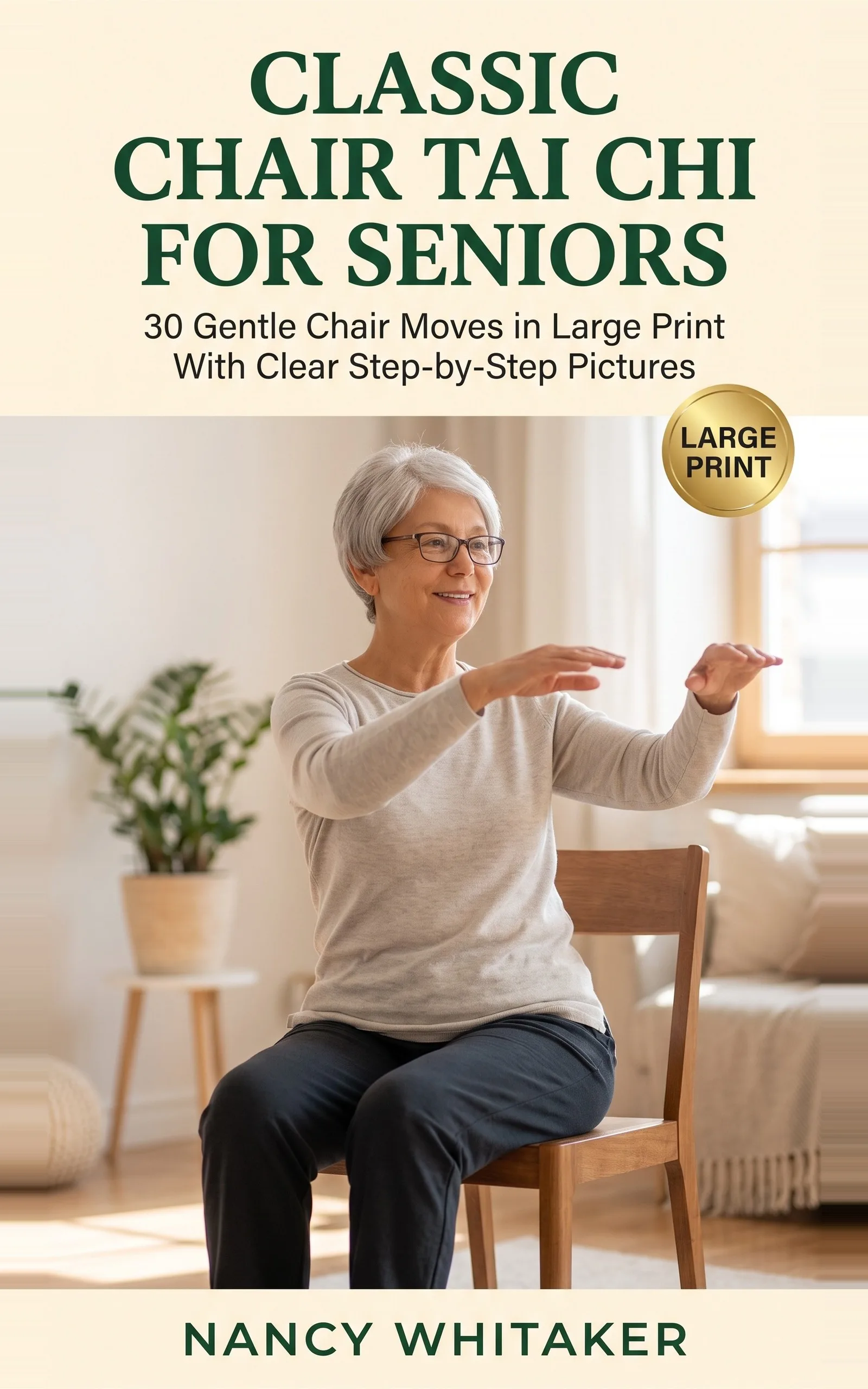
Classic Chair Tai Chi for Seniors
30 Gentle Chair Moves From the Traditional Tai Chi Form and the Eight Brocades, in Large Print With Clear Step-by-Step Pictures, and What the Research Really Says
Thirty gentle seated moves from real tai chi and the Eight Brocades, in large print, with every picture drawn from behind so your left is your own left.
Links go to Amazon. ToolGenX publishes this book under a pen name and earns from every sale. Amazon sets the price and handles delivery and returns.
Talk to your doctor before starting any new exercise. This book makes no medical claims.
- author
- Nancy Whitaker
- length
- 199 pages (paperback)
- formats
- Kindle, paperback
- sold by
- Amazon
This book is for you if
- You tried a chair tai chi video and mixed up left and right
- You are looking for a gentle seated exercise book for a parent
- Your doctor cleared you for seated movement after a hip or knee operation
- You run activities at a senior center and need routines in large print
Skip it if
- You want standing tai chi or martial arts training
- You want a promise that it prevents falls (the book says seated tai chi has not been tested for that)
// problems this book helps with
Start from your problem
Each page below answers one real question in plain words, then shows where Classic Chair Tai Chi for Seniors goes further.
- A 10-minute daily exercise routine for seniors you can do in a chair
A 10-minute daily exercise routine for seniors, done sitting: eight gentle moves in order, with repeats, pacing rules and what to do on a stiff day.
- Chair exercises for seniors at home: a gentle place to begin
Looking for chair exercises for seniors at home? Set up a safe chair and space, then try slow seated tai chi moves. Check with your doctor first.
- Chair tai chi for beginners: how to start when you have never done it
New to chair tai chi? Start with the right chair, one seated posture and the 70 percent rule, then add one or two moves a week. Talk to your doctor first.
- Does tai chi help balance, or is that just something people say?
Does tai chi help balance? Standing tai chi has good evidence. Chair tai chi has only small studies and no falls trials. Here are the numbers.
- Exercise for seniors with knee or hip problems, once your doctor says yes
Your doctor cleared you for gentle exercise after knee or hip trouble. Here are the seated rules: what to skip, what to shrink, and when to stop.
- A gift for an older parent who wants to stay active, without a gym or a screen
Looking for a gift for an older parent who wants to stay active? A large-print chair tai chi book needs no screen or class. Here is how to choose well.
- Seated vs standing tai chi: which one fits you right now?
Seated vs standing tai chi, side by side: where the moves come from, what each asks of your legs, and what the research has and has not tested.
- You keep mixing up left and right in tai chi videos. It is not you.
Mixing up left and right in a tai chi video is a mirror problem, not a memory problem. Here is why it happens and how pictures drawn from behind fix it.
Why we like a book drawn from behind
Many people quit chair tai chi videos for one reason. The teacher faces them, so left and right flip, and every move becomes a puzzle.
This book fixes that with the pictures. Each move has three to five numbered frames. The same woman sits in the same chair in every one, drawn from behind or a little to one side behind. Her left hand is your left hand. The words under each frame say "your left hand" or "your right hand" every time.
Turns use a clock face. You face 12 o'clock, and your chest never turns past 10 or 2. So "turn a little to your left" always means 11 o'clock.
Real moves, adapted for a chair, and said so plainly
The twelve tai chi moves come from the 24-form, a short Yang-style form made in China in 1956 so ordinary people could learn it. The eight Eight Brocades moves come from Baduanjin, a set of Chinese exercises named in writing from the 1100s. Every move keeps its traditional name, like Part the Wild Horse's Mane.
Both traditions were made to be done standing. There is no agreed seated version of either, which a 2020 research paper by Zhao and colleagues also noted. So the chair versions are Nancy Whitaker's own adaptations. They keep the path of the arms, the turn of the waist and where the eyes look. Steps become small foot slides. A shift of weight becomes a gentle lean from the hips.
We think that honesty matters. You know what you are learning and where it came from.
The research, with a badge on every claim
Many tai chi books promise a flat belly or an end to falls. This one puts each claim in a table with one of four badges: SOLID, PROMISING, STORY ONLY or MYTH.
The falls row is the clearest example. Standing tai chi, done by people living at home, meant 20 percent fewer people fell in a 2019 Cochrane review, rated high certainty. Chair tai chi has never been tested for falls, so its badge is STORY ONLY. The waist row is another. One large trial found waists shrank 1.8 cm in 12 weeks, under an inch, so "melts belly fat" gets MYTH.
The research lives in two places only, "The Evidence in One Page" near the front and "What the Research Says" near the back. The move pages tell you what to do. They do not promise what a move will fix.
Safety comes before the first move
The book asks every reader to talk to their doctor before starting. It gives a short list of who should check first, such as anyone with recent surgery, unsteady blood pressure, dizziness, osteoporosis or glaucoma, and questions you can take to the appointment.
Two rules run through every page. The 70 percent rule, from the Tai Chi for Health Institute: for the first few weeks, move only about 70 percent as far as you could. And the stop signs: pain, dizziness, chest pain or shortness of breath mean stop at once and get medical advice.
From there, a six-week plan adds a few moves each week, and a practice log at the back lets you tick off each day with a pencil.
What is inside
- Safety First: the chair, the shoes, the 70 percent rule, the stop signs and questions to take to your doctor
- The Evidence in One Page: every common claim in one table, each with a SOLID, PROMISING, STORY ONLY or MYTH badge
- Six seated warm-ups that make a full practice of about 8 to 10 minutes on their own
- Twelve chair tai chi moves adapted from the 24-form, each with three to five numbered frames drawn from behind
- The Eight Brocades for the chair, with the deep bends made gentle so your head stays above your heart
- Four optional standing moves done behind a chair, only if your doctor agrees
- A 10-minute routine, a 20-minute routine, an evening wind-down and a six-week plan
- What the Research Says, study by study, plus a six-week practice log and a page of questions for your doctor
Chapters
- 01How to Use This Book
- 02Safety First
- 03The Evidence in One Page
- 04Where Tai Chi Comes From
- 05Five Ideas, One Posture, One Breath
- 06Six Warm-Ups
- 07The First Six Moves
- 08Six More Moves
- 09The Eight Brocades
- 10Four Standing Moves
- 11Routines and a Six-Week Plan
- 12What the Research Says
- 13Your Practice Log
The paperback, up close









Questions about Classic Chair Tai Chi for Seniors
- Do I need to stand up for the moves in this book?
- No. Almost everything is done sitting in a sturdy chair with no arms and no wheels. The one exception is a short, optional part with four moves done standing behind the chair, holding on with both hands. Skip it if standing is not safe for you, and try it only if your doctor agrees.
- Does chair tai chi prevent falls?
- The book makes no promise about falls. Standing tai chi meant 20 percent fewer people fell in a 2019 Cochrane review of people living at home. No trial has tested chair tai chi for falls. A search done for the book found about 35 published records on seated tai chi and qigong, and none measured falls.
- Is there a video or an email sign-up?
- No. The book is complete on its own. You do not need a computer, a phone or an account. Every move has numbered pictures, short steps, a breathing cue, an easier version and a list of mistakes to watch for.
- Is the book safe for someone after hip or knee surgery?
- Talk to your doctor first. Recent hip, knee or spine surgery and joint replacement are on the book's list of reasons to check before starting. Some moves have their own notes, such as asking your doctor before the seated spine twist after hip surgery. Stop at once for pain, dizziness, chest pain or shortness of breath.
- Who is Nancy Whitaker?
- Nancy Whitaker is a pen name. Behind it is a researcher who writes plain guides for older adults, not a tai chi teacher, a doctor or a therapist. The seated moves are her own adaptations of the standing forms, and every source is listed at the back so you can check it.
Get Classic Chair Tai Chi for Seniors
Every seated move is drawn from behind so your left is your left, in large print, with the research told honestly.
Links go to Amazon. ToolGenX publishes this book under a pen name and earns from every sale. Amazon sets the price and handles delivery and returns.