Last updated
When to overrule AI: the signs its confident answer is wrong for your business

| When you notice this | What it usually means | Your move |
|---|---|---|
| Your own first guess and the AI's answer disagree | One of you is at the edge of what you know | Stop and check the key fact before acting |
| A precise number about your client or your customers | The AI is filling a gap with a guess | Confirm it against your real data |
| The task is unusual, not the normal case | The AI may be past its range without saying so | Treat the answer as a draft, not a verdict |
| You know a fact that is not in what you gave it | The AI cannot weigh what it never saw | Weigh your fact first, then check |
| The answer crosses something you refuse to do for money | It is aiming at the average, not your business | Overrule it. No check needed |
| You feel uneasy and can name a specific reason | This doubt is likely a warning | Investigate that one thing first |
| You are tired, it is late, the doubt is vague | Your own judgment is worn out right now | Do not overrule or accept. Decide tomorrow |
How to use the signs in the table
The table is a set of rules for one moment: the AI has given you a confident answer, and you have to decide whether to act on it.
Most rows do not tell you to throw the answer away. They tell you to check one thing. Only one row says overrule on the spot, and that is when the answer crosses a line you have already decided you will not cross for money. The book calls these your refusals.
The first row matters most. It only works if you make your own rough guess before you read what the AI says. Once you have read its answer, your own view has nowhere to form. So the rule is: on calls that matter, guess first, then read.
The last two rows are about you, not the AI. The book sorts doubt into three kinds. A warning is specific and gets louder when you look closer. Tiredness is vague and fades after sleep. Fear grows when you picture other people watching. Each needs a different move, and only a warning is a reason to overrule.

Why tone will never tell you
A person who is out of their depth usually shows it. They say "I think" and "maybe." You hear the wobble and lean in.
AI has no wobble. It states a made-up number in the same voice it uses for a number it knows. That calm tone is just how smooth writing sounds. It is not a report on how sure the tool is.
The cleanest proof is a study of 758 consultants. Inside the AI's range, people using it finished about 12% more tasks, in about a quarter less time, with better quality. On a task just outside that range, they were about 19% less likely to get it right than people working alone (Dell'Acqua et al., Organization Science). The task looked similar. The AI did not slow down or hedge.

The pricing advice that was confidently wrong
In the book, a client asks Jonah whether to change their pricing to three tiers. Before he asks the AI, he writes his own guess on a notepad: no, not yet, their churn problem is not a price problem. Churn means customers leaving.
Then he asks the AI. It says yes, restructure now, and it will lift revenue about 15%.
His guess and the AI's answer point in different directions. That is row one. The 15% is row two, a precise number about data the AI never had. So he does not send it. He pulls the real churn data and plans to talk to two clients who left.
It takes an afternoon. The data shows people were not leaving over price. They were leaving in the first thirty days over a setup problem. A new price plan would have done nothing for them.
That save came from one habit: guess first, notice the gap, then go and look.
Keep using AI while you watch the edge
None of this means trust AI less in general. It means keep your own judgment in use, so it is awake on the day it is needed.
The book gives three habits. Form your own read first on calls that count. Once in a while, test the AI on something you already know the answer to, so you learn where it fails on your kind of work. And check what has to be true against something that is not the AI.
That last one matters because judgment you do not use gets weaker. A 2025 study of 666 people linked heavy AI use with weaker critical thinking (Gerlich, Societies). It is a link, not proof of cause. Still, I would rather keep the habit than find out the hard way.
The opposite mistake: dropping AI after one bad answer
Overruling has its own trap. Researchers call it algorithm aversion. In five studies, Dietvorst, Simmons and Massey found that people lose faith in a forecasting algorithm faster than in a person after seeing both make the same mistake (Journal of Experimental Psychology: General, 2015). People who had watched the algorithm work were less likely to pick it, even when they had seen it beat the human.
So one wrong answer is not a reason to overrule everything after it. It is a reason to learn where that answer came from. Was the task outside the AI's range? Did it need data the AI never had? That tells you which kind of answer to check next time, and which kind you can keep trusting.
Keep a short log of your overrides
The book's advice is to keep your own map of where the AI fails on your kind of work, and to redraw it as the tool and your tasks change. A simple way to do that is one line each time you overrule or nearly overrule:
| Date | What the AI said | What I did | Who turned out right |
|---|---|---|---|
| (fill in) | (one line) | Followed, checked or overruled | Me, the AI, or not sure yet |
Look back at it once a month. If you keep overruling the same kind of answer and keep being right, that is a real edge, so check those every time. If you keep overruling and the AI keeps being right, you are spending time on doubt that is not paying off.
The book behind these rules
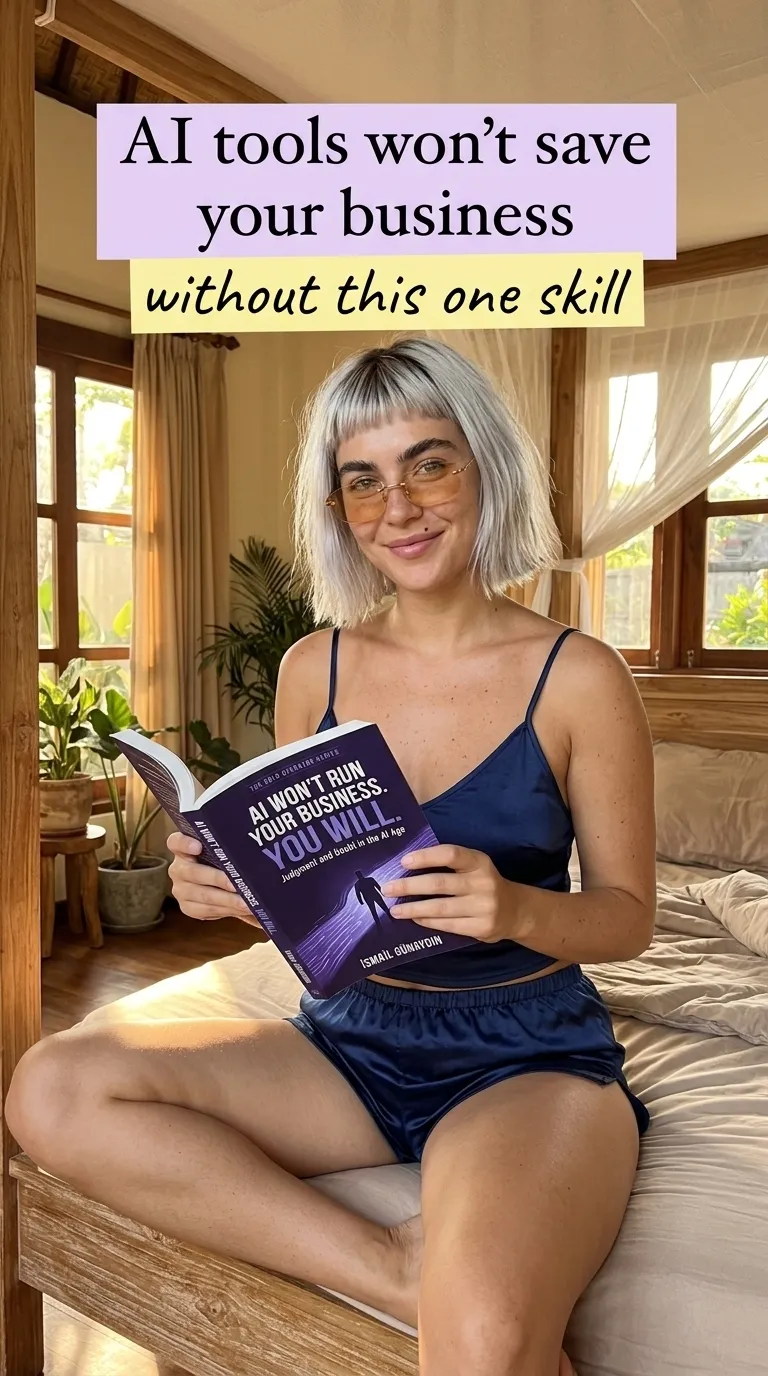
This is the problem AI Won't Run Your Business. You Will. was written for.
The Jagged Edge: Knowing When the Confident Machine Is Wrong is the core chapter. It explains the invisible edge and gives you the Judgment Gate, four lines you fill before acting on an AI answer.
The Doubt: Information to Read, Not Weakness to Suppress covers the last two rows of the table. It gives you the Doubt Decoder for sorting a warning from tiredness or fear.
The Why: AI Does the What and the How; Only You Hold the Why is where your refusals come from. You write them down on one page called the Why Anchor.
The free Judgment Workbook has all three tools ready to print. If an AI answer already went out wrong, start with what to do when a wrong AI answer reached a client.
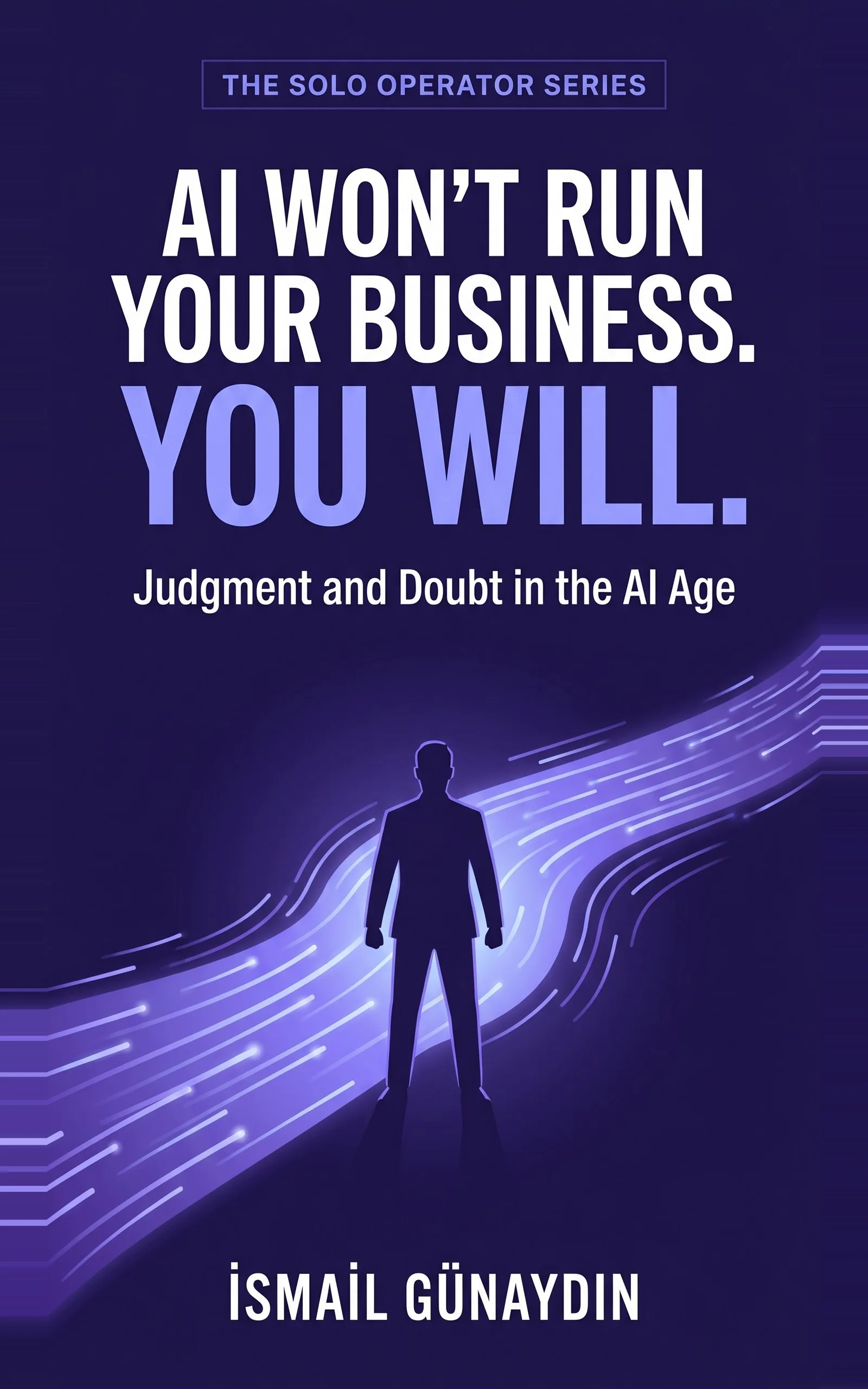
The book for this problem
AI Won't Run Your Business. You Will.
Judgment and Doubt in the AI Age. By İsmail Günaydın, 60 pages.
Where this problem is in the book:
- The Jagged Edge: Knowing When the Confident Machine Is Wrong
- The Doubt: Information to Read, Not Weakness to Suppress
- The Why: AI Does the What and the How; Only You Hold the Why
Links go to Amazon. I wrote this book and earn a royalty on every sale. Amazon sets the price and handles delivery and returns.

Is AI Won't Run Your Business. You Will. the right book for you?
Yes, if
- You cannot tell when to trust an AI recommendation and when to push back
- You want plain rules, not a lecture on AI risk
- You have a decision in front of you right now that the AI has an opinion on
Skip it if
- You want a technical guide to how language models work
- You want a rule that says always trust or never trust AI
Fair doubts before you buy
Can't I just trust AI on the easy stuff and check the hard stuff?
Roughly, yes. The book's catch is that the line between easy and hard for the AI is not where you would guess, and it moves. A model that handles normal contracts well may invent a clause the moment a contract is unusual. So you keep a rough map of where it fails on your own work.
Is this not just common sense?
It is common sense when you are rested. The book is about the other moments: deadline, ninth decision of the day, an answer that sounds more sure than you feel. That is when common sense goes quiet, so it helps to have rules you wrote down before.
Get AI Won't Run Your Business. You Will.
AI is right often enough that you stop checking; five human jobs keep your hand on the wheel when it is confidently wrong.
Links go to Amazon. I wrote this book and earn a royalty on every sale. Amazon sets the price and handles delivery and returns.
Part of The Solo Operator Series, five short books that can be read in any order.

Questions people ask about this
- When should you not trust AI?
- When the answer depends on things it cannot see, such as your client's history or your own customer data, and when the task is unusual. Also be careful when the cost of being wrong is real. Inside its range AI is very good. Just outside it, it is wrong in the same calm voice.
- How do I know if an AI answer is wrong?
- Not from the tone, which stays the same. Form your own rough answer first, then compare. If they disagree, check the facts that matter against a source that is not the AI. A confident number about data the AI never had is a strong warning sign.
- Should I go with my gut or the AI?
- Neither by default. Read your gut first. If your doubt is specific and gets sharper as you look, treat it as a warning and check. If it is vague and you are tired, wait until tomorrow. If it is about how you will look to others, set it aside and decide on the facts.
- What is the jagged frontier of AI?
- It is the uneven line between tasks AI does well and tasks it gets wrong. In a study of 758 consultants, AI help made people faster and better inside the line. Just outside it, people using AI were about 19% less likely to get the right answer. The line is not marked and it moves.
- Is it bad to overrule AI too often?
- It can be. Overruling everything is as unhelpful as accepting everything, because you lose the speed and still miss things. The book's aim is targeted checking: find the few facts that must be true, confirm only those, and let the AI carry the rest.
- What is algorithm aversion?
- It is the opposite of blind trust. People drop a computer tool after seeing it make one mistake, even when it does better than a person overall. A 2015 set of five studies by Dietvorst, Simmons and Massey found people lose faith in an algorithm faster than in a human who makes the same error. The fix is to learn where the mistake came from, not to overrule everything.
Related problems
- Can I trust ChatGPT for business decisions, or only for advice?
ChatGPT is a great advisor and a risky decider. See the difference side by side, and the four-line check that keeps the decision yours.
- The client deliverable is due in an hour and AI wrote most of it. How do you check it fast?
Re-reading an AI draft top to bottom catches little. Check only the facts that would hurt if wrong, against a real source. Steps for the next hour.
- Automation bias explained simply: why you go along with the AI even when you know better
Automation bias is the pull to follow a confident tool over your own facts. The two errors it causes, why it gets worse with AI, and what cuts it.
- What not to hand to AI in your business, and what you can give it freely
Give AI the drafting, research and options. Keep the choice, the doubt and the why. A plain split of what stays yours, with the reasons.
- Everything inside AI Won't Run Your Business. You Will.
Every chapter, who the book is for, and every problem it helps with.