Last updated
AI gave a confidently wrong answer and it went to a client. Here is what to do now.

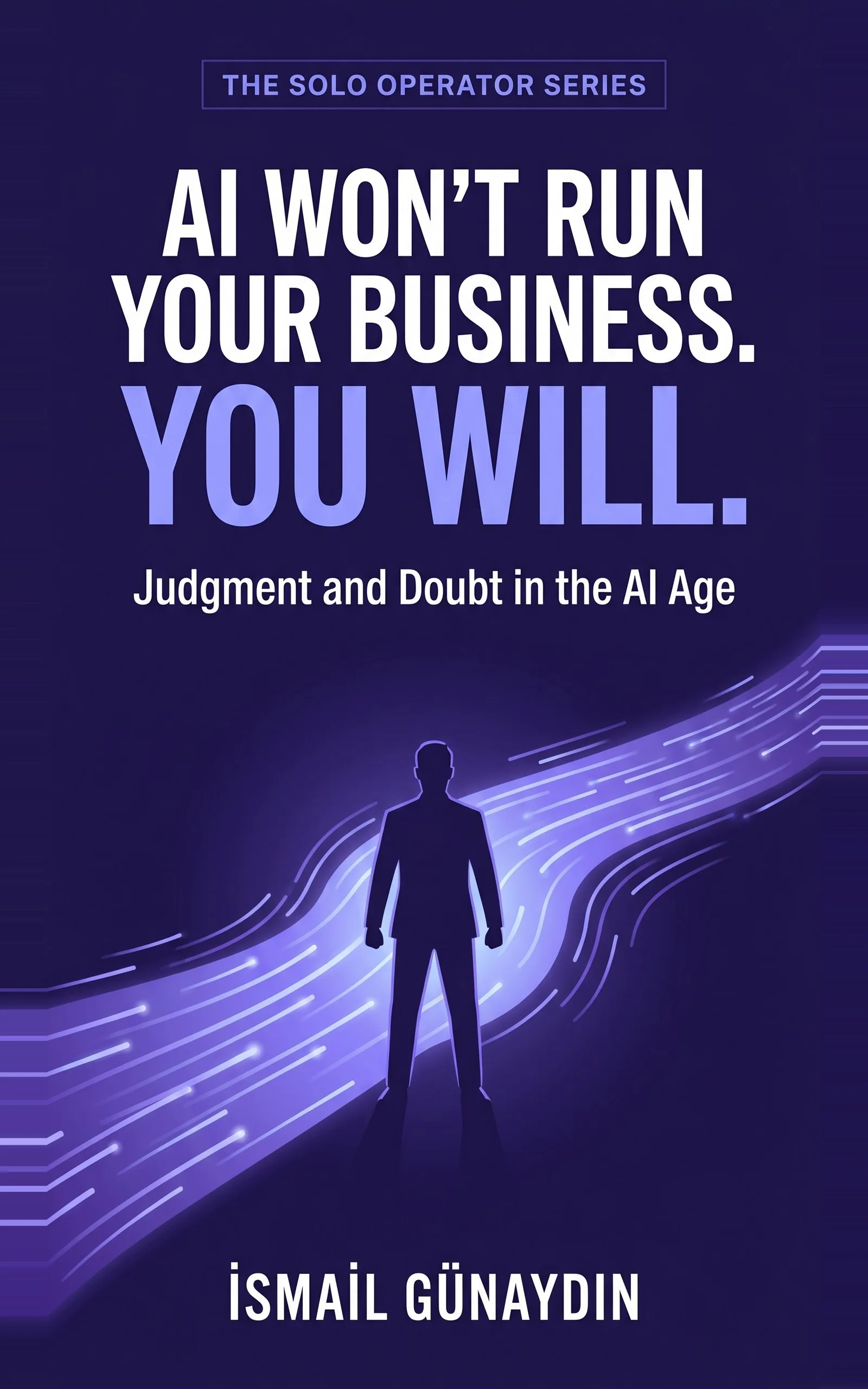
The book for this problem
AI Won't Run Your Business. You Will.
Judgment and Doubt in the AI Age. By İsmail Günaydın, 60 pages.
Where this problem is in the book:
- The Decision: AI Offers; You Choose, and You Live With It
- The Jagged Edge: Knowing When the Confident Machine Is Wrong
Links go to Amazon. I wrote this book and earn a royalty on every sale. Amazon sets the price and handles delivery and returns.
Do these four things before the end of today
- Reach out now. Do not wait to see if the client noticed. Waiting feels like a choice. It is usually a choice you skipped.
- Name the mistake in plain words. Say what was wrong and what is right. Do not lead with "the AI did it." The client hired you.
- Check the fix against something that is not the AI. The real price list. The real numbers. The actual rule. Do not ask the same tool to check its own work.
- Write one line for your own file. What was wrong, and which fact you should have checked. You will use this line next week.
That is the whole fix for today. Keep it short and fast. A clear, quick "I got this wrong, here is the right version" protects more trust than a long, late one.
A short message you can adapt
Most people stall on the wording, so here is a plain shape. It follows the steps above: say what was wrong, give the right version, and do not hide behind the tool. Change it to fit your client and your voice.
Hi Sam, I need to correct something I sent you on Tuesday. The proposal said the monthly fee would be $1,200. That was wrong. The right figure is $1,450, and I have attached a corrected copy. I am sorry for the mix-up. If you already shared the first version with anyone, let me know and I will help set it straight.
The names and numbers are only an example. Keep yours just as short. One mistake, one fix, one offer to help. A long message full of reasons reads like an excuse.

If the client already acted on it
Sometimes the wrong answer has already been used. A price was quoted to their own customer, a date went into a plan, a form was filed. Then the order of work changes.
- Ask what they did with it. One question, early in the call or message: did this go anywhere yet?
- Fix the harm before the paperwork. If a deadline or a payment is at risk, help with that first. The corrected document can follow.
- Keep a record. Save what you sent, when, and what you corrected. If anything comes back later, you will want the facts, not your memory.
- Check your own rules if you work in a regulated field. In law, accounting, finance or health, your professional body or your insurer may have rules about errors and what you must tell a client. Read them or ask them. This page cannot tell you what they require.

Why waiting is the expensive mistake
In the book, a consultant named Jonah sends a client a quote the AI liked. It was wrong for that client, and the client went quiet. Jonah drafted a call to fix it. Then he asked the AI whether to send it. The AI said wait, the odds were low.
He waited. Three weeks later the client signed with someone else and said they would have come back if he had just reached out. The first loss came from the AI's blind spot. The second loss was all his.
So if your hand is on the phone right now, use it.

It sounded right, so you sent it
Here is the part nobody likes to say out loud. You did not send it because you are careless. You sent it because the AI had been right for months, and it sounded more sure than you felt.
That is a known pattern. Researchers named it back in 1999. When a tool gives a confident answer, we tend to go along with it, even when our own notes say something else. The cause is trust, not being dumb.
The AI's tone does not change when it is wrong. A big study of 758 consultants found that on a task just past what AI could do, the people using it were about 19% less likely to get it right than people working alone (Dell'Acqua et al., Organization Science). Same calm voice. Wrong answer.
There is a slower cost too. One 2025 study of 666 people found that heavy AI use went along with weaker critical thinking (Gerlich, Societies). That is a link, not proof of cause. Still, the habit of not checking is the one to break. I use AI every day and trust it with a lot. Not with the deciding.

A two-minute check for next time
The book calls it the Judgment Gate. You fill four short lines before an important AI answer goes out:
- The AI's answer, in one line.
- Is this inside what the AI really knows, or is it guessing about your client?
- How would you know if it is wrong?
- One check against a source that is not the AI.
The second line does most of the work. A confident number about your client's own data is a red flag, because the AI does not have that data. It is filling the gap. If you want the fuller version, see how to check AI work before it goes to a client.

The book that picks up from here
This is the problem AI Won't Run Your Business. You Will. was written for.
The Decision: AI Offers; You Choose, and You Live With It covers the Jonah story in full and gives you the Decision Ownership Line. It is four lines you fill before a choice goes out: what the call is, who really decided, who carries it, and your reasons in your own words.
The Jagged Edge: Knowing When the Confident Machine Is Wrong explains the invisible line where AI goes from great to wrong, and gives you the Judgment Gate above with a worked example.
The free Judgment Workbook has all seven tools as a printable PDF. Start with the Hand-on-the-Wheel Check. It shows you, in five questions, where you stopped checking.
Is AI Won't Run Your Business. You Will. the right book for you?
Yes, if
- You just found out something AI wrote for you was wrong, and the client has it
- You stopped checking AI drafts because they were right for months
- You want a short way to stop this from happening twice
Skip it if
- You want a script for a legal dispute with a client
- You want proof that AI is useless (the book says use it, with your judgment on)
Fair doubts before you buy
I am in a crisis right now. Why would I read a book?
You should not read it right now. Send the fix first, using the steps on this page. The book is for the week after, when you want to know why it happened and how to keep it from happening again. It is short on purpose, about 60 pages.
Isn't the answer just to stop using AI?
No. The book is clear on this. Inside what it does well, AI makes you faster and better. The problem is the edge where it stops being right and keeps sounding sure. You learn to spot that edge. You do not throw away the tool.
Get AI Won't Run Your Business. You Will.
AI is right often enough that you stop checking; five human jobs keep your hand on the wheel when it is confidently wrong.
Links go to Amazon. I wrote this book and earn a royalty on every sale. Amazon sets the price and handles delivery and returns.
Part of The Solo Operator Series, five short books that can be read in any order.
Questions people ask about this
- Should I tell my client I used ChatGPT?
- The book does not hand you a disclosure rule. What it does say is that the client hired your judgment, so the mistake is yours to own either way. Saying the AI got it wrong may be true, but it reads as passing the blame. Lead with what was wrong and what the right answer is.
- Why does AI sound so sure when it is wrong?
- Because the sure tone is just how fluent writing sounds. It is not a report on how certain the tool is. AI states a made-up number in the same calm voice it uses for a number it knows. That is why tone tells you nothing about whether the answer is true.
- How do I fix a wrong AI answer I already sent?
- Contact the client fast, name the mistake plainly, and send the corrected version. Check the corrected facts against a source that is not the AI, like the real price sheet or the real data. Re-reading the AI's own text will not catch the error, because a wrong answer reads just as clean as a right one.
- How do I stop AI mistakes from reaching clients?
- On any answer that could cost a client, write your own rough guess before you read what the AI says. If your guess and the AI disagree, that gap is your signal to check. Then confirm only the few facts that would hurt if wrong, against a source outside the AI.
- Is it my fault or the AI's fault?
- The book's answer is plain: the AI carries no consequence, so the consequence has one address, and it is you. That sounds harsh, but it is useful. A mistake you own teaches you where to check next time. A mistake you blame on the tool teaches you nothing.
- What if the client already acted on the wrong information?
- Ask what they did with it, and help fix any real harm first, like a missed deadline or a wrong price given to their own customer. Then send the corrected version. Keep a record of what you sent and what you changed. If you work in a regulated field, check your professional body's or insurer's rules on errors.
Related problems
- The client deliverable is due in an hour and AI wrote most of it. How do you check it fast?
Re-reading an AI draft top to bottom catches little. Check only the facts that would hurt if wrong, against a real source. Steps for the next hour.
- When to overrule AI: the signs its confident answer is wrong for your business
AI sounds just as sure when it is wrong. Here are the signs it has gone past what it knows, and exactly what to do with each one before you act.
- Can I trust ChatGPT for business decisions, or only for advice?
ChatGPT is a great advisor and a risky decider. See the difference side by side, and the four-line check that keeps the decision yours.
- Everything inside AI Won't Run Your Business. You Will.
Every chapter, who the book is for, and every problem it helps with.