Last updated
Can I trust ChatGPT for business decisions, or only for advice?
| Question | AI as advisor | AI as decider |
|---|---|---|
| What it does | Lays out options and trade-offs, then stops | Moves from its answer straight to action |
| How you feel after reading it | A choice still rests on you | It feels settled, you only approve |
| Who carries the result | You, and you know it | Still you, but you did not really choose |
| What you learn when it goes wrong | Why your call failed, so you adjust | Very little, the reasons live in the chat |
| Best use | Argue both sides, find what you missed | None for calls that cost you money or a client |
Reading the table: one tool, two seats
The table above is the whole idea of the first chapter. The same AI can sit in one of two chairs. As an advisor, it briefs you and stops at the edge of the choice. As a decider, it carries you past that edge.
The tricky part is that the words on the screen look the same either way. You read clean, sure prose in both cases. The difference is not in what the AI writes. It is in whether you stood up between its answer and the action.
So the useful question is not "can I trust ChatGPT?" It is "which seat did I give it today?"
Look at the fourth row. It matters more than it seems. When a choice you really made goes wrong, you learn why. When a choice you only approved goes wrong, you are left with a result you cannot explain, because the reasons were never yours.
The trust problem is not about the AI being smart
ChatGPT is very good at a lot of business work. That is not in question. The question is what happens to you when it is right most of the time.
Researchers named this pattern back in 1999. When a tool gives a confident answer, people go along with it even when their own valid information says something else. They also stop noticing what the tool did not flag. The cause was trust, not laziness. Later work found that when people had to explain and defend their choices, the problem dropped.
Newer work on chat tools finds the same thing. The smoother and surer the answer reads, the lower your guard goes.
And the AI does not get less sure when it is wrong. In the study of 758 consultants, people using AI on a task just past its range were about 19% less likely to get it right (Dell'Acqua et al., Organization Science). The voice stayed calm the whole time.
Why it sounds sure even when it is guessing
Most warnings you will read say the same thing: ChatGPT can make things up. That is true, and the book explains why it is so hard to catch.
A junior employee who is out of their depth shows it. They hedge. They say "I think" and "maybe," and you lean in to check. The AI has no wobble like that. It states a half-invented number in the same calm tone it uses for a number it knows cold. Its confidence is not a report on how sure it is. It is just how fluent writing sounds.
And the weak spots move. A tool that summarizes your contracts well may invent a clause the day a contract is unusual. A tool that drafts good client emails may make up a statistic the moment you ask it for a fact. So you cannot learn one list of safe and unsafe jobs and stop there. You keep your own judgment awake and point your checks at the facts that would hurt if wrong.
Is it safe to put business data into ChatGPT?
This is the other half of trust, and many people searching this question are asking it. The book is about judgment, not privacy, so here is what OpenAI itself says.
On its enterprise privacy page (updated January 8, 2026), OpenAI says it does not train its models on data from ChatGPT Business, ChatGPT Enterprise or its API by default. The same page says it does use data from its services for individuals to train models. So the plan you are on matters.
A few plain habits help either way:
- Check which plan you are on and read its data settings before you paste anything private.
- Leave out client names, passwords and account numbers when you do not need them for the answer.
- If a client contract limits where their data can go, follow the contract, not the tool's settings.
If the data is sensitive, ask the person who handles your legal or IT questions before you use any AI tool on it.
A pricing call that went the wrong way
In the book, Jonah runs a one-person consulting practice. A long-time client wants a custom job, and he asks the AI what to quote. It says quote high, with neat reasons.
Jonah knew something that was not in the file. This client had walked away from a competitor once over a price that felt greedy. He had that fact in his own head. He was three deadlines deep, and the screen sounded so sure. He sent the high quote.
The client went quiet, then went elsewhere. The AI had judged everything it could see. It could not see the history, and it did not know it could not.
You have probably had a smaller version of this. You had the right number in your notes. You went with the screen anyway. That is the moment this page is about.

How to keep the decision yours in thirty seconds
The book gives you three small moves. Make the call out loud, as in "I am choosing this." Say your reasons without looking at the screen. Then write down who decided and who carries the result.
After the lost client, Jonah filled this in before his next big quote. The AI said premium. He wrote that he chose the standard rate, that he overrode the AI for a reason it could not see, and that if it underpriced the work, the lost margin was his. It took about thirty seconds.
You can end up picking exactly what the AI suggested. That is fine. What matters is that you picked it. I use AI for a great deal and trust it with a lot. Not with the deciding.
One more caution. A 2025 study of 666 people found heavy AI use went along with weaker critical thinking (Gerlich, Societies). It is a link, not proof of cause, but it is a good reason to keep doing your own thinking on the calls that matter.
Where the book goes deeper
This is the problem AI Won't Run Your Business. You Will. was written for.
The Decision: AI Offers; You Choose, and You Live With It is the chapter behind the table. It tells the full Jonah story, explains advisor versus decider, and gives you the Decision Ownership Line, the four lines you fill before a choice ships.
The Jagged Edge: Knowing When the Confident Machine Is Wrong helps you see where the AI's range ends, which is the hard part of trust. If you want that side first, read when to overrule AI.
The free Judgment Workbook has every tool from the book as a printable PDF, including the Decision Ownership Line.
The book for this problem
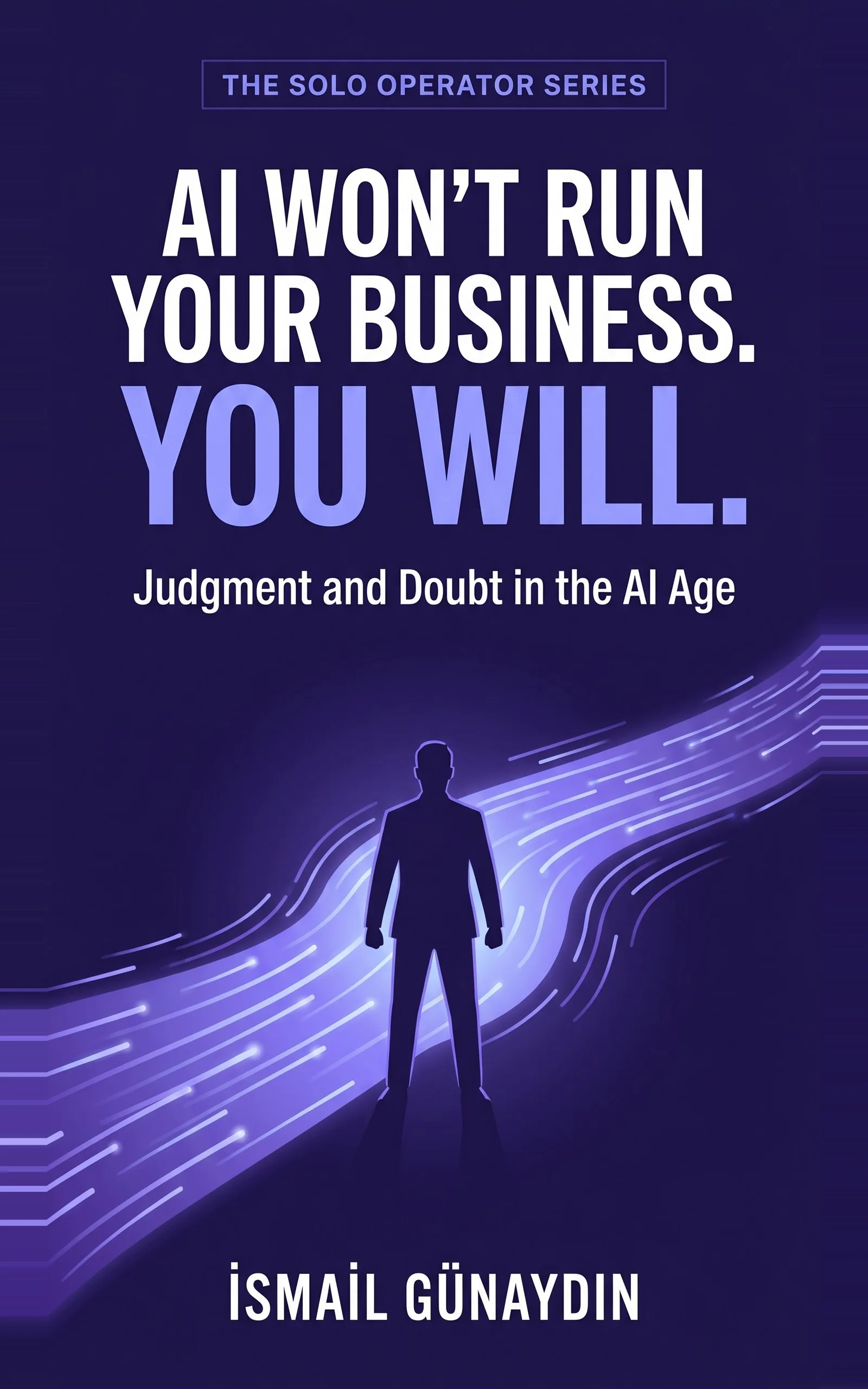
AI Won't Run Your Business. You Will.
Judgment and Doubt in the AI Age. By İsmail Günaydın, 60 pages.
Where this problem is in the book:
- The Decision: AI Offers; You Choose, and You Live With It
- The Jagged Edge: Knowing When the Confident Machine Is Wrong
Links go to Amazon. I wrote this book and earn a royalty on every sale. Amazon sets the price and handles delivery and returns.

Is AI Won't Run Your Business. You Will. the right book for you?
Yes, if
- You use ChatGPT on pricing, clients or plans and are not sure how far to trust it
- You have noticed you mostly approve what it says now
- You want a clear line between asking AI and letting AI choose
Skip it if
- You want a list of the best AI tools for business
- You want to be told AI is safe to run things on its own
Fair doubts before you buy
I already know not to trust AI blindly. What would the book add?
Most people know it in the abstract. The book shows the moment it slips, which is when you are tired and the answer sounds more sure than you feel. Then it gives you a four-line sheet to fill before a decision ships, so knowing becomes a habit you can see on paper.
Why not just ask ChatGPT to double-check its own advice?
You can ask it to argue against itself, and the book likes that. But a check from the same tool shares its blind spots. The book's rule is to check the facts that matter against something that is not the AI, like your own records or the real data.
Get AI Won't Run Your Business. You Will.
AI is right often enough that you stop checking; five human jobs keep your hand on the wheel when it is confidently wrong.
Links go to Amazon. I wrote this book and earn a royalty on every sale. Amazon sets the price and handles delivery and returns.
Part of The Solo Operator Series, five short books that can be read in any order.
Questions people ask about this
- Is it safe to use ChatGPT for business advice?
- Yes, as an advisor. The book's view is to let it advise without limit: ask for the case against its own pick, make it argue both sides, ask what it cannot see. The risk is not the advice. It is letting the advice turn into the decision with no person in between.
- Can ChatGPT make business decisions?
- It can produce a ranked answer that looks like a decision. But a decision means someone carries the result. The AI feels nothing when it is wrong and moves on. You get the lost client and the lost month. That is why the book keeps the choosing with you.
- How accurate is ChatGPT for business strategy?
- It depends on the task, and the line is hard to see. In a study of 758 consultants, AI help made people faster and better on tasks inside its range. On a task just outside it, people using AI were about 19% less likely to get the right answer than people working alone.
- How do I know if I am relying on AI too much?
- Notice how you feel after reading its answer. If a choice still rests on you, you are using it as an advisor. If the matter feels settled and you just click, you have handed it the decision. Another sign: you cannot explain your reasons without looking back at the screen.
- What should I check before acting on ChatGPT's business advice?
- Check the few facts that would hurt if wrong, against a source outside the AI. A confident number about your own customers is a warning sign, because the AI does not have that data. Then write one sentence in your own words on why you are choosing this.
- Can I trust ChatGPT with my business plan?
- As a sparring partner, yes. Ask it to find holes, argue the other side and list what could go wrong. Do not let it fill in facts about your own market or customers, because it does not have that data and will still sound sure. Check those numbers against real sources. Before you paste the plan in, check how your ChatGPT plan handles your data.
Related problems
- When to overrule AI: the signs its confident answer is wrong for your business
AI sounds just as sure when it is wrong. Here are the signs it has gone past what it knows, and exactly what to do with each one before you act.
- Automation bias explained simply: why you go along with the AI even when you know better
Automation bias is the pull to follow a confident tool over your own facts. The two errors it causes, why it gets worse with AI, and what cuts it.
- What not to hand to AI in your business, and what you can give it freely
Give AI the drafting, research and options. Keep the choice, the doubt and the why. A plain split of what stays yours, with the reasons.
- AI gave a confidently wrong answer and it went to a client. Here is what to do now.
You sent a client something AI wrote and it was wrong. Own it today, fix the facts against a real source, and stop it from happening again.
- Everything inside AI Won't Run Your Business. You Will.
Every chapter, who the book is for, and every problem it helps with.