Last updated
What not to hand to AI in your business, and what you can give it freely
| Part of the job | Hand it to AI | Keep it yours |
|---|---|---|
| Options | List every option and the trade-offs | Pick one and live with what it costs |
| Reasons | Draft the case for and against | Say why you chose, in your own words |
| Facts | Find data, summarize, sort | Check the facts that would hurt if wrong |
| Doubt | Find the clause or number your unease points at | Decide if the doubt is a warning, tiredness or fear |
| Direction | Sharpen the wording of a goal you bring | Decide who you serve and what you refuse |
| Client work | First drafts, outlines, research | The final read on anything that could cost a client |
| Your own skill | Most daily tasks | One real decision a week, done by hand |
How to read the split
Look at the table row by row. The left column is real work, and a lot of it. AI is very good at all of it, and the book says to hand it over.
The right column is smaller. Each item is a moment where a person has to stand up between the AI's output and the action. Picking. Explaining. Checking the facts that matter. Naming what you will not do.
Notice that both columns appear in every row. You are not choosing between AI tasks and human tasks. Inside almost every task, there is a part the AI does and a part that has to stay with you.
The last row is the odd one. It is not about any one job. It is about keeping your own skill alive, the way a pilot flies by hand now and then so the autopilot is not the only one who knows how.
Why "keep the important stuff" is not enough
The usual advice says let AI do the routine work and keep the important work. It sounds right. It does not hold up.
The trouble is that the handover is a slope, not a step. A tool does one thing better than you, so you let it. Then it does the next thing, right next to the first. Each handoff makes sense. None feels like giving up. One day you notice you only approve.
There is a second trap. The AI's sure tone does not change when it moves past what it knows. In a study of 758 consultants, people using AI on a task just past its range were about 19% less likely to get it right than people without it (Dell'Acqua et al., Organization Science). So you cannot sort tasks once and be done. The line moves.
That is why the split above is about parts of the job, not whole jobs.
The Thursday the work was great and felt empty
In the book, Jonah sends a client a sharp, clean deck. The AI built most of it in under an hour. By every number, it is a good day.
Then he sits in the quiet between two calls and thinks, "Whose work is this, and why am I the one doing it?" He has no answer.
Nothing was wrong. The numbers were up. That is the point. When you hand over the why, you do not slow down. You speed up, toward whatever is easiest to start, because there is nothing left to rank the options by.
So he writes one page with four lines. What the business does. Who it is for. What he refuses to do for money. Why it matters to him. The third line made him put the pen down twice, because he could think of three times he had broken it.
After that, he used the AI for more than ever. He just held its suggestions up against those four lines first.
A quick test before you hand over a task
The table splits each job into parts. When a new task shows up and you are not sure, four questions help. They match the checklist in an OpenClassrooms course on working with AI, and they fit the book's line well.
- Can I tell if the result is good? If you have no way to check it, keep the final say. That covers a topic you do not know well enough to judge.
- Is a mistake cheap and easy to fix? A draft social post, yes. A price to a big client, a contract term or anything you cannot take back, no.
- Does it involve private data? Client details, staff records, health or money information. Leave it out unless you truly need it, and check what your AI tool and your client contract allow.
- Is a person on the other end who needs you? Letting someone go, a hard talk with a client, an apology. AI can help you plan what to say. The saying, and the care in it, stay yours.
Four yes answers in the safe direction mean hand it over and check the result. Any no means AI drafts and you decide.

The hand-off rule that holds up on a busy day
Here is the rule in one sentence: give the AI the work, keep the deciding.
In practice, that is one small habit before anything important goes out. Ask yourself, "Do I actually agree, or am I just tired and it sounds sure?" If you cannot answer, it does not go yet. I use AI every day and trust it with a great deal. That question is the part I do not hand over.
The skill side matters too. A 2025 study of 666 people found heavy AI use went along with weaker critical thinking (Gerlich, Societies). It is a link, not proof of cause. The book's answer is not less AI. It is staying the one who decides while you use it.

The book that draws this line
This is the problem AI Won't Run Your Business. You Will. was written for.
The Decision: AI Offers; You Choose, and You Live With It explains why the choice cannot be handed over: the one who chooses carries the result, and the AI carries nothing.
The Why: AI Does the What and the How; Only You Hold the Why gives you the Why Anchor, the four-line page Jonah wrote.
The Person You Become: Don't Disappear Into the Tools has the Agency Audit, which shows where you have slipped from deciding into just approving.
The free Judgment Workbook has all of these as printable sheets. For the trust side of the question, see can you trust ChatGPT for business decisions.
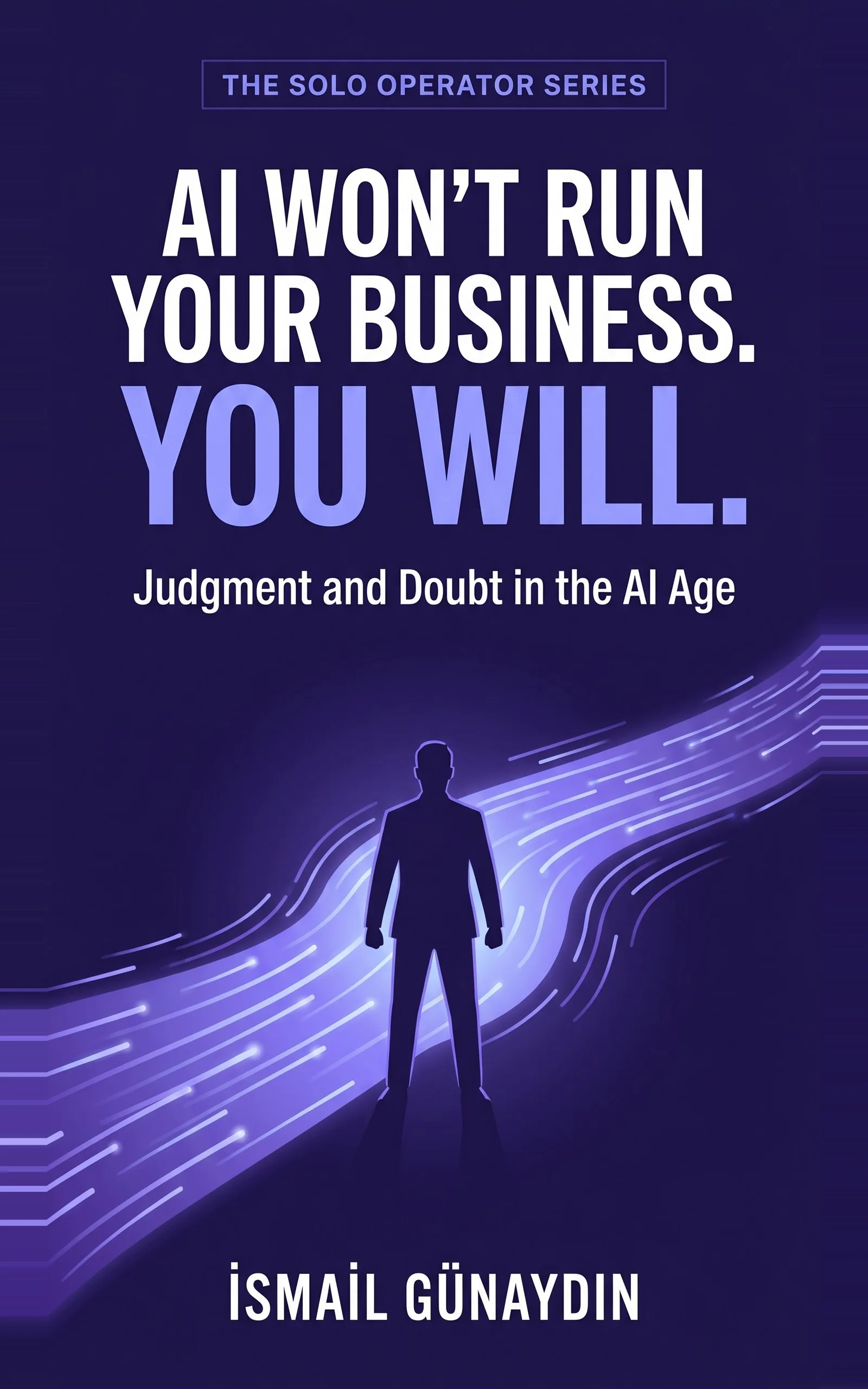
The book for this problem
AI Won't Run Your Business. You Will.
Judgment and Doubt in the AI Age. By İsmail Günaydın, 60 pages.
Where this problem is in the book:
- The Decision: AI Offers; You Choose, and You Live With It
- The Why: AI Does the What and the How; Only You Hold the Why
- The Person You Become: Don't Disappear Into the Tools
Links go to Amazon. I wrote this book and earn a royalty on every sale. Amazon sets the price and handles delivery and returns.
Is AI Won't Run Your Business. You Will. the right book for you?
Yes, if
- You are handing more and more to AI and want to know where to stop
- You run a business alone and AI now drafts most of your work
- You want a clear split you can stick to on a busy day
Skip it if
- You want a list of tasks AI can automate for you
- You want permission to avoid AI (the book says use it fully)
Fair doubts before you buy
If AI can do the task well, why keep it?
You do not keep the task. You keep the deciding about it. The AI can draft the proposal. What it cannot do is be the one who chose to send it and carries the result. The book is clear that you should hand over as much of the work as AI does well.
This sounds like it will slow me down.
The book's tools take about thirty seconds to a few minutes each. The main character ends up using AI more than before, not less. What changes is that he decides first and lets the AI serve that, instead of approving whatever it says.
Get AI Won't Run Your Business. You Will.
AI is right often enough that you stop checking; five human jobs keep your hand on the wheel when it is confidently wrong.
Links go to Amazon. I wrote this book and earn a royalty on every sale. Amazon sets the price and handles delivery and returns.
Part of The Solo Operator Series, five short books that can be read in any order.

Questions people ask about this
- What should you not use AI for in business?
- Do not hand it the final decision, the reading of your own doubt, the judgment on whether its own answer is right, or the reason your business exists. Use it for nearly everything else. The book's line is simple: AI does the what and the how, and you hold the why.
- Should AI make decisions in a small business?
- AI can advise on every decision. The choosing should stay with you, because you carry the result. When a choice the AI made goes wrong, you still pay for it, and you do not understand why it failed, because you never really chose it.
- Can ChatGPT write my mission statement?
- It can write the words, and that is the risk. It gives you an average of every mission statement it has seen. The book's rule is that AI can help you sharpen a why you bring, but must never supply one you did not. Borrow the wording, never the will.
- How much should I rely on AI for my business?
- As much as it helps, for the work itself. The amount of use is not the problem. Who decides is. Keep forming your own read first on calls that matter, and do one decision a week fully by hand so the skill stays warm.
- What is human in the loop and why does it matter?
- It means a person is part of the process and has to approve. A 2026 paper warns it can turn into theater: a human signs off but does no real judging. If you approve AI output without weighing it, you are in the loop on paper only.
- Should I give AI confidential client information?
- Only what you truly need for the task, and only after you check two things. First, what your AI plan does with the data, since business and personal plans can differ. Second, what your client contract allows. Names, account numbers and passwords can almost always be left out or swapped for placeholders without hurting the answer.
Related problems
- Can I trust ChatGPT for business decisions, or only for advice?
ChatGPT is a great advisor and a risky decider. See the difference side by side, and the four-line check that keeps the decision yours.
- When to overrule AI: the signs its confident answer is wrong for your business
AI sounds just as sure when it is wrong. Here are the signs it has gone past what it knows, and exactly what to do with each one before you act.
- You feel dumber, or less sure of yourself, since you started relying on AI. You are not imagining it.
Less sure of your own thinking after a year of ChatGPT? What the research says, why it happens, and one weekly habit that brings it back.
- Automation bias explained simply: why you go along with the AI even when you know better
Automation bias is the pull to follow a confident tool over your own facts. The two errors it causes, why it gets worse with AI, and what cuts it.
- Everything inside AI Won't Run Your Business. You Will.
Every chapter, who the book is for, and every problem it helps with.