Last updated
Automation bias explained simply: why you go along with the AI even when you know better
You had the right number in your notes
You ask AI a question about a client. It answers in four clean paragraphs. You read it and nod.
Somewhere in your notes is a fact that does not fit. Maybe you even saw it this morning. But the answer on the screen is so smooth, and you are tired, and it sounds more sure than you feel.
You send the AI's version.
Later you find the note. You think, "I saw this. Why did I go with the screen?" That moment has a name, and it is not "being stupid."

What researchers actually found
Automation bias was named by researchers studying people who worked next to automated aids. In 1999, Skitka, Mosier and Burdick described two errors.
The first is an error of commission. The tool says do X. Your own valid information says do not. You do X. The second is an error of omission. The tool misses a problem and does not flag it, so you miss it too.
The cause was not low skill. It was trust, the normal human pull to defer to a source that sounds like it knows. Work on chat AI in 2025 found the same pull, only sharper. The more fluent and sure the answer reads, the more people relax.
That is why this bias is bigger now. The screen in front of you is the most sure-sounding thing you have ever worked with.

The early study that shows it in numbers
One of the first reports on this bias was written for NASA in 1998 by Linda Skitka (Automation: Decision Aid or Decision Maker?). People did the same set of tasks with and without an automated aid. The aid was right 88% of the time.
Overall, the aid helped a little. People got about 84% right on their own and about 89% right with it. The surprise was in the moments the aid got wrong. On those six events, people working alone got 97% right. People with the aid got only 65% right.
So the tool raised the average and hid its own mistakes. The report also found the effect came from having the aid in the loop, not from people just being lazy or switched off in general.

Where you already see it every day
You do not need a cockpit to feel this bias. It shows up anywhere a tool sounds sure.
- GPS. It says turn here, and you turn, even though you can see the road is closed.
- Spell check. It finds no red lines, so you assume the email is fine. It cannot flag the right word in the wrong place.
- Chat AI. It writes a smooth answer about your client, and it beats the note in your own file.
Turning toward the closed road is an error of commission. Missing the wrong word because spell check stayed quiet is an error of omission: you stop looking for what the tool did not flag. The book makes the same point about phone numbers and driving routes. Hand a job to a tool long enough and you stop doing it yourself.
Why "just be more careful" does not work
The usual advice is to be skeptical of AI. Check everything. Trust nothing.
Try that for a week. You will re-read every answer top to bottom and save no time. Worse, it will not catch much. A wrong answer written in calm, clean prose reads just like a right one. Your eyes slide right over it.
The book is blunt about this: checking everything is the same as checking nothing. It is worry pretending to be care.
And the AI does not warn you when it is out of its depth. A study of 758 consultants found that inside the AI's range, people finished about 12% more tasks in about a quarter less time. Just outside that range, people using AI were about 19% less likely to get it right than people without it (Dell'Acqua et al., Organization Science). Nothing on the screen told them which side they were on.
The one thing that made the bias drop
Here is the useful part of the research, and it is the part most people never hear. In a follow-up in 2000, the same team found that when people were held responsible for their decisions, and had to justify them instead of just logging them, automation bias went down.
The fix was not distrust. It was ownership.
So you build in that pressure on purpose. Before a decision goes out, write four short lines. What is the call? Who actually decided, you or the AI? Who carries the result if it is wrong? And what are your reasons, in words the AI did not give you?
The second line is the honest one. Sometimes the true answer is "the AI decided and I rubber-stamped it." Seeing that in writing is the whole point. I use AI every day and lean on it hard, but this is the line I keep for myself.
There is a slow side to this bias as well. A 2025 study of 666 people linked heavy AI use with weaker critical thinking (Gerlich, Societies). That is a link, not proof of cause, but it fits the picture. The less you use your own judgment, the easier it gets to defer.
Where the book explains the rest
This is the problem AI Won't Run Your Business. You Will. was written for.
Introduction: The Hand on the Wheel sets out the two errors and why trust, not stupidity, drives them.
The Decision: AI Offers; You Choose, and You Live With It turns the accountability finding into the Decision Ownership Line, the four lines above, with a worked example from a pricing call.
The Jagged Edge: Knowing When the Confident Machine Is Wrong covers the second half of the problem: spotting the moment the AI has gone past what it can do. For a practical version, see when to overrule AI.
The free Judgment Workbook has all seven tools from the book as a printable PDF.
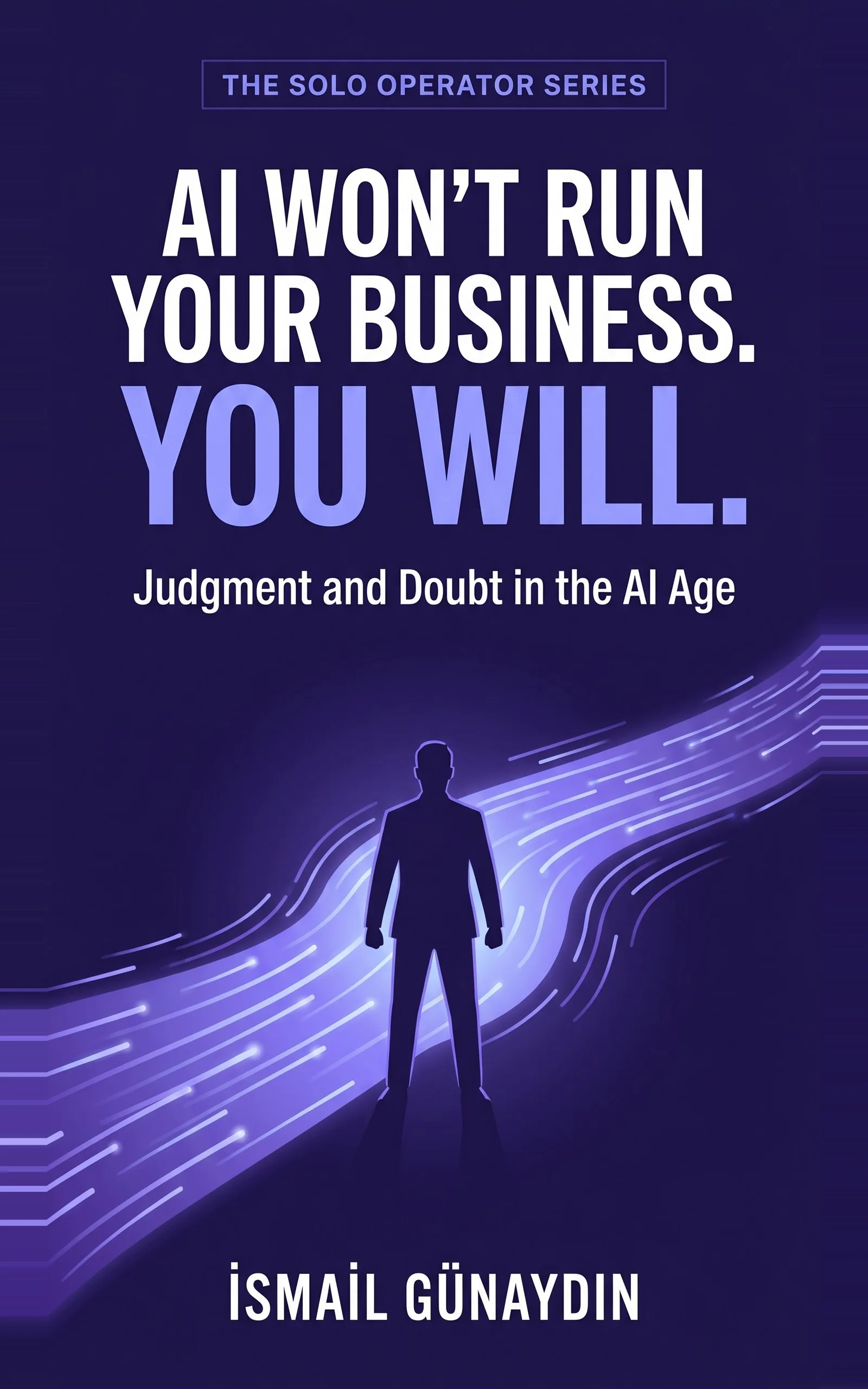
The book for this problem
AI Won't Run Your Business. You Will.
Judgment and Doubt in the AI Age. By İsmail Günaydın, 60 pages.
Where this problem is in the book:
- Introduction: The Hand on the Wheel
- The Decision: AI Offers; You Choose, and You Live With It
- The Jagged Edge: Knowing When the Confident Machine Is Wrong
Links go to Amazon. I wrote this book and earn a royalty on every sale. Amazon sets the price and handles delivery and returns.

Is AI Won't Run Your Business. You Will. the right book for you?
Yes, if
- You heard the term automation bias and want it in plain words
- You have gone with an AI answer while a better fact sat in your own notes
- You want to know what actually reduces it, not just that it exists
Skip it if
- You want an academic review of the full literature
- You want advice for pilots or hospitals (the book is for people running a business)
Fair doubts before you buy
Why read a book when I can read the original papers?
You can, and the book names them. The papers explain the bias. They do not tell a solo business owner what to do on a Tuesday afternoon with a client waiting. The book turns the finding into a four-line sheet you fill before a decision goes out.
Isn't automation bias only a problem for pilots and doctors?
The early research did look at people working with automated aids. The book's point is that the same pull now works on anyone with a chat tool, and a chat tool sounds far more convincing than a cockpit alarm. If you run a business with AI, it applies to you.
Get AI Won't Run Your Business. You Will.
AI is right often enough that you stop checking; five human jobs keep your hand on the wheel when it is confidently wrong.
Links go to Amazon. I wrote this book and earn a royalty on every sale. Amazon sets the price and handles delivery and returns.
Part of The Solo Operator Series, five short books that can be read in any order.
Questions people ask about this
- What is automation bias in simple terms?
- It is trusting what a tool says over what you know. You see the tool's confident answer, and it beats your own facts in a quiet argument you barely notice. Researchers have studied it since at least 1999, with people working next to automated aids.
- What is an example of automation bias with AI?
- In the book, a consultant asks AI what to quote a client. It says quote high. He knows this client once left a competitor over a price that felt greedy, but he sends the high quote anyway because the screen sounds sure. He loses the client. That is an error of commission.
- What is the difference between errors of commission and omission?
- Commission is doing what the tool says when your own information says not to. Omission is missing a problem because the tool did not point it out. One is following a wrong signal. The other is not noticing a missing one.
- How do you reduce automation bias?
- The same research found that when people were held responsible for their choices and had to justify them, the bias dropped. So before a decision ships, write down who decided, who carries the result, and your reasons in your own words. It takes about thirty seconds.
- Why is automation bias worse with ChatGPT?
- Because chat tools write smooth, sure prose, and newer research on language models found that the more fluent and certain an answer reads, the lower people drop their guard. The tone stays the same whether the answer is right or wrong.
- Is automation bias the same as complacency?
- They are close, but not the same. Complacency is a general switching off. A 1998 NASA report by Linda Skitka found automation bias comes from having the aid in the loop itself, not just from people being complacent. The aid was right 88% of the time. On the times it was wrong, people using it got 65% right, against 97% for people with no aid.
Related problems
- Can I trust ChatGPT for business decisions, or only for advice?
ChatGPT is a great advisor and a risky decider. See the difference side by side, and the four-line check that keeps the decision yours.
- When to overrule AI: the signs its confident answer is wrong for your business
AI sounds just as sure when it is wrong. Here are the signs it has gone past what it knows, and exactly what to do with each one before you act.
- You feel dumber, or less sure of yourself, since you started relying on AI. You are not imagining it.
Less sure of your own thinking after a year of ChatGPT? What the research says, why it happens, and one weekly habit that brings it back.
- Everything inside AI Won't Run Your Business. You Will.
Every chapter, who the book is for, and every problem it helps with.