Last updated
Your partner won't go to couples therapy. What you can do instead.
You asked, and the answer was no
Maybe it was a shrug. Maybe it was "We don't need that." Maybe it was a look that said you had just accused them of something.
And now you are sitting with two bad feelings at once. You still think something needs to change. And you feel a little foolish for asking.
You are not being dramatic. Your partner is not being impossible. You are just at different points on the same road.

One of you almost always gets there first
Research on couples who seek help finds the same pattern again and again. One partner notices the problem first, thinks about help first, and reaches for it first. The other often gets there later, or needs a different kind of invitation.
So the first no is not the final word. It is often the first step in their own timeline.
What sits behind the no
In a study of men in unhappy relationships, the biggest reasons for avoiding couples therapy had little to do with how unhappy they were. Two came out on top. They felt they didn't really need it. And they felt a private shame about asking for help.
You can't argue someone out of either of those. A list of reasons only proves the point they fear: that something is wrong with them.
What you can do is make the ask smaller. Less to feel ashamed of. Less to say no to.

A checkup feels different from a repair
Researchers have tested this idea. In a large randomized study, couples offered a brief, low-pressure relationship checkup became closer and less distressed than couples who waited. A checkup is something healthy couples do. A repair is something broken couples need. The words matter.
There is also research on doing the work at home. Couples who worked through a structured program together, online, with no therapist in the room, improved in large randomized trials. Those programs had set steps and kept both partners involved week after week. Loose self-help that couples dip in and out of showed very little effect. So if you try something at home, the structure is the part that seems to count.
When you ask again, leave three things out. Don't say "we need help." Don't list what's wrong. Don't promise it will fix anything. Something like this works better:
It's not therapy. Nobody else sees it. We can skip anything we don't like.
Our page on how to ask a skeptical partner to try has more wording you can borrow.

Ask what the no is about, then just listen
Most advice on this says the same first step: before you push, find out why. A no can be about many things. Not seeing the need. Shame. Time or money. A fear that talking to a stranger will make things worse.
The hard part is listening to the answer without arguing with it. The book's tool for this comes from Session 7. One person speaks. The other sums up what they heard before saying anything of their own:
So you're worried that a therapist would just take my side?
Your partner says yes, or fixes it. That is all. You don't have to answer the worry tonight. You only have to show you heard it. A worry that has been heard is easier to work with later, and sometimes the smaller step you offer next can speak to it directly.
The book is honest about this tool. It is a core part of relationship-education programs such as PREP, and couples in programs like these did modestly better on average. Researchers still argue about whether the listening part is what helps. It is still a calm way to hear a no.
While you wait, work on your own side
You can't do couples work alone. You can still do your half. The book says reading the sessions on your own can help you understand your own side and make you a calmer partner, even though it can't replace the two of you together.
Some places to start on your own: notice the small bids for attention your partner makes and answer a few, as our page on when you don't talk anymore explains. Start hard topics softly. Take a real break when you feel flooded. None of these need your partner's yes.
When a smaller step is still the wrong step
Some situations need more than a kitchen table. If one of you is seriously thinking about leaving, look for a counselor who offers discernment counseling. It is a short process for couples who disagree about whether to try.
And if your partner frightens you, checks your phone, controls the money, or decides who you can see, do not do couples exercises together at all. The National Domestic Violence Hotline advises against couples counseling with an abusive partner and suggests an advocate first. Call 800-799-7233 or text START to 88788.

Written for the partner who asked first
This is the problem The 20-Minute Couples Workbook was written for. Its subtitle ends with "Even If Your Partner Is Skeptical," and it means it.
For the One Who Bought This Book is a chapter written just for you, the one who reached first. It explains why partners say no, gives a few ways to ask, and tells you what to do if the answer is still no.
Before You Start: When This Book Is Not Enough lists the signs that you need a professional or a hotline instead.
How This Book Works shows your partner exactly what they are agreeing to: twenty minutes, once a week, one book, two pens, and the right to say "pass" to any question.
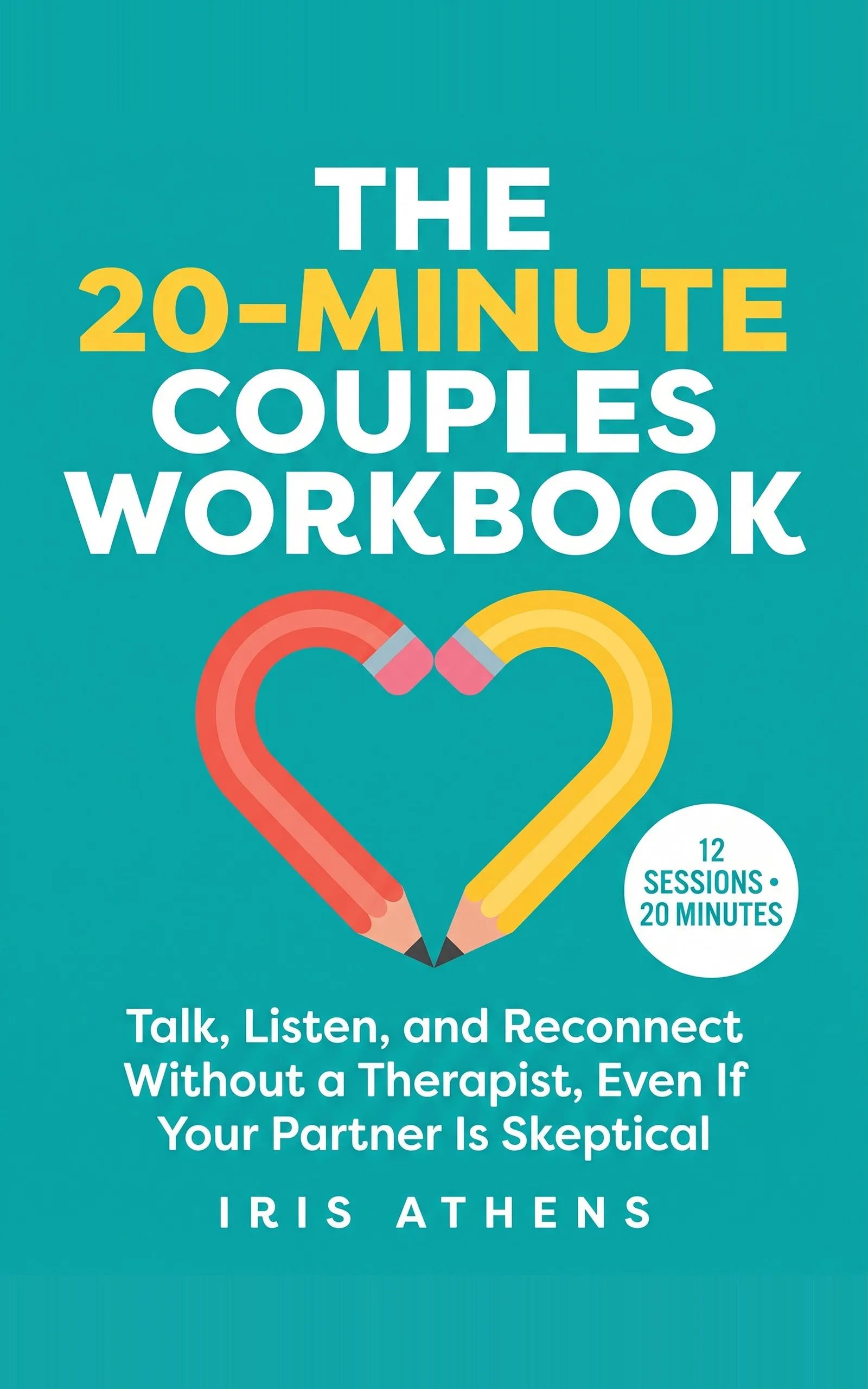
The book for this problem
The 20-Minute Couples Workbook
Talk, Listen, and Reconnect Without a Therapist, Even If Your Partner Is Skeptical. By Iris Athens, 154 pages.
Where this problem is in the book:
- For the One Who Bought This Book
- Before You Start: When This Book Is Not Enough
- How This Book Works
Links go to Amazon. ToolGenX publishes this book under a pen name and earns from every sale. Amazon sets the price and handles delivery and returns.

Is The 20-Minute Couples Workbook the right book for you?
Yes, if
- You asked about couples therapy and got a flat no
- You are the one who noticed the problem first
- You want something you can offer that feels smaller than an office visit
Skip it if
- Your partner frightens you, controls your money or phone, or tracks where you go
- One of you wants to leave and the other wants to stay
- You want a way to make your partner admit they are the problem
Fair doubts before you buy
If my partner won't do therapy, why would they do a workbook?
They might not, and we won't pretend otherwise. But a workbook asks for less. No office, no stranger, no list of what's wrong. The first three sessions are only about what is going well, so there is less to feel ashamed of and less to say no to.
Can't I just read it on my own?
You can, and it may help you understand your own side. Just know the limits. In one study where only one partner did an online program, that person felt better in their own life, but the relationship itself didn't measurably change. These exercises are built for two.
Get The 20-Minute Couples Workbook
One book, two pens, twenty minutes a week: twelve guided sessions give "can we talk" a shape, starting with what already works.
Links go to Amazon. ToolGenX publishes this book under a pen name and earns from every sale. Amazon sets the price and handles delivery and returns.
This workbook is not therapy. If either of you feels unsafe, call the National Domestic Violence Hotline at 800-799-7233.

Questions people ask about this
- What do you do when your partner refuses couples therapy?
- First, don't push in the middle of a fight. Pick a calm moment and offer something smaller, like a short weekly talk at home that starts with what is going well. If the answer is still no, give it a few weeks and ask again, once, kindly. People change their minds more often than they admit.
- Why do men refuse couples counseling?
- In one study of men in unhappy relationships, the biggest reasons had little to do with how unhappy they were. They came down to feeling they didn't really need it, and a private sense of shame about asking for help. A smaller, private first step speaks to both.
- Can couples therapy work if only one person goes?
- Going alone can help you, but don't expect it to change the relationship by itself. When only one partner used an online couples program in a small study, that partner felt better, while the relationship didn't measurably change. It can still make you a calmer partner.
- Is it too late for couples therapy if we waited years?
- No. You may have read that couples wait six years before getting help. Researchers who checked 270 cases found an average of about 2.7 years, and most came within two. Either way, the best time to start is the week you actually start.
- What if one of us wants to leave and the other wants to stay?
- Then a workbook is the wrong tool. Look for a counselor who offers discernment counseling, a short process built for couples who disagree about whether to try. In one report on a hundred such couples, about half decided to work on the relationship.
- How do I find out why my partner won't go to therapy?
- Ask once, in a calm moment, and then listen instead of answering back. The workbook's listening tool helps here: sum up what you heard before you say anything of your own, and let your partner say yes or fix it. You are not trying to win the point. You are finding out whether the no is about need, shame, money, time or a fear of making things worse.
Related problems
- You bought something to work on your relationship. How to ask a skeptical partner to try it.
You want to work on things together and your partner rolls their eyes. Words to use, words to skip, and why the first sessions should be easy.
- Couples workbook or couples therapy: which one fits where you are right now?
A side-by-side look at doing a couples workbook at home versus seeing a couples therapist, with the clear signs that a book is not enough.
- You and your partner don't really talk anymore. Is that normal, and how do you start again?
No fights, just quiet. Why couples drift into talking only about logistics, and three small habits that bring real conversation back.
- You keep having the same fight with your partner. Here is why it never ends.
Having the same argument for years is common. Learn why some fights never get solved, and a 12-minute way to talk about what sits under yours.
- Everything inside The 20-Minute Couples Workbook
Every chapter, who the book is for, and every problem it helps with.