Last updated
You and your partner don't really talk anymore. Is that normal, and how do you start again?

It's 9pm and you're both on the couch, both on your phones
Nobody is angry. That is almost the strange part. Dinner was fine. You talked about the dentist and whose turn it is to get milk.
Then you sat down and the screens came out. Your partner laughed at something. You didn't ask what. They didn't say.
You can't remember the last time you talked about anything that wasn't a task. And a quiet voice asks whether this is just what happens, or whether you are slowly becoming roommates.

Why "we should talk more" doesn't work
The usual advice is a date night, or a big talk about the relationship. Both have the same problem. They ask for a lot of energy at the exact moment you have none.
A big talk can also feel like a test. If one of you says "we need to talk," the other one's shoulders go up an inch. Now you are not reconnecting. You are bracing.
Most closeness is not built in big talks. It is built in small moments, many times a day. Those are the moments that slipped away.

The small reaches you may be missing
Picture this scene from the book. Nadia is drying a pan and sees a man walking a cat on a leash outside. "Chris, come look," she says. Chris is on his laptop and says "mm" without looking up. Nadia watches the cat turn the corner by herself. She doesn't mention it again.
The psychologist John Gottman calls that a bid. A small reach for attention. "Come look" really means "be with me for a second." The cat doesn't matter. The answer does.
In a study of about fifty newlywed couples who spent a day in a lab apartment, couples who brushed off each other's bids at dinner tended to have rougher arguments later. It was one lab and a small group, and nobody can say which way it runs. But the habit costs nothing to try. A look and three words are enough. "Ha, where?"
When you are truly busy, a quick answer still counts:
Hold that thought, I want to hear it in five minutes.
Then ask in five minutes.

Your picture of each other has gone out of date
There is a second reason couples go quiet. You stop knowing what's new.
In one scene, Harold tells a neighbor his biggest worry is his brother's knee surgery. Bev, married to him for over forty years, nearly drops her watering can. She knew about the knee. She had no idea he had been lying awake over it.
Gottman calls this a love map: your picture of your partner's inner world right now. It goes out of date because people don't announce their inner changes. So the fix is a question about now. Try one tonight:
What's the biggest stress in your life right now?
Guess the answer first, in your head. If you miss, that is the most useful result. Say "tell me a little about that," and listen.

Good news is a door, too
The third habit is about good things. When your partner shares good news, the urge is often to point at the practical problem. "Won't that eat your whole Saturday?" It is well meant. It also lets the air out.
Shelly Gable and her colleagues found that people felt better after sharing good news, and the boost was bigger when the listener responded with real interest. So ask one curious question first. "Wait, really? Who asked you?" The Saturday problem can wait until Sunday.
A note we put on every page: if the quiet in your home comes from fear, this is not a communication problem. The National Domestic Violence Hotline is free at 800-799-7233.

When the quiet isn't peaceful
There are two kinds of quiet. One is drift: nobody is upset, there is just nothing new being said. The habits above are for that.
The other kind comes from fights. You stop bringing things up because it always goes badly. One of you goes silent, turns away or picks up a phone in the middle of a hard talk. John Gottman called this stonewalling. It is one of four habits, with criticism, contempt and defensiveness, that showed up more in couples who later split up in his long studies with Robert Levenson.
The book is careful here. That research does not prove these habits cause breakups, and every couple uses some of them some of the time. It is about patterns over many talks. The book's fix for stonewalling is to say what is happening and take a real break, then come back:
I'm shutting down. I need a break, and I'll come back to this.
If the silence is mostly this kind, start with our page on how to take a break when a fight gets too heated.

How to bring it up without a big talk
You don't need to say "we need to talk." That line puts shoulders up. Pick a calm moment, not a bad day, and make the ask small. The book's sample lines leave out what's wrong and promise nothing:
I found a short thing we could try. It's twenty minutes, once a week, just us. Want to try one and see?
The book calls this a checkup, not a repair. In a large randomized study it cites, couples offered a brief, low-pressure relationship checkup became closer and less distressed than couples who waited. Then put the phones face down for those twenty minutes. That is one of the book's ground rules.

Three sessions for couples who went quiet
This is the problem The 20-Minute Couples Workbook was written for. The first sessions have no conflict in them at all. They are about knowing each other again.
Session 2, Love Maps, is a guessing game about each other's current life, with a page to write down what you learned.
Session 3, Turning Toward, has each of you list your own bids and how you would like them answered, so your partner stops missing them by accident.
Session 4, When Good Things Happen, practices answering good news with real interest.
And 52 Questions for the Kitchen Table gives you one easy question for every week of the year. Our page of questions to ask your partner to reconnect shares a few of them.
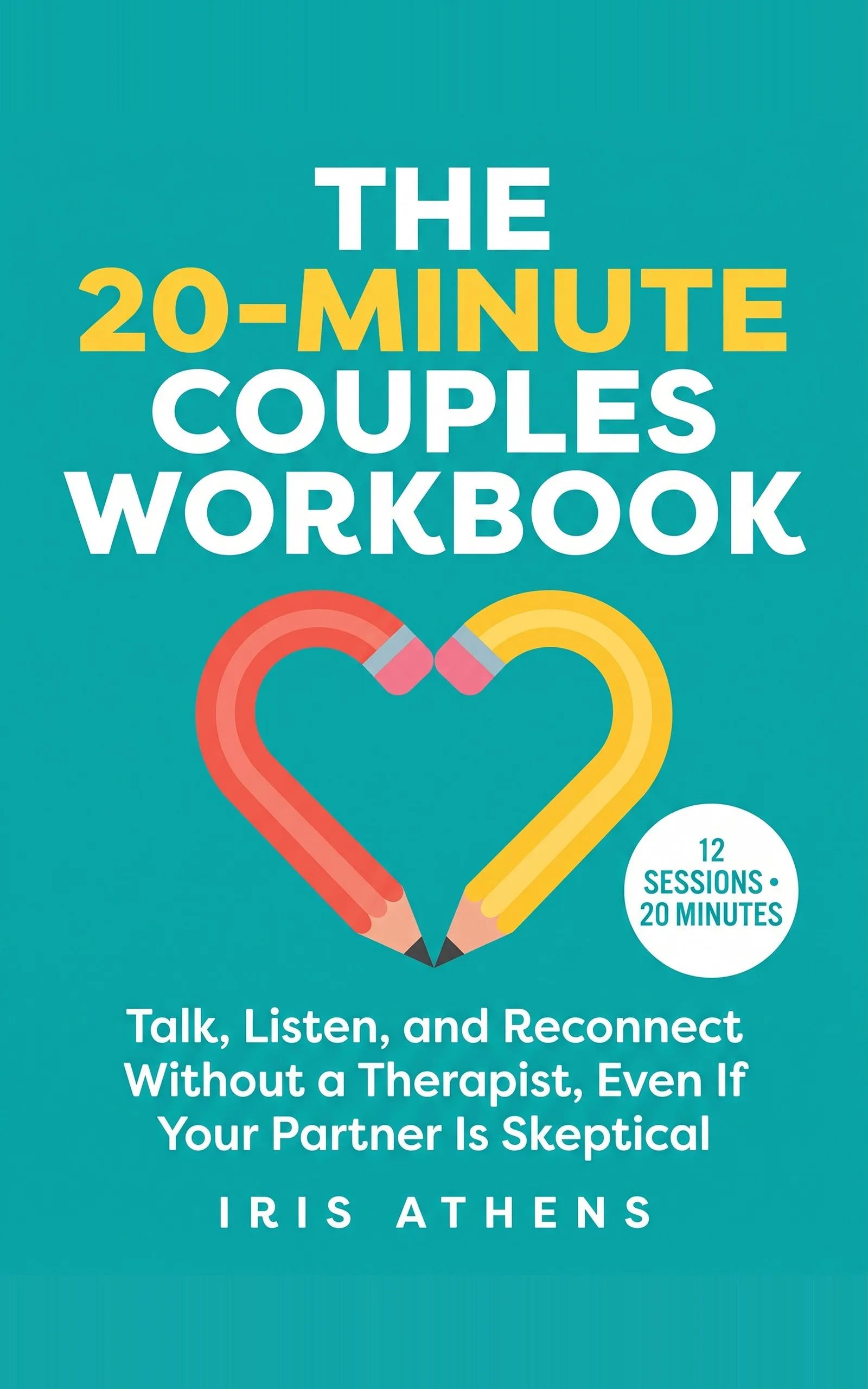
The book for this problem
The 20-Minute Couples Workbook
Talk, Listen, and Reconnect Without a Therapist, Even If Your Partner Is Skeptical. By Iris Athens, 154 pages.
Where this problem is in the book:
- Love Maps
- Turning Toward
- When Good Things Happen
- 52 Questions for the Kitchen Table
Links go to Amazon. ToolGenX publishes this book under a pen name and earns from every sale. Amazon sets the price and handles delivery and returns.

Is The 20-Minute Couples Workbook the right book for you?
Yes, if
- Your talks are about groceries, kids and the calendar, and not much else
- You don't fight. It's just quiet
- You miss your partner even though they are in the next room
Skip it if
- The silence is because one of you is afraid of the other
- One of you is struggling with depression, drinking or drug use that is getting worse. A professional is the better first step
Fair doubts before you buy
We are just busy. Isn't this what long relationships look like?
A lot of long relationships do look like this, and it is not a crisis. But busy is the reason the small moments get missed, not proof they don't matter. The fixes here take a few seconds at a time, so busy couples can do them.
Talking about our feelings for twenty minutes sounds awful.
Then good news: the first sessions are not about feelings in a heavy way. One is a guessing game about your partner's current life. Another is about how you each like to be answered when you point at something out the window. It is closer to a game night than a therapy hour.
Get The 20-Minute Couples Workbook
One book, two pens, twenty minutes a week: twelve guided sessions give "can we talk" a shape, starting with what already works.
Links go to Amazon. ToolGenX publishes this book under a pen name and earns from every sale. Amazon sets the price and handles delivery and returns.
This workbook is not therapy. If either of you feels unsafe, call the National Domestic Violence Hotline at 800-799-7233.

Questions people ask about this
- Is it normal for couples to stop talking?
- It is very common, especially in long relationships. People change jobs, pick up new worries and drop old dreams, and they rarely announce it. So partners end up running on an old picture of each other. That is a reason to update the picture, not a sign the relationship is over.
- How do you reconnect with your partner when you've drifted apart?
- Start small. Ask one question about your partner's life right now, and listen to the whole answer. Catch one small bid for attention a day. And when they share good news, ask a curious question before you raise any practical worries.
- What are bids for connection?
- A bid is a small reach for attention, like saying come look at this, sighing at the phone, or sending a funny video. The psychologist John Gottman uses the word. You can turn toward it with a few words, turn away by missing it, or turn against it with irritation.
- How do I get my partner to open up to me?
- Ask about now, not forever. Questions like what is the biggest stress in your life right now tend to work better than big questions about the relationship. Guess the answer first, then ask, and if you were wrong, say tell me a little about that and just listen.
- Why does my partner seem flat when I share good news?
- Often they are tired or distracted and jump to the practical downside without meaning to. Research by Shelly Gable and colleagues found that how partners respond to good news is linked to how close they feel. You can each say how you would like good news answered.
- Is it a bad sign if my partner goes silent when we argue?
- Going silent in the middle of a hard talk is what John Gottman called stonewalling, one of four habits seen more often in couples who later split up. One silent evening means little, since every couple does this sometimes. The research is about patterns over many talks. The workbook's fix is a proper break to calm down, said out loud, and then coming back to the talk.
Related problems
- Questions to ask your partner to reconnect, and how to ask them so they work
Good questions to ask your partner when you feel distant, from easy to a little deeper, plus the simple listening rules that make them work.
- You bought something to work on your relationship. How to ask a skeptical partner to try it.
You want to work on things together and your partner rolls their eyes. Words to use, words to skip, and why the first sessions should be easy.
- How to bring up a hard conversation with your partner without starting a fight
Every time you bring something up, it turns into a fight. A soft start-up in three plain parts, with a before and after example you can copy tonight.
- You keep having the same fight with your partner. Here is why it never ends.
Having the same argument for years is common. Learn why some fights never get solved, and a 12-minute way to talk about what sits under yours.
- Everything inside The 20-Minute Couples Workbook
Every chapter, who the book is for, and every problem it helps with.