Last updated
How to bring up a hard conversation with your partner without starting a fight

You've been holding this in for a week
You have been thinking about it since Monday. The towels on the bed. The tank on empty. You keep waiting for the right moment, and the right moment never comes.
Then it comes out anyway, at the wrong time, in the wrong tone. "You never put gas in the car. Do you think it fills itself?" Your partner's face closes. Ten minutes later you are arguing about something from last spring.
You were not wrong to bring it up. The trouble was the first sentence.

Why the first sentence decides so much
Sybil Carrère and John Gottman studied 124 newlywed couples as they talked about a real disagreement. Couples who later split had started their talks with more harshness and less warmth.
That study gets quoted a lot, so here is the other half. A second team ran a similar test with 85 couples and found that a harsh start did not predict whether they stayed together. So we don't treat the first three minutes as fate. We treat them as the easiest part to change.

Complaint or criticism: the line your partner hears
Here is the difference that does most of the work.
A complaint is about something that happened. "The cabinet doors were open again this morning."
A criticism is about who your partner is. "You never notice anything."
A complaint hands your partner a small problem to look at. A criticism hands them a reason to defend themselves. And a person busy defending is not listening. They are building a case.
Most of us mean a complaint and say a criticism. The words "always" and "never" are the giveaway.

The soft start in three plain parts
A soft start has three parts. One feeling word. One situation from this week. One request your partner could actually do.
Here is the gas tank example from the book, both ways:
Harsh: You never put gas in the car. Do you think it fills itself?
Soft: I felt rushed this morning when the tank was almost empty and I was already late. Could you fill it up when it gets to a quarter?
If that sounds too much like a counselor's office, use the plain version:
It bugs me when the tank is nearly empty in the morning. Could you fill it at a quarter?
Before you say it, check four things. Does it start with how you feel? Does it name one situation? Is there no "always" or "never"? Is the ask something they could do this week?
Watch for one trap. The first line below sounds like a feeling, but it is a guess about your partner. The second one is about you.
I feel like you don't care.
I feel ignored.
And if you add one more line after the request, cut it. The extra line is usually where the fight starts.

Practice on the thermostat first
Don't test this on the biggest issue you have. Start with something small that keeps coming up but has never become a big fight. Dishes left to soak. A phone at dinner. If the topic makes your partner's stomach drop, they can say "too big," and you pick something smaller.
The listener has a job too. Say back what you heard in one sentence. Then pick one of three replies:
That's fair.
I can do that.
Can I think about it and get back to you?
No counter-complaint yet. Their turn comes next.
If either of you is scared of how the other will react, this is not the right tool. The National Domestic Violence Hotline is free and confidential at 800-799-7233.

Pick the moment before you pick the words
Most advice on this starts with timing, and for good reason. The best soft start still lands badly at 11 p.m. on a hard day.
Late-night talks are a common trap. Many people try to settle things before bed. The book checks that rule in its Myth Check and finds no study behind it. What research does show leans the other way. In diary and lab studies, couples argued more after poor sleep, and they solved problems best when both of them were well rested.
So choose a calm moment when you are alone together and neither of you is rushed. Not in the middle of another argument. Not in front of the kids or friends. The book's simplest fix is a set weekly time, same day and same hour, with phones face down. A complaint that has a home is easier to hold until then.
If it is already late and you are tired, the book's line for that is short:
I love you. We'll finish this tomorrow at seven.
Then finish it at seven.

Practice the soft start with the workbook
This is the problem The 20-Minute Couples Workbook was written for. You do it together, one book and two pens, twenty minutes a week.
Session 6, Start Soft, is the full exercise. Each of you picks one small complaint, writes the harsh version in private, rewrites it soft, and then says it out loud while the other practices hearing it.
Session 7, Listen Until They Feel Heard, gives the listener a simple way to sum up before replying, so the soft start lands.
Session 8, The Four Horsemen, helps each of you spot your own worst habit in a fight. Criticism is one of the four, and the soft start is its fix.
If your talks have gone quiet rather than tense, our page on what to do when you don't talk anymore may fit better.
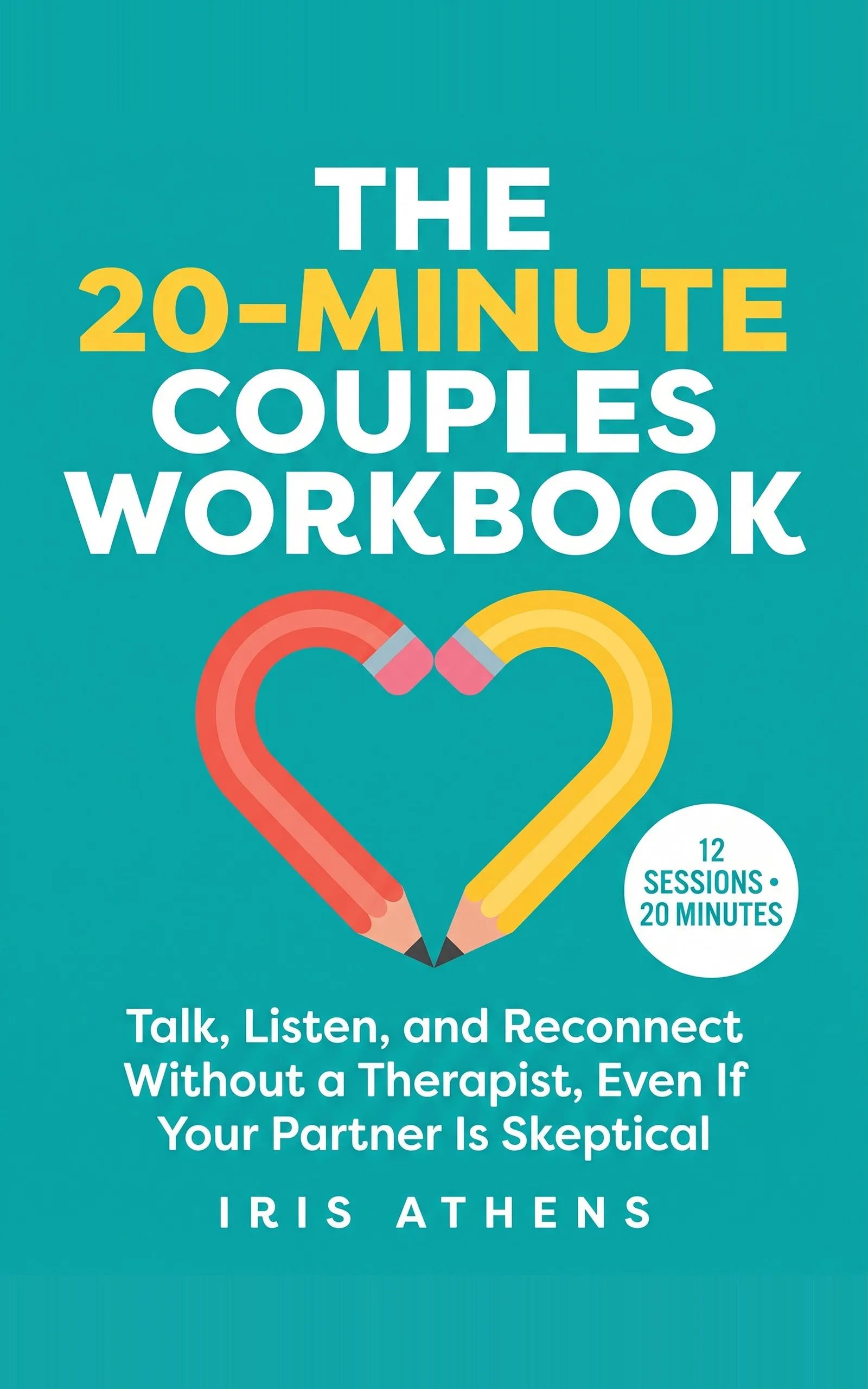
The book for this problem
The 20-Minute Couples Workbook
Talk, Listen, and Reconnect Without a Therapist, Even If Your Partner Is Skeptical. By Iris Athens, 154 pages.
Where this problem is in the book:
- Start Soft
- Listen Until They Feel Heard
- The Four Horsemen
Links go to Amazon. ToolGenX publishes this book under a pen name and earns from every sale. Amazon sets the price and handles delivery and returns.

Is The 20-Minute Couples Workbook the right book for you?
Yes, if
- You hold things in because bringing them up always goes badly
- Your partner gets defensive before you finish your first sentence
- You want words you can actually say, not a theory
Skip it if
- The issue is an affair, a betrayal or whether to stay together
- You feel afraid of how your partner will react. Then call the National Domestic Violence Hotline at 800-799-7233 first
Fair doubts before you buy
This sounds like therapy-speak. My partner will roll their eyes.
That is why the book gives a plain version too: it bugs me when this happens, could you do that? It does the same job and sounds like a normal person. You also practice it on small things, like the thermostat, so it never feels like a scripted speech.
Why should I be the one to soften it when they are the one causing the problem?
You don't have to be the only one. In the book, both partners take a turn bringing a complaint and both take a turn listening. The soft start is not about letting anyone off the hook. It is about getting your point heard instead of fought.
Get The 20-Minute Couples Workbook
One book, two pens, twenty minutes a week: twelve guided sessions give "can we talk" a shape, starting with what already works.
Links go to Amazon. ToolGenX publishes this book under a pen name and earns from every sale. Amazon sets the price and handles delivery and returns.
This workbook is not therapy. If either of you feels unsafe, call the National Domestic Violence Hotline at 800-799-7233.

Questions people ask about this
- How do you bring up a problem without starting a fight?
- Start with one specific situation and one request. Say how you felt, what happened this week, and what would help. Leave out words like always and never, and stop after the request. Pick a calm moment, not the middle of another argument.
- What is a soft start-up?
- A soft start-up is a gentle way to open a hard talk. It names one feeling, one situation, and one doable request. The idea comes from clinical advice. Nobody has tested the exact formula on its own, but it is an easy way to put a complaint on the table without starting a war.
- What is the difference between a complaint and a criticism?
- A complaint is about something that happened, like the cabinet doors being left open this morning. A criticism is about who your partner is, like saying they never notice anything. A complaint gives your partner a problem to look at. A criticism gives them a reason to defend themselves.
- Do the first three minutes of an argument predict divorce?
- Not in any way you should worry about. One study of 124 newlywed couples linked a harsh start to later divorce. Another team tested 85 couples and found that a harsh start did not predict whether they stayed together. A few bad minutes don't seal anyone's fate.
- Why does my partner get defensive when I bring things up?
- Often because what they hear sounds like an attack on who they are, not a note about one event. When people feel judged, they protect themselves first and listen second. Naming a behavior instead of a trait gives them something they can actually fix.
- When is the best time to bring up a problem with your partner?
- A calm, rested moment when you are alone, not late at night and not in the middle of another argument. Research on sleep found couples argued more after poor sleep and solved problems best when both were well rested. The workbook's answer is a set weekly time, phones face down. If it is late, say you love them and pick a time tomorrow.
Related problems
- You keep having the same fight with your partner. Here is why it never ends.
Having the same argument for years is common. Learn why some fights never get solved, and a 12-minute way to talk about what sits under yours.
- The fight is getting too heated right now. How to take a break that actually helps.
Your heart is pounding and you can't hear your partner anymore. What to say, how long to pause, and how to come back without starting round two.
- You and your partner don't really talk anymore. Is that normal, and how do you start again?
No fights, just quiet. Why couples drift into talking only about logistics, and three small habits that bring real conversation back.
- Questions to ask your partner to reconnect, and how to ask them so they work
Good questions to ask your partner when you feel distant, from easy to a little deeper, plus the simple listening rules that make them work.
- Everything inside The 20-Minute Couples Workbook
Every chapter, who the book is for, and every problem it helps with.