Last updated
The AI agent's report looks perfect. Should you trust it before you act?
Twenty minutes later, a perfect report
You sent a helper agent to look over your website while you answered email. Twenty minutes later it's back.
Headings. A severity column. A neat count at the top. "14 pages are missing descriptions. 6 images slow down the whole site. Recommended action: fix all."
It reads like something you'd pay a consultant for.
Fine. Fix all.
Before you type that, ask one question. Did anyone actually count?

Why reading it more carefully won't help
The report is a summary. You see the conclusion. You don't see the counting.
So you can read it twice and still not know. A careful read tells you it sounds right. It can't tell you if the agent searched one way and missed the pages written another way.
Claude Code does scan helper reports before the main session reads them. It neutralizes text that pretends to be system messages, and it marks reports that talk about permissions. That protects you from a report that gives orders. It is not a fact check. It won't recount your pages.

Twelve chickens, and two behind the shed
You send your little brother to count the chickens. He's back in a minute. "Twelve!" You know there are fourteen. He counted the ones he could see from the back door.
He wasn't lying. He counted from one spot and said the number as if it covered the whole yard.
On July 2, 2026, my agents did the same thing on one of my sites. "5 pages are missing metadata" was really 3. A fix for a slow image would have made loading slower on most pages. And a link problem the agent put at 109 files was really 334. Too many and too few, in one report.
That week gave me the three-step check. For each finding that would cost me if wrong: open the file, recount with my own search, look at three by hand. The best practices page in the docs makes the same point from the other side. Give Claude a check it can run, because it stops when work looks done.

Ask for proof in the request, not after
Checking is cheaper when the report arrives with its receipts. The book's reviewer rules go at the end of every review or audit prompt. These four do most of the work:
Every finding needs proof:
  file name + line number + the exact text you saw.
  No proof, no finding.
Give real counts, and say how you counted:
  "3 files, found by searching for X and for Y."
  If you only looked at a sample, write "sample of N".
Report real problems only. If you find nothing
  important, say "nothing important found."
  That is a good result.
Do not trust web page summaries for numbers.
  Quote numbers only from the raw page text, and
  say which page they came from.
The third rule matters more than it looks. A reviewer asked for problems will find some. Saying that "nothing important found" is a fine answer makes its real findings worth more.
What a report you can trust looks like
Put the report next to this list before you act on it.
- It says how it counted. Which searches, in which folders. "14 pages" with no method is a guess with a number on it.
- It says if it sampled. "Sample of 20" is honest. A sample written up as the whole is the chicken count.
- It shows raw output for every "verified." If Claude says all links or IDs were checked, ask: "Show me the raw output of each check." No output means no check.
- It points to real places. File, line and the exact text, so you can open one in ten seconds.
- It says what it did not look at. A report that covers everything usually covered less than it says.
A report that meets all five still gets the three-step check on any finding that would cost you. It just takes less time.
Nine IDs, eight wrong
Some facts are worse than miscounts. They are invented.
On September 18, 2026, I audited one of my sites. Its hidden data listed partner companies, each with an ID from Wikidata, a free public knowledge base. There were nine IDs. Eight were wrong. A payments company pointed to a human-rights group. A sales platform pointed to a plant. Three IDs didn't exist at all.
The code had shipped under a note that claimed a perfect score. The IDs had been written from memory. The note was just as sure as the IDs.
The fix took seconds. One call to the Wikidata API returns the real label for any ID. Now no ID goes live on my sites without that lookup. A report saying "all verified" with no raw output means nothing was verified.

The book's chapters on checking
This is the problem Claude Code for Non-Programmers was written for. The book is independent and is not affiliated with Anthropic.
A Team of Agents gives you the reviewer rules I paste into every review request, a helper file that truly can't write, and the Finding Check table that turns "the agent said" into "I counted."
Safety and Failure sorts every claim into four boxes, from machine-checkable to judgment, and ends with a fact-check list for anything going public.
Real Business Systems shows the same checks inside real jobs, like auditing 22 sites, where agents find candidates and a full pass confirms them.
The book for this problem
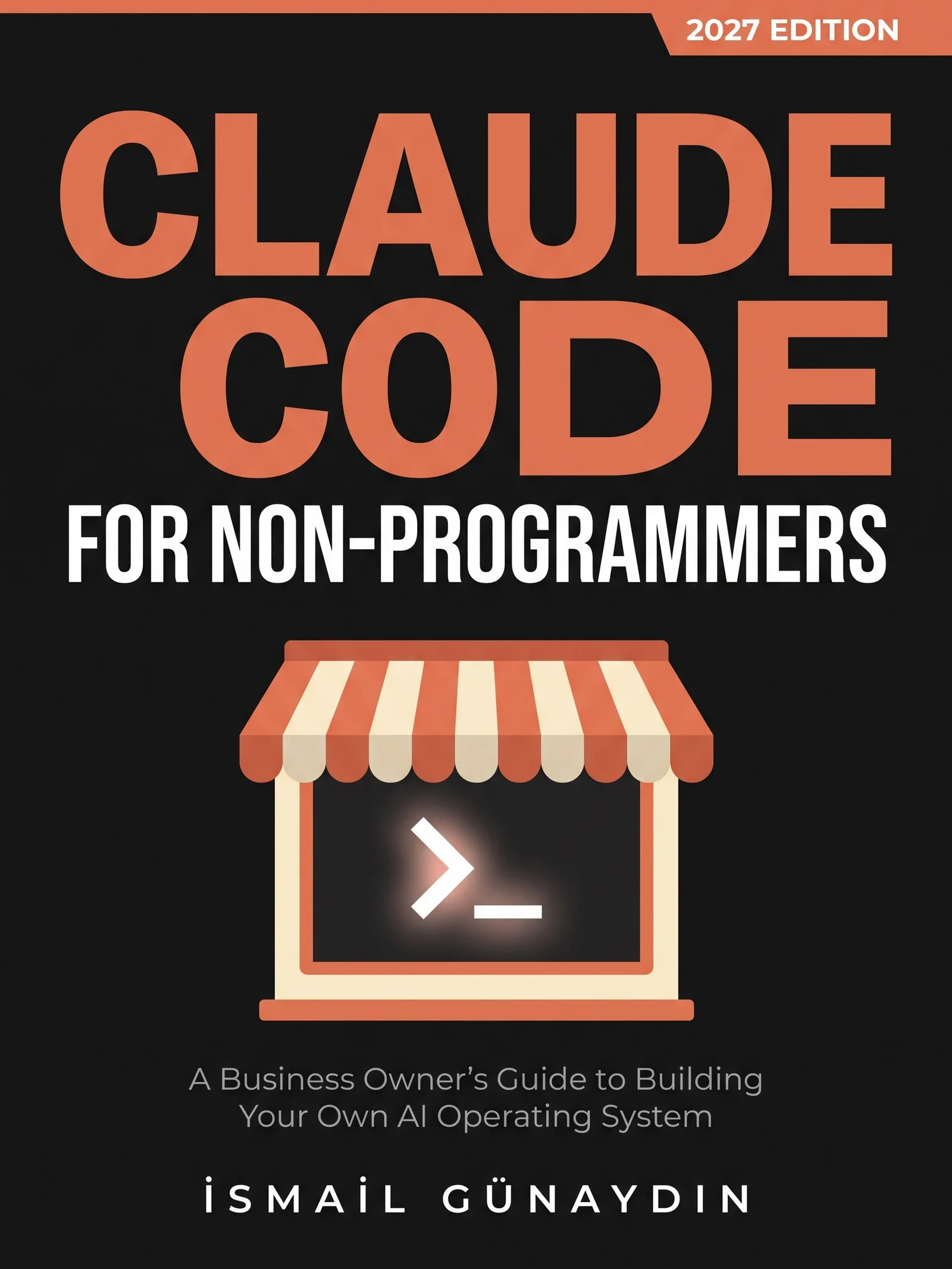
Claude Code for Non-Programmers
A Business Owner's Guide to Building Your Own AI Operating System (2027 Edition). By İsmail Günaydın, 355 pages.
Where this problem is in the book:
- A Team of Agents
- Safety and Failure
- Real Business Systems
Links go to Amazon. I wrote this book and earn a royalty on every sale. Amazon sets the price and handles delivery and returns.

Is Claude Code for Non-Programmers the right book for you?
Yes, if
- A helper agent handed you a neat report with counts and a fix-all list
- You're about to tell a client what the AI found
- Claude says all IDs or links are verified, and you aren't sure what that means
Skip it if
- You want an agent you never have to check
- You only use the chat window for drafts you read anyway
Fair doubts before you buy
If I have to check everything, what's the point of the agent?
You don't check everything. You check the findings that would cost you something if they're wrong, and you check them with a second method plus your own eyes. Agents find candidates fast. You confirm them. That split is still far faster than doing the search yourself.
Can't I just ask a second agent to review the first one?
Yes, and the docs suggest a fresh reviewer that didn't do the work. But reviewers asked to find gaps usually report some. So ask for real problems only, say that nothing important found is a good answer, and still check what comes back.
Get Claude Code for Non-Programmers
A business owner who has never opened a terminal can give Claude real jobs on real files, safely, using one working system including the parts that broke.
Links go to Amazon. I wrote this book and earn a royalty on every sale. Amazon sets the price and handles delivery and returns.
This book is independent and is not affiliated with or endorsed by Anthropic.

Questions people ask about this
- Why are AI agent reports wrong?
- Common shapes: one search treated as the truth, a sample treated as the whole, a web page summary treated as the source, and a check that measures something next to what you care about. The mistakes go both ways. An agent can report too much or too little.
- Does Claude Code make up facts?
- It can. A hallucination is a confident, well-formatted statement with nothing behind it. The book finds them clustered in IDs and codes, links and citations, quotes and named people, statistics and market judgments. Claude Code's own documentation doesn't publish a hallucination rate.
- How do I make a Claude Code agent read-only?
- Use the tool list, not a sentence. In the helper's file, a disallowedTools line that takes away Write, Edit, Bash and PowerShell means it can't change files or run commands. The built-in Explore and Plan helpers already can't write.
- How do I check a number in an AI report?
- Open the file it points to. Ask Claude in your main session to recount using a different search than the agent used. Then open three of the results yourself. Tell people "I verified, the real number is 3," never "the agent said 5."
- Can I trust Claude's web research numbers?
- Treat them as leads. When Claude fetches a page, it gets a model-written summary, not the raw page, and details can blur or appear that the page never said. For a number that matters, ask for the exact sentence and the address, and open it yourself.
- What should an AI agent's audit report include?
- Proof for every finding: the file, the line and the exact text it saw. Real counts with the method, such as which searches it ran, and a note if it only checked a sample. Raw output for anything it calls verified. And a plain "nothing important found" when that is the truth. A report missing these needs more checking, not less.
Related problems
- Claude Code changed files it shouldn't have. What to do right now
Files changed that you never approved. Stop it, rewind this session, restore from git, and what no undo button can bring back. Plain steps first.
- How to run Claude Code on a schedule, and know the job actually ran
Four ways to schedule Claude Code compared, what each needs to stay on, and the watcher that catches jobs that die without a word.
- Claude Code forgets everything each session. How do you make it remember?
You told it about the new supplier last week and today it uses the old one. Why each session starts fresh, how memory notes work, and the traps to avoid.
- What is Claude Code, and can you use it if you don't write code?
Claude Code is Claude with hands: it works on the files in a folder. What it can reach, what it can't, and a safe first job for a non-coder.
- Everything inside Claude Code for Non-Programmers
Every chapter, who the book is for, and every problem it helps with.