Last updated
The plan launches soon. Here is how to run a pre-mortem in 20 minutes

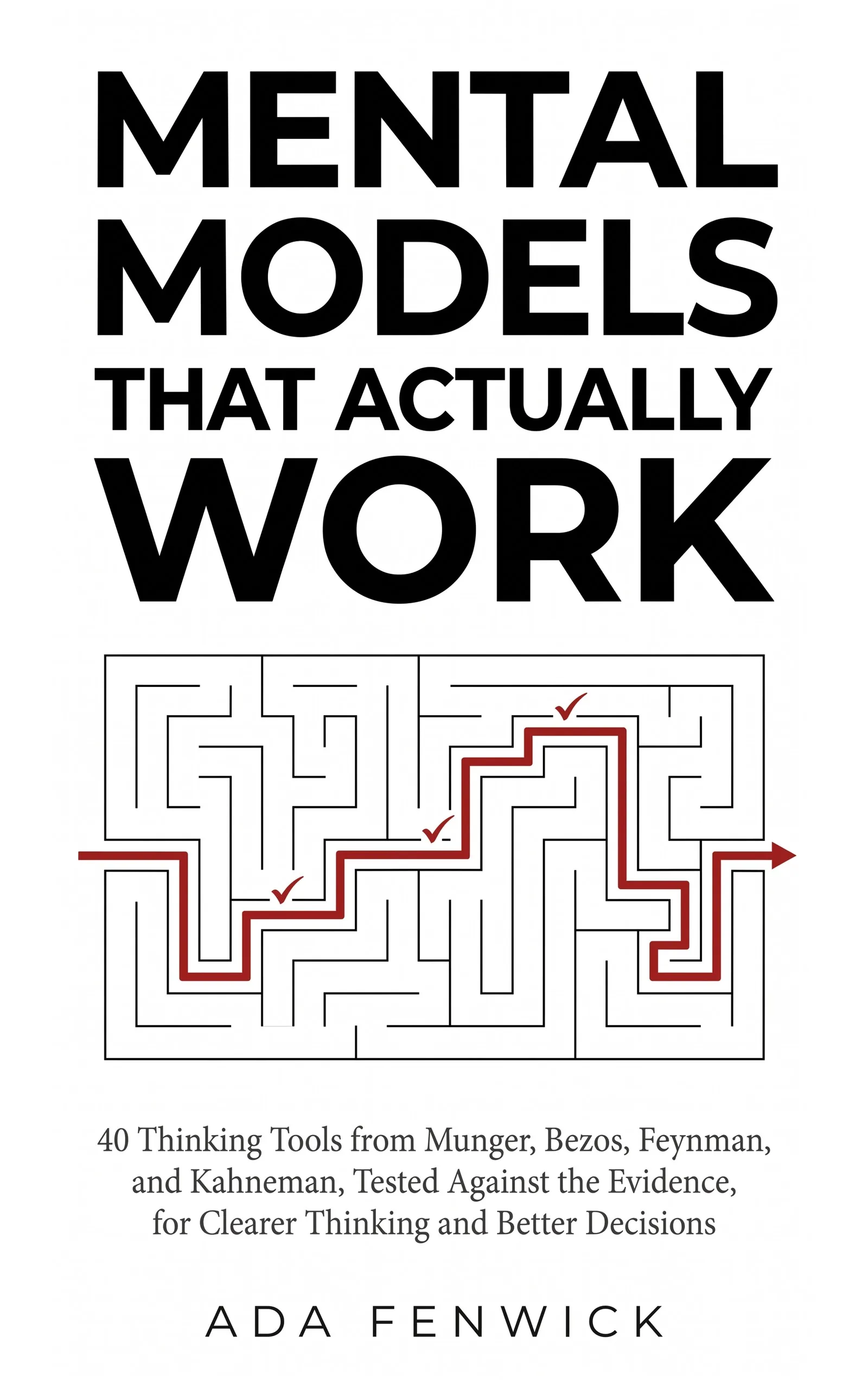
The book for this problem
Mental Models That Actually Work
40 Thinking Tools from Munger, Bezos, Feynman, and Kahneman, Tested Against the Evidence, for Clearer Thinking and Better Decisions. By Ada Fenwick, 288 pages.
Where this problem is in the book:
- The Pre-Mortem: Imagine It Failed, Then Ask Why
- Steelman and Red Team
- One-Way and Two-Way Doors
Links go to Amazon. ToolGenX publishes this book under a pen name and earns from every sale. Amazon sets the price and handles delivery and returns.
Do this before the meeting ends
You do not need a new tool or a long prep. You need paper, a timer and about twenty minutes. Here are the steps from the book, in order.
- Say the plan in one or two sentences so everyone pictures the same thing. Pick a future date when you would know if it worked.
- Say the failure as fact. "It is that date. The plan failed. Not a near miss. A clear failure."
- Set a timer for three to five minutes. Everyone writes, alone and in silence, every reason it failed.
- Go around the room one reason at a time until the lists run dry. The leader goes last.
- Sort every reason into two columns: things we control and things we don't. If the first column is thin, go around again and ask only for reasons that are on us.
- Pick the two or three most worrying reasons we control. For each, decide one change to the plan or one early warning sign.
- Write down who owns each change and when you will check.

The step most guides leave out
Step 5 is the one to protect. In a 2021 set of studies with 2,345 people, pre-mortems did make people less overconfident. But people tended to blame things outside their control, like the weather or bad luck. And the poster's bottom line was blunt: no difference in taking action to improve results.
If your list says "the market turned," there is nothing to fix. You feel humbler and do the same thing anyway. So require some reasons that are on you.

Why the silence matters
Picture the usual last meeting. The leader asks, "Any concerns?" Someone mentions a slow vendor. The engineer who thinks the timeline is fantasy says nothing.
Now say it already failed and hand out paper. The room gets busy. People who said nothing fill half a page. The book puts it in one line: it turns doubt from disloyalty into the assignment.
Silent writing first keeps the boldest voice from setting the list. The leader last keeps the boss's worries from becoming everyone's worries. Keep the tone on the plan, not on people. "The handoff broke down" helps. "Sam was too slow" starts a fight.
Who to invite, and running it online
Most pre-mortem guides tell you to invite more than the core team. The book agrees, with a sharper rule: invite the people who will actually do the work, not only the people who approved it. They usually know where the plan is thin.
If the team meets online, the silent step still matters. Have everyone write in a private note first. Then paste the lists in at the same moment, so nobody edits their worries after seeing the boss's.

After the launch, check the list
A pre-mortem is not done when the meeting ends. The book's log for this tool has six lines: the plan, the failure reasons you control, the ones you do not, the changes you made, your confidence before and after, and what actually went wrong.
Fill in the last line on the check date. Did the trouble come from your list, or from somewhere nobody looked? Either answer makes the next pre-mortem better. And it is the only way to learn if the meeting changed anything, since, as the book notes, no large trial shows that pre-mortems lead to better project results.

Alone, in ten minutes
No team? A small 2020 study found no difference between solo and group pre-mortems. Write the date and "It failed" at the top of a page. Write for five minutes. Mark each reason C for in your control or O for outside it. Get at least three C's, then change one thing today.
The book uses a freelancer example. "The economy slowed" is an O. "Never found a third client" and "No cushion when a payment came late" are C's. Each one points to something to do before the start date.

Where to go after the meeting
This is the problem Mental Models That Actually Work was written for, and the full card is in The Pre-Mortem: Imagine It Failed, Then Ask Why. That chapter also takes apart the famous 30 percent claim. It traces to a 1989 study that counted reasons, not correct ones. Gary Klein's own 2007 article is short and worth a read.
Steelman and Red Team covers the limit of a pre-mortem: it only brings out doubts already in the room. That chapter shows how to borrow the minds that see the plan differently.
One-Way and Two-Way Doors helps you decide if this launch even needs the full treatment. If it is cheap to roll back, see our page on one-way vs two-way door decisions.

Is Mental Models That Actually Work the right book for you?
Yes, if
- You have a plan going live soon and a nagging feeling about it
- Your team says 'no concerns' in meetings but you doubt that is true
- You work alone and want a ten-minute version
Skip it if
- You need a full project risk process for a regulated field
- You want proof that pre-mortems make projects succeed (no study shows that yet)
Fair doubts before you buy
Can't I just ask the team for concerns?
You can, but people tend to hold back. Nobody wants to be the one who doubts the plan in front of the boss. Saying it already failed makes doubt the task, so the quiet worries come out on paper.
Is a free article on pre-mortems enough?
For the steps, nearly. What most articles skip is the evidence. The book shows where the famous 30 percent number came from and why it does not mean what people say. It also adds the control-or-not sort that fixes a known weak spot.
Get Mental Models That Actually Work
Forty thinking tools, each traced to its source and labeled by how well it holds up, so you know which to use and when.
Links go to Amazon. ToolGenX publishes this book under a pen name and earns from every sale. Amazon sets the price and handles delivery and returns.

Questions people ask about this
- What is a pre-mortem?
- It is a planning exercise where a team assumes the project has already failed and writes down why. Gary Klein described it in Harvard Business Review in September 2007. A postmortem asks why something died. A pre-mortem asks while there is still time to change the plan.
- How long does a pre-mortem take?
- About 20 minutes for a group and 10 minutes alone, in the version in the book. The silent writing part is three to five minutes. Most of the rest is sorting the reasons and picking changes.
- Do pre-mortems actually work?
- They lower overconfidence and surface more risks in small studies. In one, pre-mortem teams found better risks than ordinary brainstorming teams. No large trial shows that projects turn out better. The book rates the tool PROMISING for that reason.
- Can you do a pre-mortem alone?
- Yes. A small 2020 study found no difference between pre-mortems done alone and in groups. Write the date and the words 'It failed' at the top of a page. Write for five minutes, then mark each reason as one you control or one you don't.
- Do pre-mortems make you 30 percent better at finding risks?
- That claim goes further than the research. The figure traces to a 1989 study that counted how many reasons people gave for events, not whether the reasons were right. It also had no plans and no teams.
- Did Daniel Kahneman invent the pre-mortem?
- No. The technique is credited to the psychologist Gary Klein, who described it in Harvard Business Review in September 2007. Kahneman helped make it famous in his 2011 book Thinking, Fast and Slow, and he credits Klein for it.
Related problems
- You keep overthinking a big decision. Is something wrong with you?
Stuck overthinking a big decision? Sort it by whether you can undo it, then set a bar and a stop date so more research stops buying comfort.
- One-way vs two-way door decisions: which kind is the choice in front of you?
One-way vs two-way door decisions compared: what each means, how much care each deserves, and the catch about keeping doors open.
- Which mental models actually work, and which are just famous quotes?
Which mental models actually work? See which tools have real studies behind them, and which famous quotes, like Munger's incentive line, have no source.
- Everything inside Mental Models That Actually Work
Every chapter, who the book is for, and every problem it helps with.