Last updated
Thought experiments for adults: how to start using them on real problems

You want something better to do with your head
Your evenings fill with the same loop. Phone, news, a show, sleep. Your mind feels underused, like a gym you pay for and skip.
You have heard of thought experiments. Einstein chasing a beam of light. The ones Galileo ran centuries before him. They sound like something for people with chalkboards.
You wonder if they could work on the stuff you actually think about. Your job. Your money. That one decision you keep putting off.
They can. You just need a few that are built for that.

Why puzzle lists do not change how you think
Most lists of thought experiments are for debating. They are fun at dinner. Then you go home and your real problems look exactly the same.
The other trouble is that imagining is the easy half. Anyone can picture a strange world. The hard part is following it with strict logic, one step at a time, and writing it down so you can check it later. Most lists skip that part.
Einstein's real gift was not imagining strange things. It was imagining strange things and then following them carefully. The historian John Norton treats these thought experiments as central to his work.

Three to start with this week
Each takes 10 to 20 minutes and a notebook. Here we picked them because each one uses a different move.
Flip a law. Pick a rule everyone around you treats as fixed. "Meetings happen at the office." "You are not a morning person." Write the opposite as the law of a new world. Then be strict and list five consequences, each one following from the last. Stop at five and circle any that gave you an idea for the real world. If a step drifts into fantasy, you have lost the thread.
The person inside the box. Choose a situation you usually see from outside, like your team at work or your family budget. Picture a small person sealed inside it. They cannot see out. They can only feel what happens to them. Write two lists: "Can detect" and "Can't detect." Then ask who in the real situation is stuck in that box right now. A new hire? A customer? This copies Einstein's 1907 move, when he asked what a falling person could feel.
Powers of ten, by hand. Write your problem in a small box in the middle of a page. Draw bigger boxes around it: this month, this year, your whole career. Write two lines at each size. Then zoom in: one day, one meeting, one sentence someone said. Circle the size where the next step is clearest. Sometimes it is the big view. Sometimes the whole problem is one sentence in one email.
The book gives all three a STORY ONLY badge. Two copy habits with good sources, and the third comes from a 1977 film called Powers of Ten. None has been tested on groups of people. That is the honest state of things, and your log is the test.
A fourth: run it to the limit
This is the book's Drill 1, Chase the Beam, built on the light-beam question Einstein asked at 16. It takes about 15 minutes.
- Pick one thing in your problem that moves or changes. A price, a customer's mood, a rumor in an office, traffic on your street.
- Close your eyes and put yourself right next to it, moving at its speed, instead of watching from above.
- Push it to the limit. What if the price doubled every day? What if the rumor reached everyone in one second?
- Watch for the moment something stops making sense. Write it down in one sentence.
- Ask whether that tells you your picture is wrong or the rules are wrong. Write one line for each.
Many hidden assumptions only show up at the extremes. That is the whole point of the drill. It carries a STORY ONLY badge, like the other three.

Two you can feel in under a minute
Some thought experiments are less about solving and more about noticing how your mind works. These two are quick.
The word that falls apart. Pick a plain word, like "spoon," and say it out loud over and over at a steady pace for about fifteen seconds. For many people it starts to sound like noise. Psychologists call this semantic satiation. In 1960, Lambert and Jakobovits found that fifteen seconds of repeating a word made people rate its meaning as weaker. The meaning comes right back when you stop. Some versions online tell you to keep going for five or ten minutes. There is no evidence that trains anything, and for some people a long stretch of things feeling unreal is unpleasant. Fifteen seconds is plenty.
One minute up. Write one line about what is on your mind. Then look up at something tall, like a big tree, for one full minute, with no photo. Write how big your worry feels now. In a 2015 study by Paul Piff's team, students who looked up at tall trees for a minute became slightly more helpful than students who looked at a building. The book rates it PROMISING: the effect is modest and comes from one lab.

The one with real evidence behind it
If you want a thought experiment with research behind it, try mental rehearsal. Nikola Tesla claimed he built and ran his machines in his head before building them. We can't check that. But the method underneath has been tested many times.
In 1994, three researchers pooled dozens of studies on mental practice. Rehearsing a task in your head improved performance. It gave roughly two-thirds of the benefit of real practice. It helped most on tasks with a lot of thinking in them, and the benefit faded, so rehearse close to the event.
The book's version is called the Dress Rehearsal, and it carries a SOLID badge. Pick something you will do soon, like a hard phone call. Run through it with your eyes closed, start to finish. Include one problem, and always rehearse the recovery too. Then write down the step that felt shakiest.
Fifty drills, each with a badge
This is the problem The Genius Lab was written for: thought experiments and mind drills you can use on real life, with the evidence for each one marked.
Einstein: Chasing the Light has four drills, including Flip a Law and The Person Inside the Box. Our Einstein page covers what he really said about how he thought.
Tesla: The Workshop in Your Head has the Dress Rehearsal and separates Tesla's method from his legend.
Changing Scale has Powers of Ten, by Hand, with a worked example.
First Principles: Down to What Is True has the Because List. You write down why you do something a certain way, then sort each reason into custom or checkable fact. The ones with no fact behind them are habits you might change.
The book for this problem
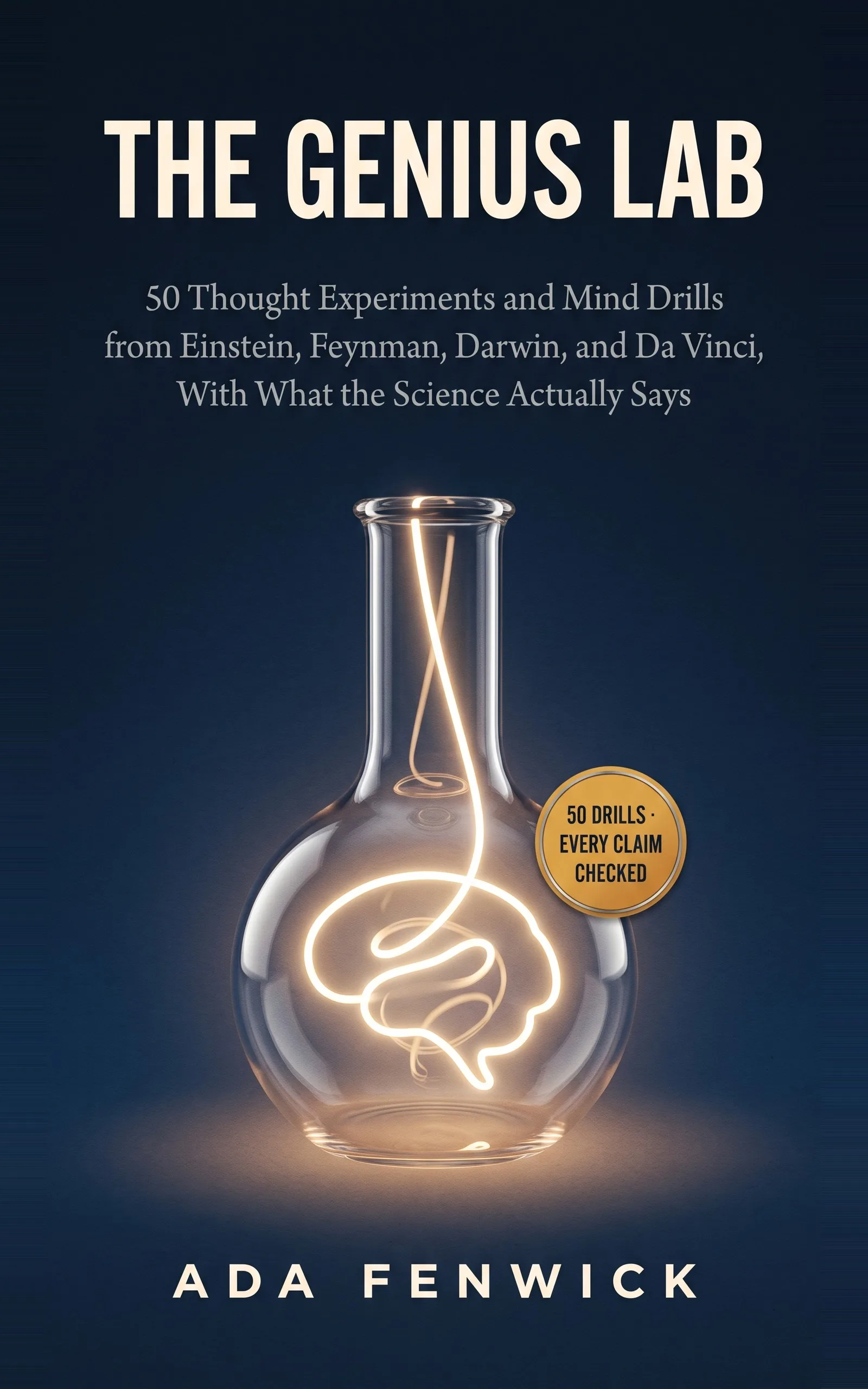
The Genius Lab
50 Thought Experiments and Mind Drills from Einstein, Feynman, Darwin, and Da Vinci, With What the Science Actually Says. By Ada Fenwick, 233 pages.
Where this problem is in the book:
- Einstein: Chasing the Light
- Tesla: The Workshop in Your Head
- Changing Scale
- First Principles: Down to What Is True
Links go to Amazon. ToolGenX publishes this book under a pen name and earns from every sale. Amazon sets the price and handles delivery and returns.

Is The Genius Lab the right book for you?
Yes, if
- You like puzzles but want them to help with your real life
- You want to think more clearly about work or money without a course
- You want to know which thinking exercises have evidence behind them
Skip it if
- You want classic philosophy puzzles to debate, like trolley problems
- You want a promise that mental exercises will raise your IQ
Fair doubts before you buy
Aren't thought experiments just for scientists and philosophers?
They started there, but the move is simple. You picture a situation, change one thing, and follow it carefully. The book uses ordinary problems on purpose, like a commute, a team at work or a family budget, so the drills work on your life instead of on made-up puzzles.
Why would I need a book for this? I can just imagine things.
Imagining is the easy half. The useful half is following the idea with strict logic and writing it down. The book gives each drill numbered steps, a badge for how strong the evidence is, and a one-line log, so after two weeks you can see what changed.
Get The Genius Lab
Fifty short drills taken from what famous thinkers actually did, each labeled by whether it works for ordinary people, with sixty myths corrected.
Links go to Amazon. ToolGenX publishes this book under a pen name and earns from every sale. Amazon sets the price and handles delivery and returns.

Questions people ask about this
- What is a thought experiment?
- It is an experiment you run in your imagination instead of a lab. You set up a situation, push it or change one rule, and follow what must happen next. Einstein did not invent them; Galileo used them, and philosophers did long before him. But Einstein used them so well that his name stuck to the idea.
- What are good thought experiments to try?
- Three easy ones from the book: flip a rule everyone treats as fixed and list five strict consequences; imagine a small person sealed inside your problem and list what they can and cannot detect; and zoom your problem out to a year and in to one sentence to find where the next step shows up.
- Do thought experiments make you smarter?
- Nobody has tested that. The book marks most thought-experiment drills STORY ONLY, which means the source is good but there are no group studies. The closest tested cousin is mental rehearsal, which a 1994 review found improves performance at about two-thirds the strength of real practice.
- How did Einstein use thought experiments?
- He put a person inside the problem and asked what they would see or feel. At 16 he asked what he would see if he chased a beam of light at its own speed. In 1907 he realized a person falling from a roof would not feel their own weight, a step toward general relativity.
- What is the difference between a thought experiment and daydreaming?
- Rules. In a daydream anything can happen next. In a thought experiment every step has to follow from the one before. If things fall up, you must work out how you would keep a cup of coffee, not jump to dragons.
Related problems
- How to think like Einstein: what he really did, and the parts the internet made up
Einstein did not ride a light beam or picture an elevator. Here is the method he described in his own words, and a 15-minute drill to try it.
- Stuck on a problem and your brain has stopped working? Do this in the next hour.
Creative block with a deadline? Work hard for 25 minutes, take a real break with no phone, then check. Here is the order, and the study behind it.
- You read it three times and still can't explain it. The Feynman technique, done properly.
Feel like you understand something until you try to explain it? That gap is normal. Here is the explain-it test, the study behind it, and how to run it.
- Everything inside The Genius Lab
Every chapter, who the book is for, and every problem it helps with.