Last updated
How to think like Einstein: what he really did, and the parts the internet made up

You searched for his method and found a pile of quotes
It's late and you have a problem that will not move. So you type "how to think like Einstein" and hope.
You get forty quotes on nice backgrounds. Half of them have no source. Then a list of seven habits that could belong to anyone.
You close the tab knowing less than before. Worse, you can't tell which parts were true.
That feeling is fair. A lot of what you read about famous thinkers is a real story stretched until it says something the person never did.

Why the quote lists leave you empty
Quotes tell you what to feel. They do not tell you what to do on a Tuesday.
They also drift. Online, Einstein "rode" a beam of light. In his own notes he wrote that he imagined chasing one. Online, he pictured a man in an elevator. His 1907 thought was a person falling off a roof. The closed box came later, in his 1916 book Relativity, where he used a "spacious chest." Other people turned the chest into an elevator.
Small changes, sure. But each one moves you further from the method and closer to a poster.
So here is the deal the book makes. We take the method. We leave the legend.

What Einstein said happened in his head
We have a rare record. In the 1940s the mathematician Jacques Hadamard asked scientists what went on in their minds while they worked. Einstein wrote back, and Hadamard printed the letter in his 1945 book on invention.
Einstein said words did not seem to play any part at first. He worked with images and feelings, some "of visual and some of muscular type." He moved these pieces around and joined them in new ways. Only later, with effort, did he turn the result into words or math.
He called the shuffling "combinatory play." It came in two stages. First loose and wordless. Then strict and written down.
Most of us skip the first stage. We jump straight to the list and the spreadsheet.
His second habit was the thought experiment. That is a test you run only in your head. You take an idea seriously enough to stand inside it, then you push it until something breaks. At 16 he asked what he would see if he chased light at the speed of light. He should see it frozen. Nothing allowed for frozen light. So something was wrong.
The historian John Norton adds a fair warning. Einstein told that story about fifty years later, and memory likes a good story. The method still holds, even if the history is fuzzy.

Try it on your own problem: Chase the Beam
This is Drill 1 in the book. It takes 15 minutes and a notebook.
- Pick one thing in your problem that moves or changes. A price. A customer's mood. A rumor in the office.
- Close your eyes and put yourself right next to it, moving at its speed. Do not watch from above.
- Now push it to the limit. What if the price doubled every day? What if the rumor reached everyone in one second?
- Watch for the moment it stops making sense. That is your frozen light. Write it in one sentence.
- Ask if the picture is wrong or the rules are wrong. Write one line for each.
Many hidden beliefs only show up at the extremes. That is the whole trick.
The book gives this drill a STORY ONLY badge. The source is good, since it is Einstein's own account. But nobody has tested the drill on groups of people. Your notebook is the test.

The other drill: Combinatory Play, step by step
Chase the Beam copies his thought experiments. This one copies the loose, wordless first stage he described to Hadamard. It is Drill 4 in the book and takes about 15 minutes.
- Write your problem at the top of a page in one short line.
- Underneath, draw three or four rough shapes for its parts. A circle for you, a box for your boss, an arrow for the deadline. Do not label them.
- Set a timer for five minutes and move the shapes around in your head. Stack them, shrink one, put one inside another. Einstein said some of his pieces were "muscular," so notice any feeling of pressure or pull too.
- When the timer ends, draw the arrangement that felt most right.
- Only now, write two sentences about what the drawing says about your problem.
If thinking without words feels hard, that is normal. People differ a lot in how much they think in words or pictures. Do not force it. Just notice what happens.
This one also carries a STORY ONLY badge. The source is about as good as historical sources get, his own letter. What nobody has tested is whether a wordless warm-up leads to better ideas than starting with words.

He stayed with one puzzle for years
Search results about Einstein's thinking often skip the boring part. He did not get one flash and move on.
In his "Autobiographical Notes," written when he was 67, Einstein tied his teenage light-beam puzzle to the ten years of thinking that led to special relativity. The 1907 falling-man idea came after he had already spent years on these questions, at a desk job in the patent office in Bern.
So if you want to copy him, copy the patience too. Keep the puzzle in your notebook. Come back to it. And when you hit a hard spot, do what his son said he did: step away into something absorbing, then come back. Our page on being stuck on a problem has the study behind that step.

Four Einstein drills and a myth check
This is the problem The Genius Lab was written for. It sorts what famous thinkers really did from what got added later, then turns the real parts into drills.
Einstein: Chasing the Light has four Einstein drills. Besides Chase the Beam, there is The Person Inside the Box, built on the falling man. There is Flip a Law, where you turn a fixed rule upside down and follow it with strict logic. And there is Combinatory Play, where you move rough shapes in your head before you use words. The chapter ends with a myth check on the light beam, the elevator and the Mozart story.
Thinking Without Words shows that people differ a lot in how much they think in words or pictures. That helps if the wordless stage feels strange to you.
How to Use the Lab explains the four badges, SOLID, PROMISING, STORY ONLY and MYTH, so you know how much weight each drill can hold. If you want the thought experiment habit on its own, our page on thought experiments for adults goes further.
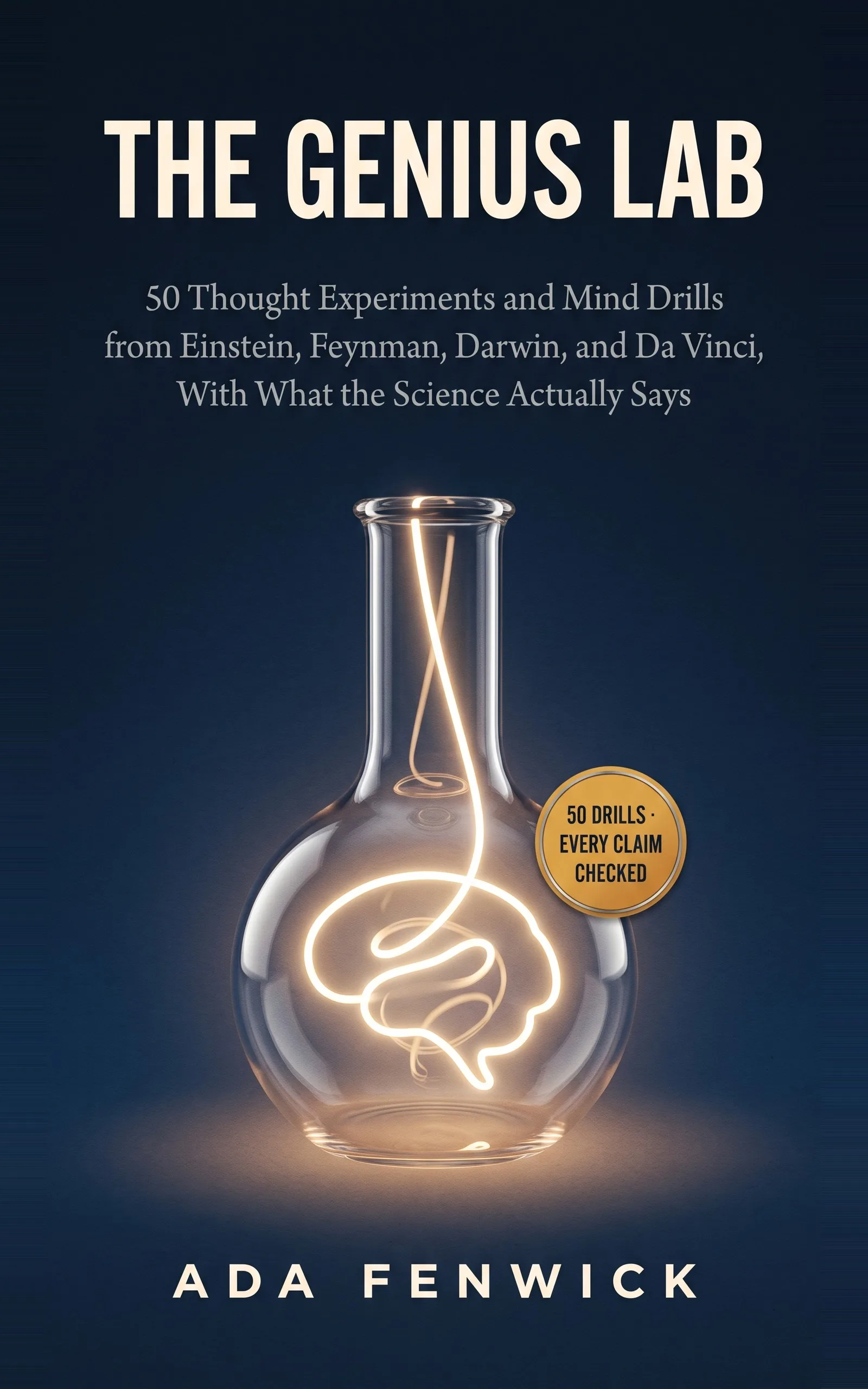
The book for this problem
The Genius Lab
50 Thought Experiments and Mind Drills from Einstein, Feynman, Darwin, and Da Vinci, With What the Science Actually Says. By Ada Fenwick, 233 pages.
Where this problem is in the book:
- Einstein: Chasing the Light
- Thinking Without Words
- How to Use the Lab
Links go to Amazon. ToolGenX publishes this book under a pen name and earns from every sale. Amazon sets the price and handles delivery and returns.

Is The Genius Lab the right book for you?
Yes, if
- You have read ten think-like-Einstein lists and none of them had a source
- You want a method you can try on a real problem tonight
- You like knowing which stories are true before you repeat them
Skip it if
- You want a promise that you will become a genius
- You want a physics lesson on relativity
Fair doubts before you buy
Every think-like-a-genius article says the same things. Why is this different?
Most of those articles never say where the story came from. The book goes back to Einstein's own writing and to careful historians, and it marks every drill with how strong the proof is. The Einstein drills all carry STORY ONLY, which means the source is good but nobody has tested the method on groups of people. The book says that out loud.
Isn't this just daydreaming with extra steps?
The first half is close to daydreaming, and that is on purpose. The second half is not. Einstein followed his loose images with strict logic, one step at a time, and the drills make you do both.
Get The Genius Lab
Fifty short drills taken from what famous thinkers actually did, each labeled by whether it works for ordinary people, with sixty myths corrected.
Links go to Amazon. ToolGenX publishes this book under a pen name and earns from every sale. Amazon sets the price and handles delivery and returns.
Questions people ask about this
- How did Einstein think?
- By his own account, mostly without words. In a letter printed in Jacques Hadamard's 1945 book, he said words did not seem to play any role at first. He worked with images and feelings, some of them muscular, and only later turned the result into words or math.
- What is combinatory play?
- It is the name Einstein gave to moving mental pieces around and joining them in new ways before you put anything into words. He said it seemed to be the essential feature of productive thought. You can copy it by drawing rough shapes for the parts of a problem and moving them in your head for five minutes.
- Did Einstein really imagine riding a beam of light?
- Not riding. He wrote that at 16 he wondered what he would see if he chased a beam of light at its own speed. The word riding came later. The historian John Norton also warns that Einstein told the story about fifty years later, so its role in the physics is not certain.
- What was Einstein's happiest thought?
- In 1907, while working at the patent office in Bern, he realized that a person falling from a roof would not feel their own weight. He later called it the happiest thought of his life. It became a key step toward general relativity.
- Did Einstein play Mozart to solve problems?
- There is no solid source for that version. What we do have is his son's memory that when his father hit a hard spot, he would turn to music, and that would help him through. The specific Mozart story is not backed up.
Related problems
- Thought experiments for adults: how to start using them on real problems
Thought experiments are not just for physicists. Here is what one is, how Einstein ran them, and three you can try on your own work this week.
- Stuck on a problem and your brain has stopped working? Do this in the next hour.
Creative block with a deadline? Work hard for 25 minutes, take a real break with no phone, then check. Here is the order, and the study behind it.
- You read it three times and still can't explain it. The Feynman technique, done properly.
Feel like you understand something until you try to explain it? That gap is normal. Here is the explain-it test, the study behind it, and how to run it.
- Everything inside The Genius Lab
Every chapter, who the book is for, and every problem it helps with.