Last updated
Pressure canner altitude chart: what pressure to use, and when to get your dial gauge tested

| Altitude | Weighted-gauge canner | Dial-gauge canner |
|---|---|---|
| 0 to 1,000 ft | 10 lb | 11 lb |
| 1,001 to 2,000 ft | 15 lb | 11 lb |
| 2,001 to 4,000 ft | 15 lb | 12 lb |
| 4,001 to 6,000 ft | 15 lb | 13 lb |
| 6,001 to 8,000 ft | 15 lb | 14 lb |
| Above 8,000 ft | Tables stop. Call your county Extension office. | Tables stop. Call your county Extension office. |
How to read the altitude chart
Find your elevation in the first column. Then read across to the kind of canner you own. That number is the pressure you hold for the whole processing time.
A weighted gauge has only two settings. It uses 10 pounds up to 1,000 feet and 15 pounds above that. A dial gauge reads any number, so it climbs one pound for each 2,000 feet.
These bands cover most low-acid foods, but not every one. The tested recipe for your food has its own altitude table, and that table always wins. On this page, we give the chart as a quick check, not a replacement.
One rule holds at every height. Never shorten the time or lower the pressure below the table. NCHFP says food may spoil if you "process for fewer minutes than specified." Skipping the altitude change above 1,000 feet can spoil it too.

Why altitude changes the number
As you go up, the air presses down less. So water boils at a lower temperature. The USDA Guide puts it this way: "Lower boiling temperatures are less effective for killing bacteria."
In a pressure canner, the heat comes from trapped steam. NCHFP says that "At sea level, a canner operated at a gauge pressure of 10.5 lbs provides an internal temperature of 240°F." Higher up, you need more pressure to reach the same heat. That is all the chart is doing.
The old rule was simpler and rougher. The 1942 USDA bulletin added 20 percent to water-bath times for each 1,000 feet. Today each tested recipe has its own altitude column, worked out for that food. NCHFP's guide to choosing the right processing time explains how to read them.

The dial gauge nobody has checked since 1990
Picture a canner on a basement shelf. It came from a parent or an estate sale. The dial still moves, the needle still points, and the lid still locks. It looks fine.
But a dial gauge can drift with age, and you can't see it drift. The problem is the one that reads high. You think the canner is at 11 pounds. It is really at 9. The food gets less heat than the recipe planned. NCHFP says: "Gauges that read high cause under-processing and may result in unsafe food."
The fix is cheap and once a year. Before canning season, call your county Cooperative Extension office. Many can test gauges. Bring the lid or gauge the way they ask, and write the result down.
If the gauge is off by 2 pounds or less, ask the tester how to adjust your target pressure. If it is off by more than 2 pounds, replace it. That is the same rule the 1942 bulletin gave. While you are at it, look at the gasket. NCHFP says "Nicked or dried gaskets will allow steam leaks."

A short checklist for canning day
- Look up your elevation in feet, once, and write it down.
- Find the altitude table in your tested recipe.
- Dial gauge? Make sure it was tested this year.
- Vent the canner for a full 10 minutes before you put on the weight or close the petcock.
- Start timing only when the canner reaches the target pressure.
- If the pressure drops below the target, bring it back and start the timing over.
- When time is up, let it cool on its own. The USDA Guide says "Do not force-cool the canner."
The NCHFP page on boiling-water and pressure canners has the full steps.

Where the book covers altitude and gauges
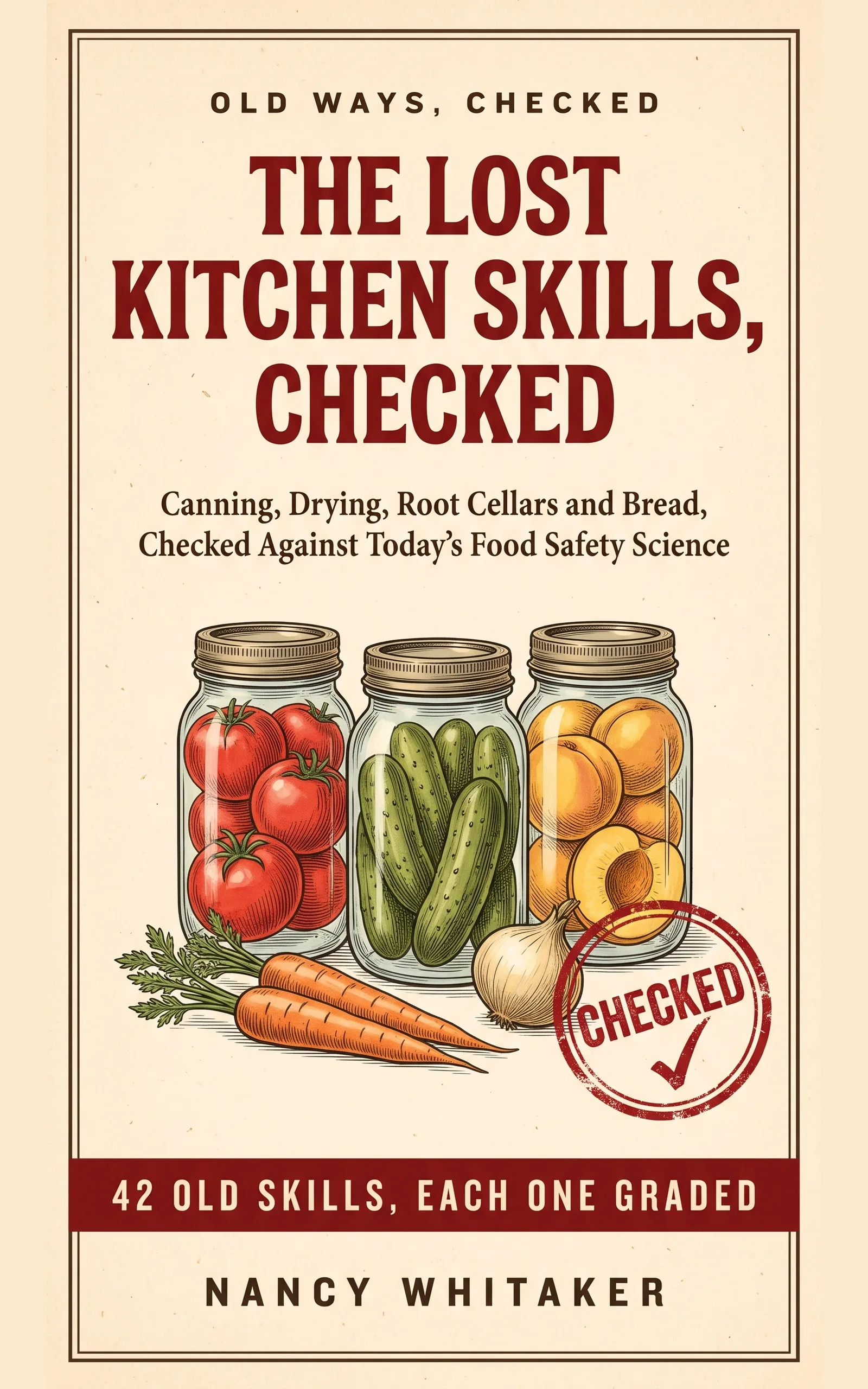
This is the problem The Lost Kitchen Skills, Checked was written for. Nancy Whitaker compares each old kitchen skill with current USDA, NCHFP and extension guidance, then badges it SAFE TODAY, UPDATE IT or RETIRED.
Pressure Canning for Beans, Meat and Soup has two cards for this page. Adjust for Altitude is badged UPDATE IT, since every recipe now has its own table. Get the Dial Gauge Tested is badged SAFE TODAY, because the 1942 rule still stands. A drawing shows the pressure by altitude for both kinds of gauge.
Water-Bath Canning for High-Acid Food shows how altitude changes water-bath times too, with the USDA peach table as an example.
The Pantry Workbook has a canning record with lines for your altitude, your gauge type and the date the dial gauge was last tested.
New to the pressure canner? Our page on why green beans can't go in a water bath explains what the canner is for.
The book for this problem
The Lost Kitchen Skills, Checked
Canning, Drying, Root Cellars, Bread, and Scratch Cooking from Our Grandparents' Kitchens, Checked Against Today's Food Safety Science. By Nancy Whitaker, 214 pages.
Where this problem is in the book:
- Pressure Canning for Beans, Meat and Soup
- Water-Bath Canning for High-Acid Food
- The Pantry Workbook
Links go to Amazon. ToolGenX publishes this book under a pen name and earns from every sale. Amazon sets the price and handles delivery and returns.

Is The Lost Kitchen Skills, Checked the right book for you?
Yes, if
- You live above 1,000 feet and your recipe card never mentions altitude
- You inherited a dial-gauge canner and have no idea if it reads true
- You want one page to check before every canning day
Skip it if
- You want a processing time for a food the tested recipes do not cover
- You live above 8,000 feet (the USDA tables stop there; call Extension)
Fair doubts before you buy
My weighted canner has worked for years. Do I need any of this?
Less of it. NCHFP says weighted gauges "need neither watching during processing nor checking for accuracy." You still need the right weight for your altitude, a clear vent pipe and a gasket in good shape.
Can I trust the gauge on a canner that has sat in a basement for twenty years?
Not without a test. The 1942 USDA bulletin already warned that gauges "may become inaccurate after a period of use." The rule then and now is the same: off by 2 pounds or less, adjust; off by more, replace it.
Get The Lost Kitchen Skills, Checked
Forty-two skills from our grandparents' kitchens, each checked against current USDA, FDA, CDC and extension guidance and badged SAFE TODAY, UPDATE IT or RETIRED, with the safe way to do it now.
Links go to Amazon. ToolGenX publishes this book under a pen name and earns from every sale. Amazon sets the price and handles delivery and returns.
This book explains published US food safety guidance and points to tested recipes. It is not medical advice. Use a tested recipe and current processing times for anything you can.

Questions people ask about this
- What pressure do I use for canning at 5,000 feet?
- For most low-acid foods, use 15 pounds on a weighted-gauge canner, or 13 pounds on a dial-gauge canner. Always check the altitude table in the tested recipe for your food, since that table wins.
- How often should a pressure canner dial gauge be tested?
- Every year before canning season. NCHFP says to "Check dial gauges for accuracy before use each year." Many county Cooperative Extension offices can test them. If yours cannot, contact the canner maker.
- What if my dial gauge is off?
- If it reads off by 2 pounds or less, ask the tester how to adjust your target pressure. If it is off by more than 2 pounds, replace the gauge. A gauge that reads high is the dangerous kind, because the food gets less heat than you think.
- Does altitude matter for water bath canning?
- Yes. Water boils at a lower temperature as you go up. Each tested recipe has its own altitude column. Hot-packed crushed tomato quarts, for example, take 45 minutes at 0 to 1,000 feet and 60 minutes above 6,000.
- How do I find my altitude for canning?
- Look up your elevation in feet. If you are not sure, the USDA Guide says to contact your local county Extension agent. Write the number down once and keep it with your canning records.
- Do I need to vent a pressure canner?
- Yes. NCHFP says all types of pressure canners must be vented for 10 minutes before they are pressurized. The 1942 bulletin used 4 to 7 minutes, so this is one of the steps that changed.
Related problems
- Can you water-bath green beans? Grandma did it for years, so why won't anyone say yes
Green beans are a low-acid food, and NCHFP says there is no safe way to can them in a boiling-water canner. Here is why, and what to use instead.
- Do you need lemon juice to can tomatoes? Yes, in every jar. Here is how much
USDA now says to add acid to every jar of canned tomatoes. See how much lemon juice or citric acid per pint and quart, and why the rule changed.
- Is open-kettle canning safe? How it compares with oven, water-bath and pressure canning
Open-kettle and oven canning are no longer recommended. See how each old method compares with water-bath and pressure canning, and what to use now.
- Everything inside The Lost Kitchen Skills, Checked
Every chapter, who the book is for, and every problem it helps with.