Last updated
Do you need lemon juice to can tomatoes? Yes, in every jar. Here is how much

| Jar size | Bottled lemon juice | Citric acid | Vinegar (5 percent acidity) |
|---|---|---|---|
| Quart | 2 tablespoons | 1/2 teaspoon | 4 tablespoons |
| Pint | 1 tablespoon | 1/4 teaspoon | Check the tested recipe |
| Any jar, pressure canned | Still add the acid | Still add the acid | Still add the acid |
How to use the acid table
Find your jar size and pick one acid. That is all. You do not add lemon juice and citric acid together. You choose one.
The acid goes into the empty jar first, before the tomatoes. That way every jar gets its full share, and you don't forget one halfway through a batch.
The pint row has no vinegar amount because the book gives the vinegar figure only per quart. If you want to use vinegar in pints, take the amount from the tested recipe you are following.
The last row is the one people miss. A pressure canner does not let you skip the acid. NCHFP says its pressure options "were not developed for tomatoes without added acid."
After the acid, you still need the tested time. The book gives one example from NCHFP. Hot-packed crushed tomatoes at 0 to 1,000 feet take 35 minutes for pints and 45 minutes for quarts in a boiling-water canner. Higher up, the time goes up. Other styles of tomatoes have their own times in USDA Guide 3.

Why a tablespoon of lemon juice matters so much
Canning splits food into two groups. Acid foods have a pH of 4.6 or lower, and they can go in a boiling-water canner. Low-acid foods have a pH above 4.6, and they need a pressure canner.
Tomatoes used to sit safely on the acid side. Then the USDA found that some tomatoes "are now known to have pH values slightly above 4.6." Slightly is enough. A jar just over the line is a jar where botulism germs could grow.
The CDC is plain about why that matters: "You cannot see, smell, or taste the toxin that causes botulism." So the fix has to happen before the jar is sealed, not after.
A little lemon juice pulls every jar back to the acid side. It is the cheapest safety step in all of canning.

The tomato card that only says salt
Say you are standing at the counter in August. The kitchen is steamy, the tomatoes are peeled and the jars are hot. Your grandmother's card says one teaspoon of salt per quart. That's it.
You hesitate. She never used lemon juice. Her tomatoes were the best you ever ate.
Both things can be true. Her card matches the 1942 USDA bulletin, which also added salt only. She was following the rules of her time. The rule changed later, when the pH numbers came in.
So you keep her salt, her tomatoes and her method of packing. You add two tablespoons of bottled lemon juice to each quart. If it tastes a little sharp, NCHFP says you may add sugar to balance it.
Before you start, check the tomatoes too. NCHFP says not to can tomatoes from dead or frost-killed vines. Firm, healthy fruit only.

Where the book covers tomatoes
This is the problem The Lost Kitchen Skills, Checked was written for. Nancy Whitaker checks 42 old kitchen skills against current USDA, FDA, CDC and extension guidance and gives each one an honest badge.
Water-Bath Canning for High-Acid Food has the card for acidifying tomatoes. It carries an UPDATE IT badge, because the idea is sound and only the method changed. The card gives the amounts per pint and quart, the vinegar option, the sugar tip and what to watch for in a jar that looks wrong. The same chapter walks through water-bath canning start to finish.
The Pantry Workbook has the Grandma's Recipe Card, Checked worksheet. Its second question asks one thing: does the card add acid? Circle yes, no or not sure, then write down the tested recipe you will use instead.
If you plan to can at a higher elevation, our page on pressure canner altitude and dial gauges explains how times and pressures change as you go up.
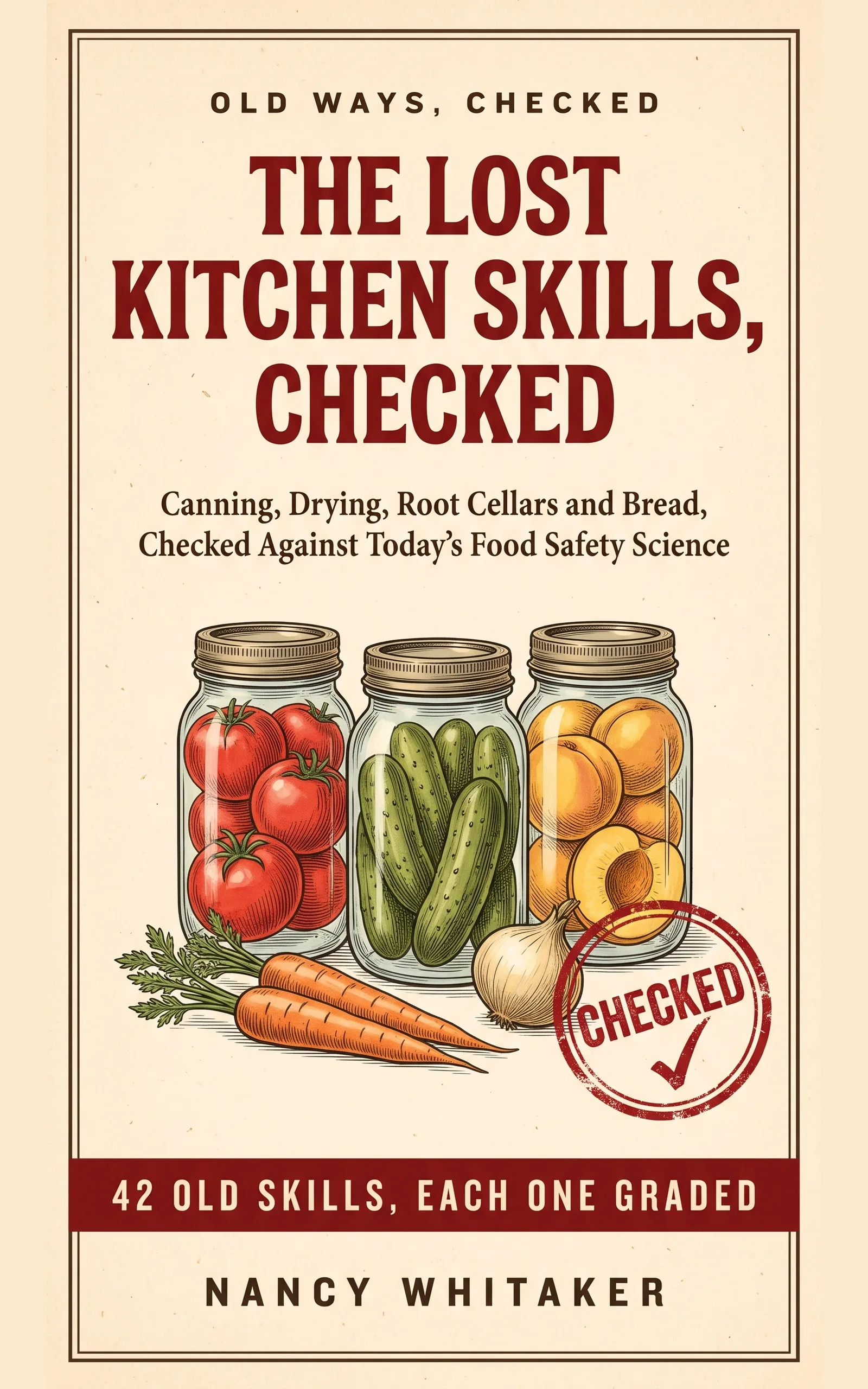
The book for this problem
The Lost Kitchen Skills, Checked
Canning, Drying, Root Cellars, Bread, and Scratch Cooking from Our Grandparents' Kitchens, Checked Against Today's Food Safety Science. By Nancy Whitaker, 214 pages.
Where this problem is in the book:
- Water-Bath Canning for High-Acid Food
- The Pantry Workbook
Links go to Amazon. ToolGenX publishes this book under a pen name and earns from every sale. Amazon sets the price and handles delivery and returns.
Is The Lost Kitchen Skills, Checked the right book for you?
Yes, if
- Your family tomato recipe adds salt and nothing else
- You are canning tomatoes for the first time this summer
- You wonder whether a pressure canner lets you skip the acid
Skip it if
- You want a full list of tomato recipes and times (the book sends you to USDA Guide 3)
- You want to invent your own canned salsa or sauce mix
Fair doubts before you buy
Will lemon juice make my tomatoes taste sour?
It can a little. NCHFP says you may add sugar to offset the acid taste if you like. Vinegar also works as the acid, but NCHFP warns it may change the flavor more than lemon juice does.
Is this just extra caution from the government?
It comes from measured pH. The USDA Guide says some tomatoes "are now known to have pH values slightly above 4.6." Above that line, a boiling-water canner is not enough on its own. A tablespoon or two per jar fixes it.
Get The Lost Kitchen Skills, Checked
Forty-two skills from our grandparents' kitchens, each checked against current USDA, FDA, CDC and extension guidance and badged SAFE TODAY, UPDATE IT or RETIRED, with the safe way to do it now.
Links go to Amazon. ToolGenX publishes this book under a pen name and earns from every sale. Amazon sets the price and handles delivery and returns.
This book explains published US food safety guidance and points to tested recipes. It is not medical advice. Use a tested recipe and current processing times for anything you can.

Questions people ask about this
- How much lemon juice do I put in a quart of tomatoes?
- Two tablespoons of bottled lemon juice per quart, or 1/2 teaspoon of citric acid. For pints, use 1 tablespoon of bottled lemon juice or 1/4 teaspoon of citric acid. Add it to the empty jar before you fill it.
- Can I use fresh lemon juice instead of bottled for canning tomatoes?
- The USDA and NCHFP directions call for bottled lemon juice, and that is what the book lists. Follow the tested recipe as written, including the kind of acid it names.
- Do I need lemon juice if I pressure can tomatoes?
- Yes. NCHFP says the pressure canning options for tomatoes "were not developed for tomatoes without added acid." The acid goes in every jar, whichever canner you use.
- Can I use vinegar instead of lemon juice in canned tomatoes?
- Yes. NCHFP allows 4 tablespoons of 5 percent acidity vinegar per quart. It warns that vinegar may cause undesirable flavor changes, so many cooks stay with lemon juice or citric acid.
- Why did my grandmother not add lemon juice to tomatoes?
- Because the old directions did not call for it. The 1942 USDA bulletin packed tomatoes with salt only. Later measurements found that some tomatoes sit slightly above pH 4.6, so the USDA added the acid step.
- Can I can tomatoes from frost-killed vines?
- No. NCHFP warns: "Do not can tomatoes from dead or frost-killed vines." Use firm, healthy tomatoes.
Related problems
- Is open-kettle canning safe? How it compares with oven, water-bath and pressure canning
Open-kettle and oven canning are no longer recommended. See how each old method compares with water-bath and pressure canning, and what to use now.
- Pressure canner altitude chart: what pressure to use, and when to get your dial gauge tested
What pressure to use at your altitude for weighted and dial gauge canners, and why a dial gauge needs a yearly accuracy test before canning season.
- Can you water-bath green beans? Grandma did it for years, so why won't anyone say yes
Green beans are a low-acid food, and NCHFP says there is no safe way to can them in a boiling-water canner. Here is why, and what to use instead.
- Everything inside The Lost Kitchen Skills, Checked
Every chapter, who the book is for, and every problem it helps with.