Last updated
Is the egg float test accurate? What a floating egg really tells you

A bowl of water and one egg that will not sink
It's Saturday morning. You have eggs from the store and a carton from a neighbor's hens. You can't remember which are which, or how long some have been in the fridge.
So you do what your grandmother did. You fill a bowl with cold water and set the eggs in one by one. Most sink. One stands on end. One floats.
The floater goes toward the trash. Then you stop. Is it really bad? Or did you just throw away a good egg?
And if the sinkers are "good," does that mean they are safe?

Why the float test answers the wrong question
The float test is real. It just measures something other than what most people think.
Every egg has a small air cell inside. As the egg ages, that air cell grows. When the cell is big enough, the egg floats. FSIS explains that an egg floats when "its air cell has enlarged sufficiently to keep it buoyant."
So a floater is old. FSIS goes on: it "is of poor quality, but it may be perfectly safe to use."
The sinkers have the opposite problem. They pass the test, so they feel safe. But age and safety are two separate things. A fresh egg can still carry germs.

The check that actually works
Keep the bowl of water. Use it to sort fresh from old. Then add one step.
Crack each doubtful egg into a small, separate bowl before it goes into anything else. Look at it and smell it. FSIS says to "examine it for an off-odor or unusual appearance before deciding to use or discard it." If it smells bad or looks odd, throw it out. FSIS says a spoiled egg "will have an unpleasant odor when you break open the shell."
That handles spoilage. It does not handle Salmonella, and nothing at home can. FSIS says germs that cause illness "do not generally affect the taste, smell, or appearance of a food."
So the last step is in the pan. The FDA says to "cook eggs until yolks are firm." Cook every egg until the yolk and the white are both firm. The FSIS page on shell eggs has the full storage chart.

Clean, uncracked eggs can still carry germs
This one surprises many people. A perfect-looking egg, clean and whole, can have Salmonella inside.
Our grandparents believed the inside of an egg was sterile. Utah State University Extension describes the old belief: "It was thought that eggs were sterile inside the hen." Research proved otherwise. Salmonella enteritidis "can contaminate eggs as they are formed inside the hen's reproductive organs."
That is also why the old water-glass crock is retired. A coating on the outside can't stop a germ that is already inside. Utah State says plainly: "do not use water glassing for egg storage." Freeze extra eggs instead, mixed with a little salt or sugar.

Keeping store eggs the American way
US store eggs are washed. That is why they belong in the fridge from the store to the pan.
Keep them in their carton on a fridge shelf, not in the door, at 40°F or below. Use raw eggs in the shell within 3 to 5 weeks. Don't wash store eggs at home, and don't leave them out more than 2 hours. FSIS explains that a cold egg left out "can sweat, facilitating the movement of bacteria into the egg."
Backyard eggs from a small flock are a separate question. The book does not cover washing farm-fresh eggs and sends you to your county extension office for those.

Where the book covers eggs
This is the problem The Lost Kitchen Skills, Checked was written for. Nancy Whitaker checks 42 old kitchen skills against current guidance and gives each a badge.
Eggs: Keeping, Testing and Preserving has three cards. Store Eggs the American Way and The Float Test, Checked are both badged UPDATE IT. Freeze Extra Eggs Instead of Water-Glassing is one of the book's four RETIRED skills, with the freezing steps that replace it. A side-by-side table shows Grandma's way and today's way for storing, testing, keeping extras and washing.
The chapter's myth check tests three claims: that the float test shows safety, that clean eggs can't have Salmonella, and that washing store eggs makes them safer.
If you like checking the old habits, our page on cooling a big pot of stock looks at another one, the pot left on the stove overnight.
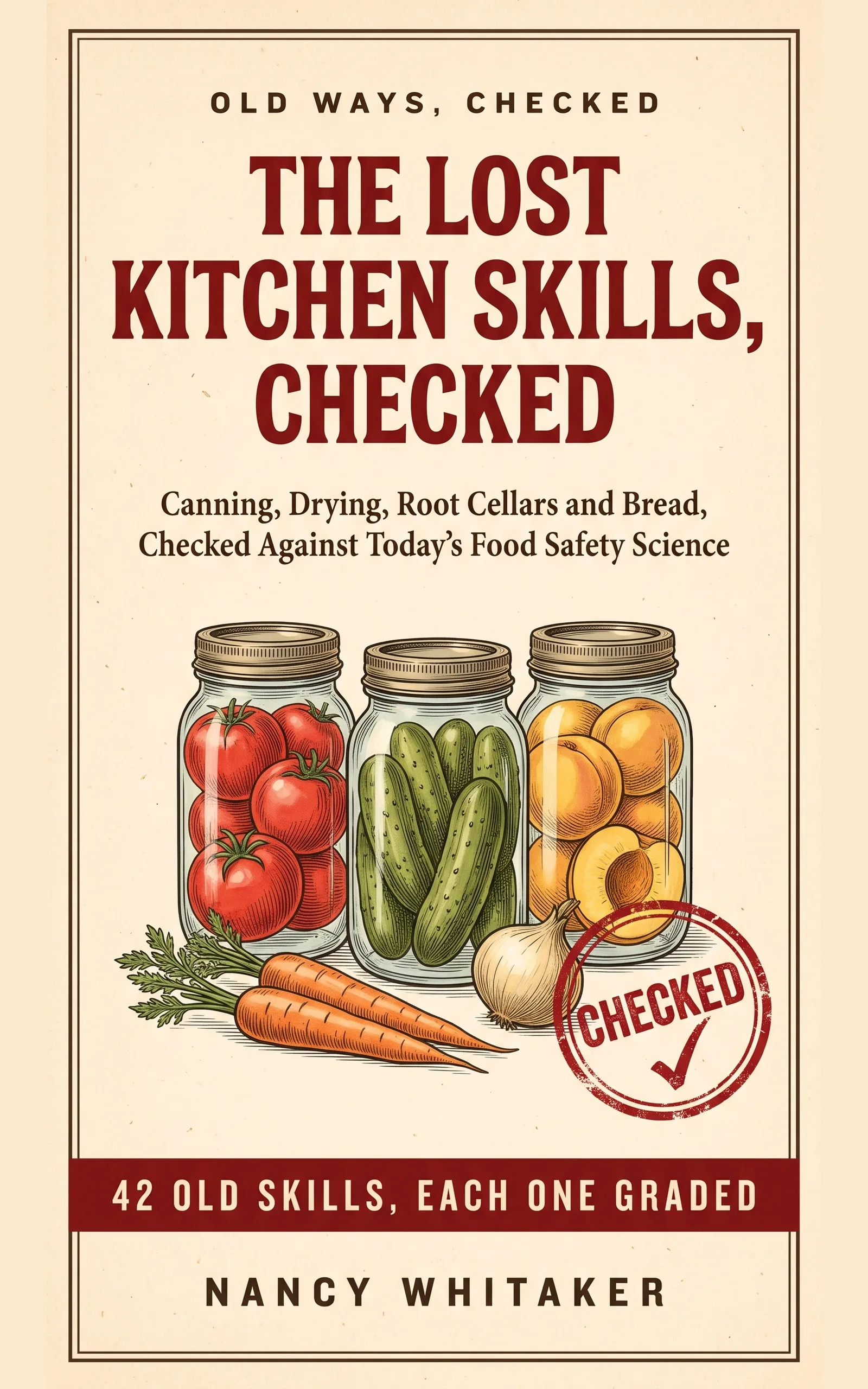
The book for this problem
The Lost Kitchen Skills, Checked
Canning, Drying, Root Cellars, Bread, and Scratch Cooking from Our Grandparents' Kitchens, Checked Against Today's Food Safety Science. By Nancy Whitaker, 214 pages.
Where this problem is in the book:
- Eggs: Keeping, Testing and Preserving
Links go to Amazon. ToolGenX publishes this book under a pen name and earns from every sale. Amazon sets the price and handles delivery and returns.

Is The Lost Kitchen Skills, Checked the right book for you?
Yes, if
- You learned the float test from a grandparent and wonder if it holds up
- You have more eggs than you can use and are not sure which are still good
- You want to know why American eggs must stay in the fridge
Skip it if
- You keep backyard hens and need washing rules for farm eggs (ask your county extension office)
- You want a test that proves an egg is free of germs (none exists at home)
Fair doubts before you buy
My grandmother used the float test all her life. Was it wrong?
Not wrong, just doing a different job. It does show age. The book gives it an UPDATE IT badge: keep the bowl of water, but use it to sort old from fresh, then crack doubtful eggs into a separate bowl.
Why would I need a book for something this simple?
For the float test alone, this page may be enough. The book is for the whole kitchen: 42 old skills, eggs among them, each checked against USDA, FDA, CDC and extension guidance, with what to do instead when the old way no longer holds.
Get The Lost Kitchen Skills, Checked
Forty-two skills from our grandparents' kitchens, each checked against current USDA, FDA, CDC and extension guidance and badged SAFE TODAY, UPDATE IT or RETIRED, with the safe way to do it now.
Links go to Amazon. ToolGenX publishes this book under a pen name and earns from every sale. Amazon sets the price and handles delivery and returns.
This book explains published US food safety guidance and points to tested recipes. It is not medical advice. Use a tested recipe and current processing times for anything you can.

Questions people ask about this
- Does a floating egg mean it is bad?
- Not on its own. FSIS says an egg floats when "its air cell has enlarged sufficiently to keep it buoyant." That means it is older and lower in quality, but it may still be safe. Crack it into a separate bowl and check for an off smell or unusual look.
- How can you tell if an egg has gone bad?
- Crack it open. FSIS says a spoiled egg "will have an unpleasant odor when you break open the shell, either when raw or cooked." Crack each doubtful egg into a small bowl first, so one bad egg does not spoil the rest of a dish.
- How long do eggs last in the fridge?
- FSIS says to use raw eggs in the shell within 3 to 5 weeks. Hard-cooked eggs keep 1 week. Keep them in the carton on a shelf at 40°F or below, not in the door.
- Can a clean, uncracked egg have Salmonella?
- Yes. FSIS says "Unbroken, clean, fresh shell eggs may contain Salmonella Enteritidis." Utah State Extension explains that the germ can get into eggs as they form inside the hen, which is why cooking eggs firm matters.
- Should I wash eggs before storing them?
- Not store-bought eggs. FSIS says "It's not necessary or recommended for consumers to wash eggs." Wash water can be pulled into the egg through the pores in the shell.
- Why do Americans refrigerate eggs when Europeans do not?
- Because of washing. The USDA Agricultural Research Service says US producers began washing and refrigerating eggs in the early 1970s, while in most of the European Union eggs are neither washed nor refrigerated. Washed eggs belong in the cold.
Related problems
- Left a pot of stock out overnight to cool? What to do with it this morning
Stock left on the stove overnight is past the 2-hour rule and should be thrown out. Here is why, and how to cool a big pot fast next time.
- How to make jerky safely at home: the heat step most videos skip
A dehydrator alone may not kill germs in raw meat. Here is the heat step for safe homemade jerky, before or after drying, and what to do with venison.
- A gift for someone who wants to learn canning and the old kitchen skills, the safe way
Shopping for someone who wants to learn canning? A book that checks old kitchen methods against food safety science, plus what to give with it.
- Everything inside The Lost Kitchen Skills, Checked
Every chapter, who the book is for, and every problem it helps with.