Last updated
"I'm only saying this because I care": what that phrase and others like it really mean

Sunday brunch, and a plan you dropped by Tuesday
Four of you at a table by the window. You mention you might train for a half marathon. You downloaded a running app last week.
Your oldest friend laughs and squeezes your arm. She loves you, she says, but she knows you. You quit spin after two classes. Everyone laughs a little, because it's brunch.
Later, in the car, you feel oddly tired. You did quit spin. But you also ran every morning for a year after college, and nobody at that table mentioned it. Including you.
By Tuesday you've deleted the app.
Nothing cruel happened. She might be a good friend in a hundred ways. But you walked in with a plan and walked out with a label.

Why "but they mean well" doesn't settle it
The usual advice is to assume good intent. Most of the time, that's right. The book agrees that every phrase in it can come from a good person on a bad day.
The trouble is what the care does to your answer. If you object to a hard message wrapped in love, you are not objecting to the message anymore. You are objecting to someone who loves you. That feels ungrateful, so you stay quiet. The message gets in with no one checking it.
So the question is not whether they care. They might. The question is what the sentence is carrying.

Strip the wrapper, read the payload
This is the first tool in the book, and the only one you need to start. Iris Athens calls the soft outside of a sentence the wrapper and what it delivers the payload.
Take the sentence the book opens with:
"I'm only saying this because I care, but you're not ready for that job."
Remove the soft words about caring. Read what's left:
"You're not ready for that job."
Now you can decide if that's true. Before, the wrapper made it hard to even look at.
The same move works on the whole family of phrases. For your own good. Just being honest. No offense. A worry said out loud. Each is a wrapper. Here is how a few of them look once you take them apart.
A worry about a trip becomes a flat claim that you shouldn't go. Now you can weigh it. A line about knowing you better than anyone becomes a claim that you aren't who you say you are. You can decline that, mildly:
"Interesting. I don't see it that way."
A friend who is "not upset, just sad for you" gives you disapproval with nothing to hold. The book's reply asks for the missing part:
"Sad about what, exactly? Let's talk about it."
And a joke followed by "but also kind of not" builds two doors. Laugh, and the message landed. Object, and you can't take a joke. Take the frame off:
"Joke aside, do you actually think that?"
Ask it calmly, as a real question. Most people back off. If they don't, you've learned something.

Why kind-sounding lines are so hard to catch
You might wonder how someone who seems to understand you so well could also be steering you. A 2021 study by Nadja Heym and colleagues helps here. Of 991 people, 175 fell into a group the authors called the dark empath: dark traits and real empathy at the same time. In that sample, the group was larger than the classic cold one.
The book's point is simple. Understanding someone and caring about them can come apart. A person can read you with real skill and still point that skill at their own goal. That is why the warmest wrappers are made of accurate insight.
This is not a reason to label anyone. The traits behind this, first described by Paulhus and Williams in 2002, sit on a scale in ordinary people. Everyone has some. The book asks you to notice what a sentence does and how often, not to decide who someone is.

The one rule that keeps you fair
One sentence is data. Three sentences are a pattern.
Your best friend can say you're too sensitive once, regret it, and never say it again. That's being human. What you watch for is repetition with a direction: the same kind of line, from the same person, always leaving you in the same place.
The book gives you an easy way to check. After a talk, notice the aftertaste. Do you feel smaller, in debt, wary of others, or more tied to them? If the same person leaves the same aftertaste ten times in a row, that average says more than any one sentence.

What to say back to the care line itself
Most lists of caring phrases tell you the phrase can be a red flag. Few tell you what to say. The book's answer depends on what is left after you strip the wrapper. There are three common cases.
What is left might be a fair point. Ask a question instead of arguing. The book's toolkit calls this questions instead of statements. A real concern holds up fine when you ask for details. A put-down made up on the spot tends to wobble.
"Can you say more about that?"
What is left is a claim about who you are. You don't have to prove yourself. The book's replies are mild and short:
"Maybe. I'm figuring it out."
What is left is a choice you already made. Thank them for the care and keep the choice, in one short sentence. You don't owe a long reason, because every reason you give is one more thing to argue with.

When the care comes from family
With family, the wrapper often turns into a bill. The book's line for this one is the classic:
"After everything I've done for you."
The past gets added up and handed to you the moment you say no. The book's reply keeps both things true at once:
"I'm grateful for what you've done. And I still can't do this one."
Use and, not but. But sounds like you are taking back the thanks. If this is the line you hear most, our page on guilt-tripping family at the holidays has more of these.

The rest of the phrasebook
This is the problem The Manipulator's Phrasebook was written for. It decodes 116 phrases, each with its payload, an honest version and a calm line to say back.
How to Use This Book gives you the one rule and the wrapper test in a few pages.
The Wrapper and the Payload lays out the seven building blocks, from the empathy wrapper to the two-door delivery, and ends with a private three-column log you can start today.
Who Talks Like This explains the research on dark traits and, just as clearly, why we never ask you to diagnose anyone.
Friends has 18 of these lines from people close to you, where care is the hardest wrapper to see through. If the wrapper shows up with power behind it, our page on whether your boss is manipulating you covers the office version.
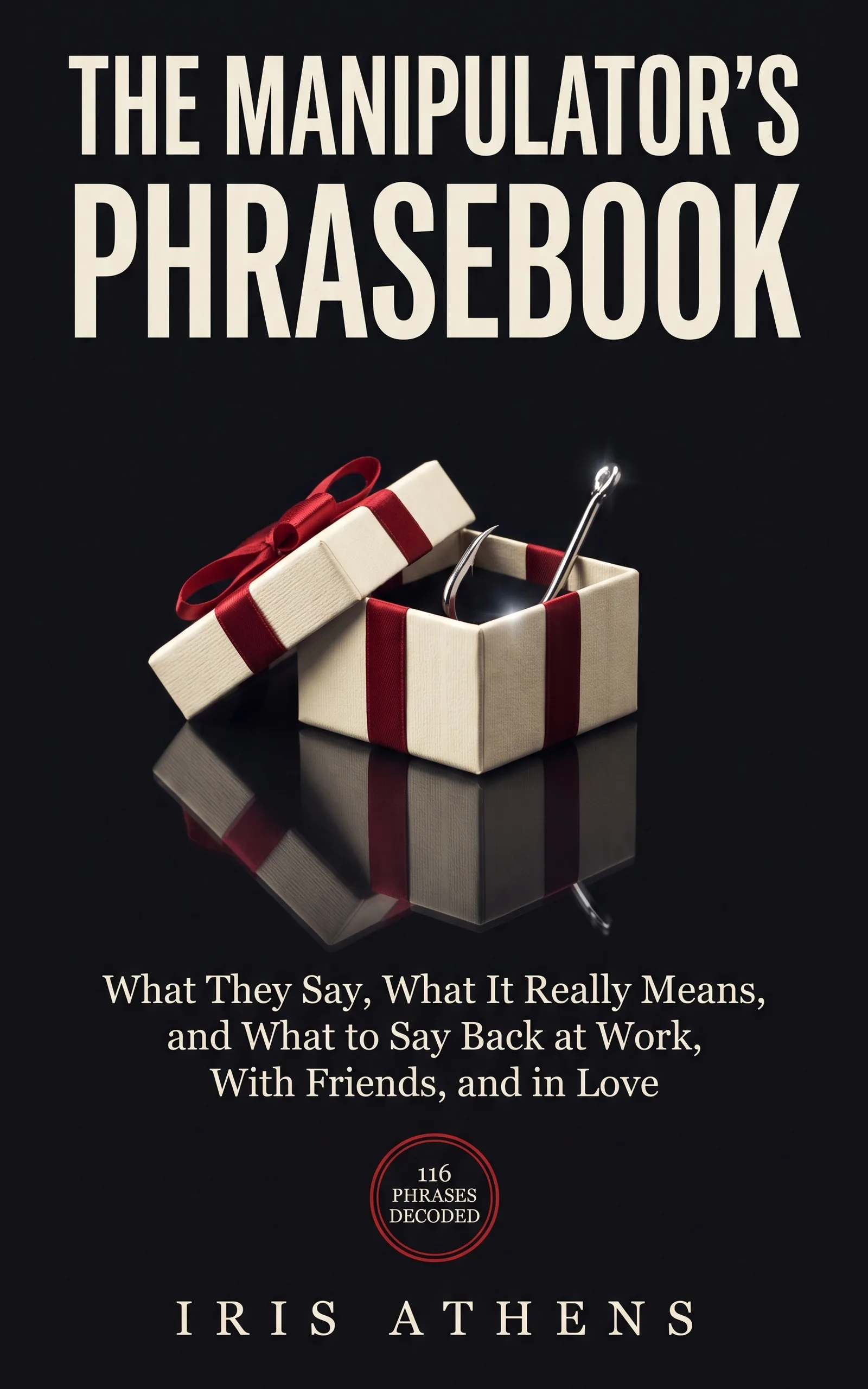
The book for this problem
The Manipulator's Phrasebook
What They Say, What It Really Means, and What to Say Back at Work, With Friends, and in Love. By Iris Athens, 214 pages.
Where this problem is in the book:
- How to Use This Book
- The Wrapper and the Payload
- Who Talks Like This
- Friends
Links go to Amazon. ToolGenX publishes this book under a pen name and earns from every sale. Amazon sets the price and handles delivery and returns.

Is The Manipulator's Phrasebook the right book for you?
Yes, if
- Someone close keeps giving you hard truths wrapped in love
- You feel ungrateful every time you want to push back
- You want a way to read these lines without turning on the person
Skip it if
- You want proof that a specific person is a narcissist
- You want lines to use on others to get your way
Fair doubts before you buy
Isn't it sometimes true that they care?
Yes, and the book says so plainly. Healthy people use warm words all the time. The difference is that their warmth isn't carrying anything heavy. When a friend says they care and then helps you move a couch, the wrapper and the contents match. You are watching for warmth that keeps arriving with a weight inside.
Why read a whole book about phrases?
Because the grammar travels. The book teaches seven building blocks that most of these sentences are made from. Once you know them, you can take apart lines that are not in the book. The 116 decoded phrases are practice, not a list to memorize.
Get The Manipulator's Phrasebook
Manipulation hides in kind-sounding sentences; 116 of them are decoded with a calm reply for each, so you can answer or walk away with a clear head.
Links go to Amazon. ToolGenX publishes this book under a pen name and earns from every sale. Amazon sets the price and handles delivery and returns.
If you are afraid of someone, call the National Domestic Violence Hotline at 800-799-7233 or text START to 88788.

Questions people ask about this
- What does it mean when someone says they are only saying this because they care?
- Often it means a hard message is coming and the speaker wants it to land without pushback. It may be honest care. To check, remove the warm words and read what is left. If what is left is a fair point, take it. If it is a claim about who you are, you can decline it.
- Is saying just being honest a form of manipulation?
- It can be, when it is used to deliver a put-down that you are not allowed to object to. If you push back, you are suddenly against honesty. The book calls this a wrapper. Honest feedback usually asks first and gives you something specific you can act on.
- How do I respond to someone who says it is for my own good?
- Strip it first in your head. A worry about a trip becomes a plain claim that you should not go on that trip. Then answer the claim, not the care. A calm reply is to thank them and say you have thought about it and are going anyway. You don't owe a long reason.
- What is an empathy wrapper?
- It is the book's name for warm words that carry control, like for your own good, worried about you, or only want what's best. It is the most common building block in manipulative sentences, because it turns control into care. The answer is to read what the sentence says once the warm words are gone.
- How can I tell concern from control?
- Watch how you feel after, over many talks. Control tends to leave you smaller, in debt, wary of other people, or more tied to the speaker. Real care leaves you steadier. One talk can go wrong for any reason. Ten in a row that feel the same are a pattern.
- What do you say back to someone who says they are only saying it because they care?
- Strip the care line first, then answer what is left. If it might be a fair point, ask a question, such as asking them to say more. Real concerns hold up when you ask for details. If it is a claim about who you are, a mild reply works, like saying maybe, you are still figuring it out. You can thank them for caring and still disagree.
Related problems
- Is my boss manipulating me, or am I reading too much into it?
Warm words, no raise, a heavier load. Learn the boss phrases that keep you waiting, a calm reply for each, and the one habit that protects you.
- Guilt-tripping family at the holidays: what they say, what it does, and what to say back
Last Thanksgiving, all or nothing, everyone else made it. Six holiday guilt lines decoded, a calm reply for each, and rules to set before you arrive.
- What to say when someone gaslights you, right now, in the middle of it
They say it never happened and you start to doubt yourself. Short lines to say back, what to do tonight, and when to call for help instead.
- Everything inside The Manipulator's Phrasebook
Every chapter, who the book is for, and every problem it helps with.