Last updated
What to say when someone gaslights you, right now, in the middle of it

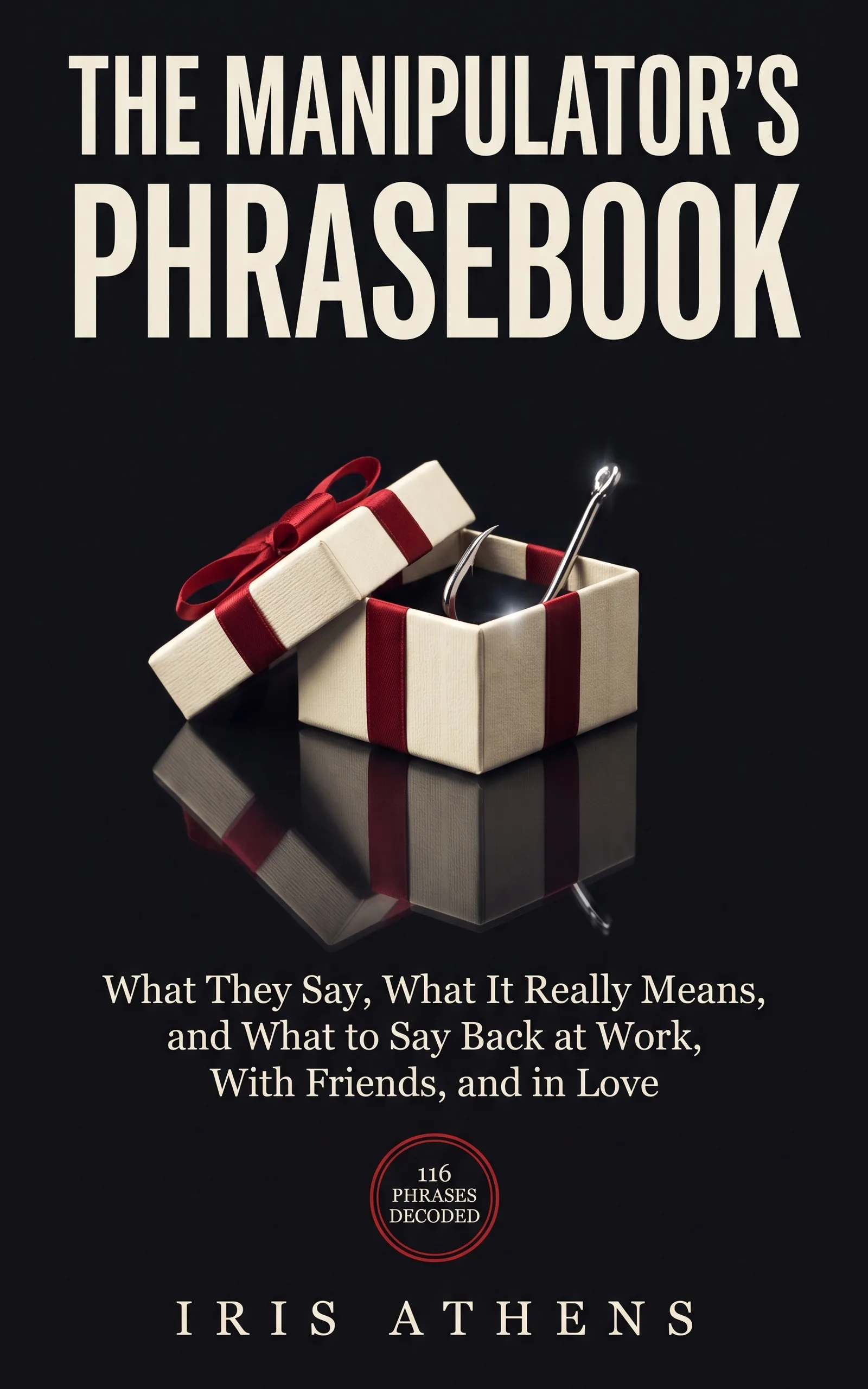
The book for this problem
The Manipulator's Phrasebook
What They Say, What It Really Means, and What to Say Back at Work, With Friends, and in Love. By Iris Athens, 214 pages.
Where this problem is in the book:
- Twelve Moves With Names
- Dating and Love
- The Calm Toolkit
- When It's More Than Words
Links go to Amazon. ToolGenX publishes this book under a pen name and earns from every sale. Amazon sets the price and handles delivery and returns.
Say this, then stop
You don't need a speech. You need one line you can say in a steady voice. Pick the one that fits. These come straight from the book.
When they say it never happened:
"I remember it clearly. We can see it differently. I'm going with my memory."
When they say you're remembering it wrong, and you always do:
"Maybe on some things. Not on this one."
When they call you crazy:
"I'm not crazy. I'm upset. I'll talk when we can both be calm."
Then leave the room. That last part matters.
Now the steps, in order:
- Say one line. Not three. Every extra reason you give is new material to argue with.
- Don't bring proof. Not tonight. Proof turns it into a trial, and you will be the one on the stand.
- Write it down later, alone. Date, exact words, what happened. Keep it somewhere the other person can't open, like a notes app with its own lock or an account only you use.
- Don't mention the note. It is for you. When you hear that never happened next week, you can check it in private and know.
That is the whole fix for tonight. It is small on purpose.

The kitchen, after it happened again
You bring up something they said last Saturday. You were there. You heard it.
They laugh, a little kindly. "That never happened." Then, "You always do this."
And the strange part is that a small voice in you starts to agree. Maybe you did mix it up. You have been tired. You start your next sentence with a small apology for your own memory, and you notice that you do that a lot now.
That is what gaslighting is for. Nobody records their life. When someone contradicts your memory with full confidence, again and again, doubt creeps in. Over time you stop trusting your own read and start relying on theirs. That reliance is the goal.

Why one calm sentence beats a good argument
It feels like the right answer is to win. Show the text. Quote the exact words.
The book's view is that you can't win this one by debate, because the other person isn't playing for this argument. They are playing for the next ten. If their version becomes the one you check first, every later argument is already decided.
So you take the fight off the table. One short line keeps your memory yours. Your private note keeps it steady. Research on self-talk by Ethan Kross and colleagues in 2014 found that talking to yourself by name, or as "you," gave people more distance in stressful moments. The book uses that in a small way: in the moment, ask silently what you need to do right now, as if a calm friend were asking.

Two more lines you will hear, and what to say
The book's Rewriting reality section has a fourth line that often comes right after the first three. It sounds like this:
"You're overreacting. This is why I can't tell you anything."
First your feelings get called too much. Then that label is used as a reason to keep things from you. The book's reply puts it back where it belongs:
"I'll handle my reaction. I just need you to tell me things."
The second line is the one many people fear most. You say it calmly, and they say you are the one gaslighting them. Don't take the bait and argue over the word. That flip has its own name, DARVO, and our page on DARVO explained simply walks through it. Your short line still stands.

When they keep pushing, say the same thing again
Pressure often comes in waves. Each wave tries a new angle: guilt, then a joke about your memory, then disappointment. If you answer each new angle, you are in a debate again.
The book's tool for this is the broken record. Pick one short sentence and repeat it in the same calm tone every time the pressure comes back. No new reasons. No raised voice.
"I remember it differently."
Then again, if you need to. Same words. When there is nothing new to push against, the talk tends to run out of steam. If it doesn't, you can still leave the room.

If it happens at work
Gaslighting at work often sounds like a boss who says that is not what was asked for, and that the instruction was very clear. A spoken instruction can't be proven either way, and over time you start to doubt yourself. The book's reply resets instead of fighting:
"I may have misunderstood. Let's get it straight so it doesn't happen again. What do you need?"
Then send a two-line email the same day: what they want, and by when. Keep those emails. The book says to watch for instructions that keep changing after the fact, always in a way that makes you wrong. Our page on whether your boss is manipulating you covers the other office lines.

When it is more than words
Here is where we stop giving scripts. If you check their mood before you speak, if they read your phone or track where you go, if they control the money, or if they have hurt you even once, this is no longer a communication problem.
With someone you are afraid of, do not name the move to their face. Do not hold a big confrontation. Talk to an advocate first. The National Domestic Violence Hotline is free and confidential: call 1-800-799-7233 or text START to 88788. If you are in danger right now, call 911.

The book that gives you the rest of the lines
This is the problem The Manipulator's Phrasebook was written for. Gaslighting is one of the moves Iris Athens names and takes apart.
Twelve Moves With Names explains gaslighting, why it works and its antidote, which the book calls paper memory.
Dating and Love has a full section called Rewriting reality, with four of the most common lines and a calm reply for each.
The Calm Toolkit gives you the broken record, the habit of repeating one sentence in the same tone, plus a pocket card of twelve lines to learn this week.
When It's More Than Words is short on purpose. It lists the signs that you need real help, how to keep notes safely, and who to call.
If the talk keeps flipping so that you end up apologizing, read our page on DARVO explained simply. It often travels with gaslighting.

Is The Manipulator's Phrasebook the right book for you?
Yes, if
- You hear that never happened so often you now doubt yourself first
- You start sentences with a little apology before you even say what you saw
- You want a few words ready for the next time
Skip it if
- You want help proving to them that they are lying
- You are afraid of this person, in which case call the hotline before using any script
Fair doubts before you buy
Shouldn't I just show them the texts and prove it?
The book says no. The record is for you, not for them. Proof turns the talk into a trial, and people who rewrite events are often better at trials than you are. You check your notes later, in private, and you know. Out loud, one calm sentence is enough.
What if I really am the one who remembers wrong?
That can happen. Memory is shaky for everyone. The book says to watch the direction. If the mix-ups always land in their favor and you are always the one who got it wrong, that is a pattern. A dated note made the same day settles it, at least for you.
Get The Manipulator's Phrasebook
Manipulation hides in kind-sounding sentences; 116 of them are decoded with a calm reply for each, so you can answer or walk away with a clear head.
Links go to Amazon. ToolGenX publishes this book under a pen name and earns from every sale. Amazon sets the price and handles delivery and returns.
If you are afraid of someone, call the National Domestic Violence Hotline at 800-799-7233 or text START to 88788.

Questions people ask about this
- What do you say to someone who is gaslighting you?
- Keep it short and calm. Tell them you remember it differently and that you are going with your memory. You don't need to prove it or argue the details. Then change the topic or end the talk. Arguing gives them more to twist.
- Should you tell a gaslighter you know what they are doing?
- Usually not as an accusation. The book suggests naming a move as an observation, never as a label for the person. With someone you are afraid of, do not name it to their face at all. That can raise the risk. Talk to an advocate first.
- How do I stop doubting myself after being gaslit?
- Write things down the same day: the date, the exact words and what happened. Keep it where the other person can't reach. Also talk to someone who knew you before this relationship and ask them plainly if you seem different. They can answer that better than the person rewriting events.
- Is gaslighting a form of abuse?
- It can be part of abuse. If you are afraid of the person, if they check your phone, control the money, cut you off from people or hurt you even once, it has moved past words. Call the National Domestic Violence Hotline at 1-800-799-7233 or text START to 88788.
- What does gaslighting sound like?
- Common lines are that never happened, you're remembering it wrong and you always do, you're crazy, and you're overreacting. Often other people get pulled in too, as in everyone thinks you've been off lately. The goal is for you to check their version of events before your own.
- What do you say when a boss or coworker gaslights you at work?
- Stay calm and reset, rather than argue about who said what. The book's line for a boss who says that is not what was asked for is to say you may have misunderstood and ask what they need. Then send a two-line email the same day confirming the task and the deadline. Keep those emails. If it gets serious, those records matter.
Related problems
- DARVO explained simply: why you raise a problem and end up apologizing
You bring up one thing and leave saying sorry. What DARVO means in plain words, how to spot it, and the one calm sentence that keeps you on topic.
- Love bombing or real interest? How to tell the difference in the first few weeks
Fast, intense attention can be a great start or a pattern. A side-by-side table, one simple test to run, and what the reaction to it tells you.
- "I'm only saying this because I care": what that phrase and others like it really mean
Some kind words carry a heavy message. Learn to strip the wrapper, read what is left, and answer phrases like just being honest without a fight.
- Everything inside The Manipulator's Phrasebook
Every chapter, who the book is for, and every problem it helps with.